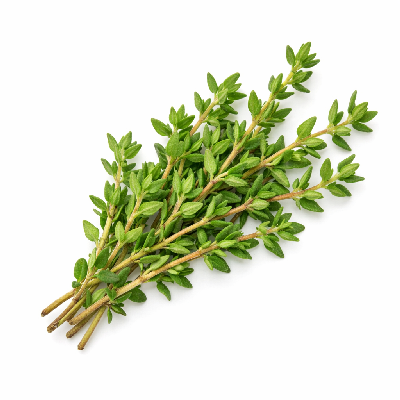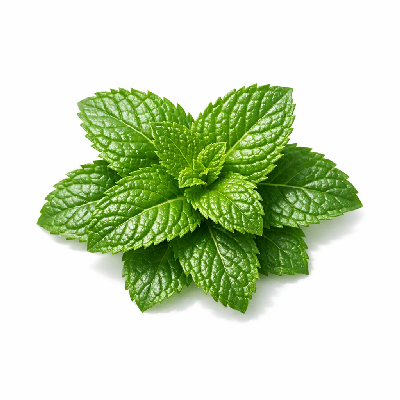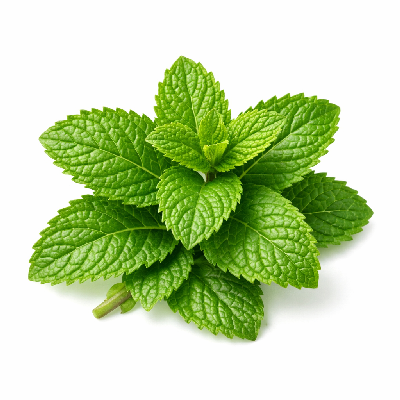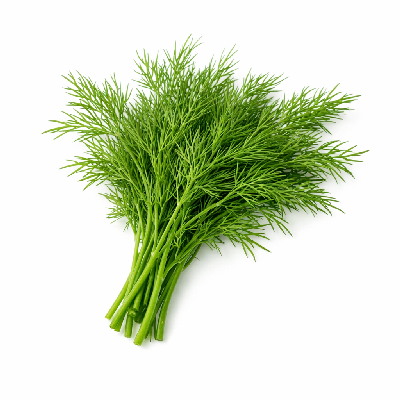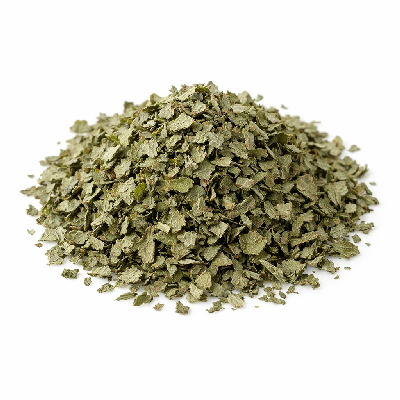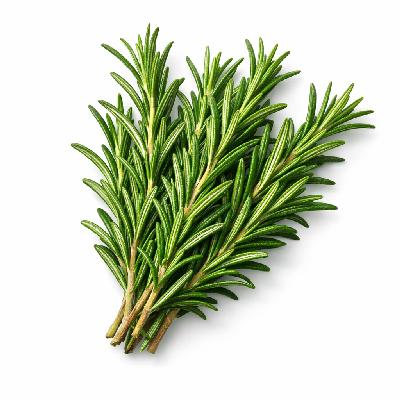
Fresh Raw Rosemary
Source of Calories
Nutrition Facts
| Nutrient | Amount | % Daily Value |
|---|---|---|
| Total Carbohydrates | 0.35 g | 0% |
| Net Carbohydrates | 0.11 g | 0% |
| Sugars | No data | - |
| Added Sugars | 0 g | 0% |
| Dietary Fiber | 0.24 g | 1% |
| Protein | 0.06 g | 0% |
| Total Fat | 0.1 g | 0% |
| Saturated Fat | 0.05 g | 0% |
| Monounsaturated Fat | 0.02 g | - |
| Polyunsaturated Fat | 0.02 g | - |
| Trans Fat | 0 g | 0% |
| Cholesterol | 0 mg | 0% |
| Vitamins | ||
| Vitamin A | 14.91 mcg | 2% |
| Vitamin C | 0.37 mg | 0% |
| Vitamin D | 0 mcg | 0% |
| Minerals | ||
| Sodium | 0.44 mg | 0% |
| Potassium | 11.36 mg | 0% |
| Calcium | 5.39 mg | 0% |
| Magnesium | 1.55 mg | 0% |
| Iron | 0.11 mg | 1% |
| Zinc | 0.02 mg | 0% |
% DV refers to how much a single serving of an individually packaged food or supplement contributes nutritionally to your daily diet, based on a 2,000-calorie-a-day diet. Generally, having 5% DV or less of a nutrient per serving is considered low, and 20% DV or more of a nutrient per serving is considered high.
Fat Composition
The suggested total fat consumption should be limited to 30% of total energy intake or less. The type of fat consumed should primarily be unsaturated fatty acids, with no more than 10% of total energy intake coming from saturated fatty acids (about 200 calories on a 2000-calorie diet) and no more than 1% of total energy intake coming from trans-fatty acids.
Vitamin Coverage
Vitamin A
2%
Vitamin C
0.4%
Vitamin D
0%
Vitamin E
-
Vitamin K
-
Vitamin B1
0.1%
Vitamin B2
0.2%
Vitamin B3
0.1%
Vitamin B5
0.3%
Vitamin B6
0.3%
Vitamin B7
-
Vitamin B9
0.5%
Vitamin B12
0%
There are 13 essential vitamins required for the body to work properly, which are categorised into two categories: fat-soluble and water-soluble vitamins. Vitamins have a Recommended Dietary Allowance (RDA), provided by the Dietary Reference Intakes (DRIs), which vary by age and sex. The %DV indicates how much one serving contributes to the average recommended daily intake.
Mineral Coverage
Calcium
0.4%
Iron
0.6%
Magnesium
0.4%
Phosphorus
0.1%
Potassium
0.2%
Sodium
0%
Zinc
0.1%
Copper
0.6%
Manganese
0.7%
Selenium
-
Minerals are micronutrients, of which 13 of them are essential to the human body. The Recommended Dietary Allowance includes Calcium (1,300 mg/d), Phosphorus (1,250 mg/d), Potassium (4,700 mg/d), Sodium (2,300 mg/d), Chloride (1,500 mg/d), Magnesium (420 mg/d), Iron (18 mg/d), Zinc (11 mg/d), Copper (0.9 mg/d), Selenium (55 mcg/d), Molybdenum (45 mcg/d), Manganese (2.3 mg/d) and Iodine (150 mcg/d).
Protein Quality
Leucine
0.1%
Isoleucine
0.2%
Valine
0.2%
Lysine
0.1%
Tryptophan
0.2%
Threonine
0.2%
Phenylalanine
0.2%
Methionine
0.1%
Histidine
0.1%
Guidelines recommend a serving of protein with each meal and 1.2-1.6 g of protein per kg of body weight per day.
The data provided by eato.health is for informational purposes only and should not be considered medical advice. Please consult your physician before beginning any diet or nutrition plan.
About
How Long to Burn Off 2 Calories?
*Based on this person: 25-year-old female, 5'7", 144 lbs

Swimming
< 1 min

Jogging
< 1 min

Cycling
< 1 min

Walking
< 1 min
The data provided by eato.health is for informational purposes only and should not be considered medical advice. Please consult your physician before beginning any diet or nutrition plan.
📚 Health Research & Evidence About This Food
Rosemary demonstrates significant antioxidant and anti-inflammatory properties, with in vitro and in vivo studies showing its compounds can neutralize free radicals and reduce inflammation. Research also suggests rosemary may support cognitive function, improving memory and concentration, according to Medical News Today. Furthermore, evidence indicates potential anti-proliferative effects relevant to cancer chemoprevention and benefits for metabolic parameters like weight, cholesterol, and glycaemia.
1. Rosemary: Health Benefits, Precautions, and Drug Interactions
Source: Medical News Today, 2017
Summary: Rosemary, a fragrant evergreen herb, offers a range of potential health benefits including antioxidant and anti-inflammatory effects, mood and memory enhancement, neurological protection, skin health improvements, and pain relief, while also containing essential nutrients like iron, calcium, and vitamin B6.
2. Rosemary Health Benefits, Nutrients per Serving, Preparation Information, and More
Source: WebMD
Summary: Rosemary, a popular Mediterranean herb, is recognized for its health benefits including potentially reduced cancer risk, immune system support, stress reduction, and improved memory and concentration, attributed to compounds like carnosic acid and rosmarinic acid, and is also rich in manganese and various phytochemicals.
Read More: https://www.webmd.com/diet/health-benefits-rosemary
3. Evaluation of in Vitro Anti-Inflammatory Effects of Crude Ginger and Rosemary Extracts Obtained Through Supercritical Co2 Extraction on Macrophage and Tumor Cell Line: The Influence of Vehicle Type.
Source: PubMed
Summary: Rosemary extracts, alongside ginger, exhibit in vitro anti-inflammatory effects on macrophage and tumor cell lines, attributed to their polyphenolic compounds, as evaluated through supercritical CO2 extraction.
Read More: https://pubmed.ncbi.nlm.nih.gov/26511466/
4. Anti-Proliferative and Antioxidant Properties of Rosemary Rosmarinus Officinalis.
Source: PubMed
Summary: Rosemary constituents demonstrate anti-proliferative and antioxidant properties, exhibiting various pharmacological activities for cancer chemoprevention and therapy in both in vitro and in vivo models.
Read More: https://pubmed.ncbi.nlm.nih.gov/17487414/
5. Carnosic Acid-Rich Rosemary (Rosmarinus Officinalis L.) Leaf Extract Limits Weight Gain and Improves Cholesterol Levels and Glycaemia in Mice on a High-Fat Diet.
Source: PubMed
Summary: Rosemary leaf extract, rich in carnosic acid, effectively limits weight gain and improves cholesterol levels and glycaemia in mice fed a high-fat diet, indicating its potential for preventing metabolic disorders through antioxidant, anti-inflammatory, and anti-hyperglycaemic actions.
Read More: https://pubmed.ncbi.nlm.nih.gov/21676274/
6. Rosmarinus Officinalis L. Hexane Extract: Phytochemical Analysis, Nanoencapsulation, and in Silico, in Vitro, and in Vivo Anti-Photoaging Potential Evaluation
Source: Nature, 2022
Summary: Rosemary hexane extract demonstrates significant anti-photoaging potential through its photoprotective, antioxidant, anti-inflammatory, and anti-wrinkling properties, as evidenced by comprehensive phytochemical analysis, in vitro assays, in silico molecular modeling, and in vivo evaluation in a UVB-irradiated rat model, supporting its use in cosmeceuticals.
Read More: https://www.nature.com/articles/s41598-022-16592-7