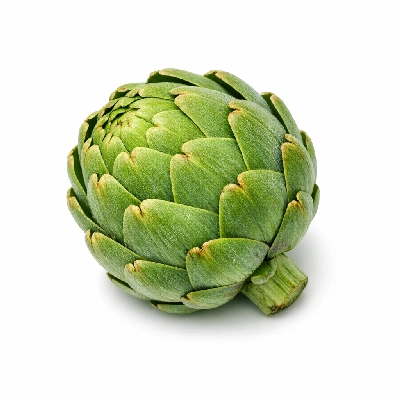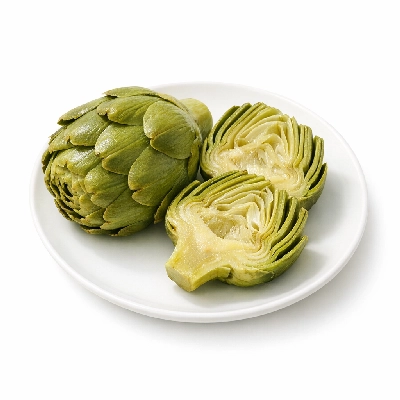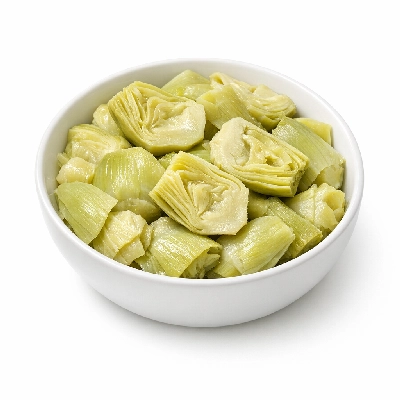
Boiled Artichokes without Salt
Source of Calories
Nutrition Facts
| Nutrient | Amount | % Daily Value |
|---|---|---|
| Total Carbohydrates | 14.34 g | 5% |
| Net Carbohydrates | 7.5 g | 3% |
| Sugars | 1.19 g | 3% |
| Added Sugars | 0 g | 0% |
| Dietary Fiber | 6.84 g | 24% |
| Protein | 3.47 g | 7% |
| Total Fat | 0.41 g | 1% |
| Saturated Fat | 0.09 g | 0% |
| Monounsaturated Fat | 0.01 g | - |
| Polyunsaturated Fat | 0.17 g | - |
| Trans Fat | 0 g | 0% |
| Cholesterol | 0 mg | 0% |
| Vitamins | ||
| Vitamin A | 0.8 mcg | 0% |
| Vitamin C | 8.88 mg | 10% |
| Vitamin D | 0 mcg | 0% |
| Minerals | ||
| Sodium | 72 mg | 3% |
| Potassium | 343.2 mg | 7% |
| Calcium | 25.2 mg | 2% |
| Magnesium | 50.4 mg | 12% |
| Iron | 0.73 mg | 4% |
| Zinc | 0.48 mg | 4% |
% DV refers to how much a single serving of an individually packaged food or supplement contributes nutritionally to your daily diet, based on a 2,000-calorie-a-day diet. Generally, having 5% DV or less of a nutrient per serving is considered low, and 20% DV or more of a nutrient per serving is considered high.
Fat Composition
The suggested total fat consumption should be limited to 30% of total energy intake or less. The type of fat consumed should primarily be unsaturated fatty acids, with no more than 10% of total energy intake coming from saturated fatty acids (about 200 calories on a 2000-calorie diet) and no more than 1% of total energy intake coming from trans-fatty acids.
Vitamin Coverage
Vitamin A
0.1%
Vitamin C
10%
Vitamin D
0%
Vitamin E
2%
Vitamin K
15%
Vitamin B1
5%
Vitamin B2
8%
Vitamin B3
8%
Vitamin B5
6%
Vitamin B6
6%
Vitamin B7
-
Vitamin B9
27%
Vitamin B12
0%
There are 13 essential vitamins required for the body to work properly, which are categorised into two categories: fat-soluble and water-soluble vitamins. Vitamins have a Recommended Dietary Allowance (RDA), provided by the Dietary Reference Intakes (DRIs), which vary by age and sex. The %DV indicates how much one serving contributes to the average recommended daily intake.
Mineral Coverage
Calcium
2%
Iron
4%
Magnesium
12%
Phosphorus
7%
Potassium
7%
Sodium
3%
Zinc
4%
Copper
17%
Manganese
12%
Selenium
0.4%
Minerals are micronutrients, of which 13 of them are essential to the human body. The Recommended Dietary Allowance includes Calcium (1,300 mg/d), Phosphorus (1,250 mg/d), Potassium (4,700 mg/d), Sodium (2,300 mg/d), Chloride (1,500 mg/d), Magnesium (420 mg/d), Iron (18 mg/d), Zinc (11 mg/d), Copper (0.9 mg/d), Selenium (55 mcg/d), Molybdenum (45 mcg/d), Manganese (2.3 mg/d) and Iodine (150 mcg/d).
The data provided by eato.health is for informational purposes only and should not be considered medical advice. Please consult your physician before beginning any diet or nutrition plan.
About
How Long to Burn Off 64 Calories?
*Based on this person: 25-year-old female, 5'7", 144 lbs

Swimming
10 min

Jogging
9 min

Cycling
9 min

Walking
15 min
The data provided by eato.health is for informational purposes only and should not be considered medical advice. Please consult your physician before beginning any diet or nutrition plan.
📚 Health Research & Evidence About This Food
Boiled artichokes are a nutrient-dense and low-sodium food, rich in dietary fiber and antioxidant compounds that observational evidence suggests may support digestive health and liver function. The fiber acts as a prebiotic, fostering a healthy gut microbiome and potentially aiding digestive issues, while clinical research, according to PubMed, has investigated artichoke leaf extract for non-alcoholic fatty liver disease.
1. Artichokes: Health Benefits, Nutrients, Preparation, and More
Source: WebMD
Summary: Artichokes are recognized as a superfood due to their high antioxidant levels, offering potential benefits for blood pressure control, cholesterol reduction, and liver health, while also being a nutrient-dense, low-calorie food.
Read More: https://www.webmd.com/diet/health-benefits-artichokes
2. Top 8 Health Benefits of Artichokes and Artichoke Extract
Source: Healthline, 2019
Summary: Artichokes are packed with fiber, antioxidants, and essential nutrients, and both whole artichokes and their extract may contribute to improved heart health, digestion, liver function, and blood sugar regulation.
Read More: https://www.healthline.com/nutrition/artichoke-benefits
3. 10 Health Benefits of Artichokes
Source: Cleveland Clinic
Summary: Artichokes are a fiber-dense and antioxidant-rich vegetable containing phytochemicals like cynarin and silymarin, which support gut, liver, and heart health by lowering cholesterol, aiding bile production, and acting as a prebiotic.
Read More: https://health.clevelandclinic.org/artichoke-benefits
4. Functional Foods in Gastrointestinal Health: The Role of Moringa, Artichoke, and Welsh Onion in Managing Diarrhea.
Source: PubMed
Summary: Artichokes are discussed as a functional food with a potential role in managing diarrhea by addressing disruptions in intestinal motility, barrier function, and fluid homeostasis.
Read More: https://pubmed.ncbi.nlm.nih.gov/40318110/
5. Efficacy of Artichoke Leaf Extract in Non-Alcoholic Fatty Liver Disease: A Pilot Double-Blind Randomized Controlled Trial.
Source: PubMed
Summary: Artichokes, specifically their leaf extract, are being investigated in a pilot double-blind randomized controlled trial for their efficacy in treating non-alcoholic fatty liver disease, a common chronic liver condition with limited therapeutic options.
Read More: https://pubmed.ncbi.nlm.nih.gov/29520889/
6. Effects of Different Cooking Methods on Antioxidant Profile, Antioxidant Capacity, and Physical Characteristics of Artichoke.
Source: PubMed
Summary: Artichokes' antioxidant profile, antioxidant capacity, and physical characteristics are significantly affected by different cooking methods, including boiling, steaming, and frying, as evaluated through LC-MS/MS analysis of phenolic compounds.
Read More: https://pubmed.ncbi.nlm.nih.gov/18759447/