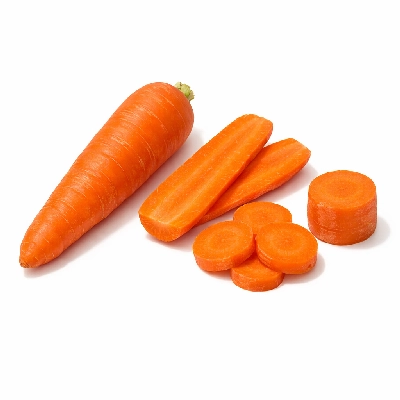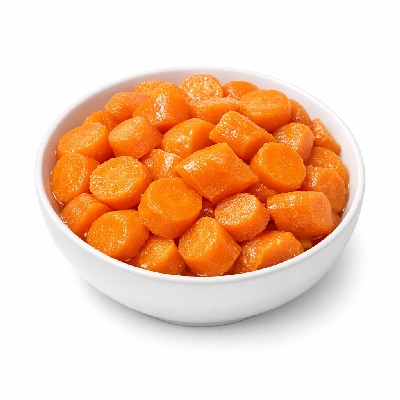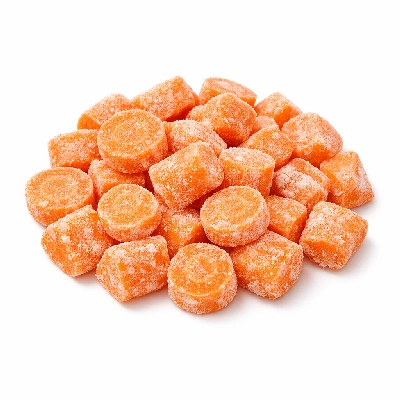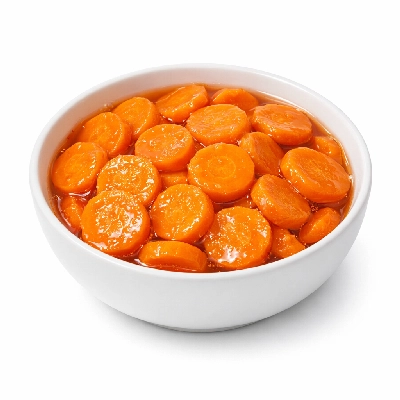
Raw Baby Carrots
Source of Calories
Nutrition Facts
| Nutrient | Amount | % Daily Value |
|---|---|---|
| Total Carbohydrates | 1.24 g | 0% |
| Net Carbohydrates | 0.8 g | 0% |
| Sugars | 0.71 g | 2% |
| Added Sugars | 0 g | 0% |
| Dietary Fiber | 0.44 g | 2% |
| Protein | 0.1 g | 0% |
| Total Fat | 0.02 g | 0% |
| Saturated Fat | 0 g | 0% |
| Monounsaturated Fat | 0 g | - |
| Polyunsaturated Fat | 0.01 g | - |
| Trans Fat | 0 g | 0% |
| Cholesterol | 0 mg | 0% |
| Vitamins | ||
| Vitamin A | 103.43 mcg | 11% |
| Vitamin C | 0.39 mg | 0% |
| Vitamin D | 0 mcg | 0% |
| Minerals | ||
| Sodium | 11.7 mg | 1% |
| Potassium | 35.55 mg | 1% |
| Calcium | 4.8 mg | 0% |
| Magnesium | 1.5 mg | 0% |
| Iron | 0.13 mg | 1% |
| Zinc | 0.03 mg | 0% |
% DV refers to how much a single serving of an individually packaged food or supplement contributes nutritionally to your daily diet, based on a 2,000-calorie-a-day diet. Generally, having 5% DV or less of a nutrient per serving is considered low, and 20% DV or more of a nutrient per serving is considered high.
Fat Composition
The suggested total fat consumption should be limited to 30% of total energy intake or less. The type of fat consumed should primarily be unsaturated fatty acids, with no more than 10% of total energy intake coming from saturated fatty acids (about 200 calories on a 2000-calorie diet) and no more than 1% of total energy intake coming from trans-fatty acids.
Vitamin Coverage
Vitamin A
11%
Vitamin C
0.4%
Vitamin D
0%
Vitamin E
-
Vitamin K
1%
Vitamin B1
0.4%
Vitamin B2
0.4%
Vitamin B3
0.5%
Vitamin B5
1%
Vitamin B6
0.9%
Vitamin B7
1%
Vitamin B9
1%
Vitamin B12
0%
There are 13 essential vitamins required for the body to work properly, which are categorised into two categories: fat-soluble and water-soluble vitamins. Vitamins have a Recommended Dietary Allowance (RDA), provided by the Dietary Reference Intakes (DRIs), which vary by age and sex. The %DV indicates how much one serving contributes to the average recommended daily intake.
Mineral Coverage
Calcium
0.4%
Iron
0.7%
Magnesium
0.4%
Phosphorus
0.3%
Potassium
0.8%
Sodium
0.5%
Zinc
0.2%
Copper
2%
Manganese
1%
Selenium
0.2%
Minerals are micronutrients, of which 13 of them are essential to the human body. The Recommended Dietary Allowance includes Calcium (1,300 mg/d), Phosphorus (1,250 mg/d), Potassium (4,700 mg/d), Sodium (2,300 mg/d), Chloride (1,500 mg/d), Magnesium (420 mg/d), Iron (18 mg/d), Zinc (11 mg/d), Copper (0.9 mg/d), Selenium (55 mcg/d), Molybdenum (45 mcg/d), Manganese (2.3 mg/d) and Iodine (150 mcg/d).
Protein Quality
Leucine
0.2%
Isoleucine
0.4%
Valine
0.3%
Lysine
0.2%
Tryptophan
0.4%
Threonine
0.3%
Phenylalanine
0.3%
Methionine
0.1%
Histidine
0.2%
Guidelines recommend a serving of protein with each meal and 1.2-1.6 g of protein per kg of body weight per day.
The data provided by eato.health is for informational purposes only and should not be considered medical advice. Please consult your physician before beginning any diet or nutrition plan.
About
How Long to Burn Off 5 Calories?
*Based on this person: 25-year-old female, 5'7", 144 lbs

Swimming
< 1 min

Jogging
< 1 min

Cycling
< 1 min

Walking
2 min
The data provided by eato.health is for informational purposes only and should not be considered medical advice. Please consult your physician before beginning any diet or nutrition plan.
📚 Health Research & Evidence About This Food
Baby carrots are highly nutritious, rich in beta-carotene and other antioxidant pigments crucial for eye health, such as lutein and zeaxanthin, and their consumption significantly increases skin carotenoid levels, with studies showing a notable increase in skin carotenoid scores in young adults. As a low-calorie food, they also provide dietary fiber, particularly soluble fiber like pectin, which supports heart health by helping to lower high blood cholesterol and regulate blood sugar, and contain vitamins A, K, and C, and potassium, offering similar nutritional value to mature carrots.
1. Uv-B Light Enhances Antioxidant Activity in Sliced Carrots
Source: USDA ARS
Summary: Exposing sliced carrots to ultraviolet B (UV-B) light significantly boosts their antioxidant activity by increasing the synthesis of phenolic compounds like anthocyanins and flavonoids.
Read More: https://www.ars.usda.gov/research/publications/publication/?seqNo115=259084
2. Carrots 101: Nutrition Facts and Health Benefits
Source: Healthline, 2019
Summary: Baby carrots are highly nutritious, rich in beta-carotene, fiber, potassium, and various antioxidants, with little difference in nutrient content compared to whole carrots.
Read More: https://www.healthline.com/nutrition/foods/carrots
3. Here's What Happened to My Body When I Ate Carrots Every Day
Source: Prevention, 2026
Summary: Carrots are a nutritional powerhouse, primarily known for their beta-carotene content, which the body converts into vitamin A, crucial for eye health.
4. Are Carrots Good for You? 7 Benefits
Source: Cleveland Clinic
Summary: Carrots are rich in alpha-carotene and beta-carotene, which are antioxidant pigments crucial for eye health, and their fiber content supports heart health by helping to lower high blood cholesterol.
Read More: https://health.clevelandclinic.org/reasons-why-carrots-of-all-colors-are-healthy-for-you
5. Trying to Eat More Vegetables? Snacking on Carrots Might Help – American Society for Nutrition
Source: nutrition.org, 2024
Summary: Eating baby carrots significantly increased skin carotenoids in young adults, with scores rising in the group consuming baby carrots alone and in the group receiving both baby carrots and a beta-carotene supplement.
Read More: https://nutrition.org/trying-to-eat-more-vegetables-snacking-on-carrots-might-help/
6. Carrots: Health Benefits, Nutrition Facts, and Risks
Source: WebMD
Summary: Baby carrots offer similar nutritional value to mature carrots, being low-calorie and rich in vitamin A, vitamin K, potassium, fiber, and vitamin C.
Read More: https://www.webmd.com/food-recipes/benefits-carrots