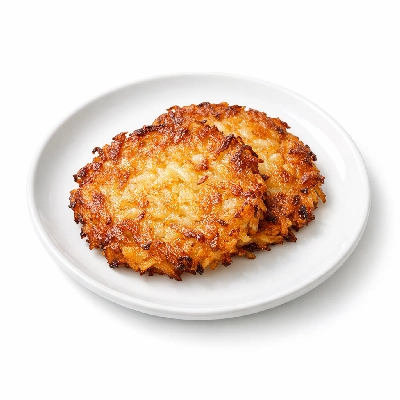
Refrigerated Prepared Potatoes Hash Brown, Pan-fried, in Canola Oil
Source of Calories
Nutrition Facts
| Nutrient | Amount | % Daily Value |
|---|---|---|
| Total Carbohydrates | 44.19 g | 16% |
| Net Carbohydrates | 39.51 g | 16% |
| Sugars | 1.51 g | 4% |
| Added Sugars | No data | - |
| Dietary Fiber | 4.68 g | 17% |
| Protein | 4.21 g | 8% |
| Total Fat | 13.39 g | 17% |
| Saturated Fat | 1.05 g | 5% |
| Monounsaturated Fat | 8.54 g | - |
| Polyunsaturated Fat | 3.72 g | - |
| Trans Fat | 0.04 g | 100% |
| Cholesterol | 0 mg | 0% |
| Vitamins | ||
| Vitamin A | No data | - |
| Vitamin C | 3.51 mg | 4% |
| Vitamin D | 0 mcg | 0% |
| Minerals | ||
| Sodium | 100.1 mg | 4% |
| Potassium | 915.2 mg | 19% |
| Calcium | 13 mg | 1% |
| Magnesium | 41.6 mg | 10% |
| Iron | 0.96 mg | 5% |
| Zinc | 0.82 mg | 7% |
% DV refers to how much a single serving of an individually packaged food or supplement contributes nutritionally to your daily diet, based on a 2,000-calorie-a-day diet. Generally, having 5% DV or less of a nutrient per serving is considered low, and 20% DV or more of a nutrient per serving is considered high.
Fat Composition
The suggested total fat consumption should be limited to 30% of total energy intake or less. The type of fat consumed should primarily be unsaturated fatty acids, with no more than 10% of total energy intake coming from saturated fatty acids (about 200 calories on a 2000-calorie diet) and no more than 1% of total energy intake coming from trans-fatty acids.
Vitamin Coverage
Vitamin A
-
Vitamin C
4%
Vitamin D
0%
Vitamin E
15%
Vitamin K
21%
Vitamin B1
3%
Vitamin B2
5%
Vitamin B3
26%
Vitamin B5
19%
Vitamin B6
28%
Vitamin B7
-
Vitamin B9
-
Vitamin B12
0%
There are 13 essential vitamins required for the body to work properly, which are categorised into two categories: fat-soluble and water-soluble vitamins. Vitamins have a Recommended Dietary Allowance (RDA), provided by the Dietary Reference Intakes (DRIs), which vary by age and sex. The %DV indicates how much one serving contributes to the average recommended daily intake.
Mineral Coverage
Calcium
1%
Iron
5%
Magnesium
10%
Phosphorus
13%
Potassium
19%
Sodium
4%
Zinc
7%
Copper
15%
Manganese
13%
Selenium
-
Minerals are micronutrients, of which 13 of them are essential to the human body. The Recommended Dietary Allowance includes Calcium (1,300 mg/d), Phosphorus (1,250 mg/d), Potassium (4,700 mg/d), Sodium (2,300 mg/d), Chloride (1,500 mg/d), Magnesium (420 mg/d), Iron (18 mg/d), Zinc (11 mg/d), Copper (0.9 mg/d), Selenium (55 mcg/d), Molybdenum (45 mcg/d), Manganese (2.3 mg/d) and Iodine (150 mcg/d).
The data provided by eato.health is for informational purposes only and should not be considered medical advice. Please consult your physician before beginning any diet or nutrition plan.
About
How Long to Burn Off 315 Calories?
*Based on this person: 25-year-old female, 5'7", 144 lbs

Swimming
47 min

Jogging
40 min

Cycling
41 min

Walking
1 h 14 min
The data provided by eato.health is for informational purposes only and should not be considered medical advice. Please consult your physician before beginning any diet or nutrition plan.
📚 Health Research & Evidence About This Food
Hash brown potatoes, as a form of potato, can cause blood sugar spikes, particularly in individuals with insulin resistance or beta cell dysfunction, according to Stanford Medicine research published in *Nature Medicine*. While potatoes are naturally fat-free, cholesterol-free, and low in sodium, offering fiber and antioxidants, the frying process used for hash browns leads to the highest formation of acrylamide, a chemical that can form during high-temperature cooking, as the FDA notes, and also adds fat.
1. Acrylamide and Diet, Food Storage, and Food Preparation
Source: FDA, 2024
Summary: Frying potatoes results in the highest formation of acrylamide compared to roasting and baking.
2. Potatoes: Health Benefits, Nutrients per Serving, Recipes, and More
Source: WebMD
Summary: Potatoes are naturally fat-free, cholesterol-free, and low in sodium, offering a good source of fiber, including resistant starch, and antioxidants.
Read More: https://www.webmd.com/diet/health-benefits-potatoes
3. Blood Sugar Response to Various Carbohydrates Can Point to Metabolic Health Subtypes, Study Finds
Source: Stanford Medicine, 2025
Summary: Hash brown potatoes, as a form of potato, were among the carbohydrates that caused blood sugar spikes in individuals who were either insulin resistant or had beta cell dysfunction, with the highest spikes for potatoes observed in these groups within a study.
Read More: https://med.stanford.edu/news/all-news/2025/06/carb-sugar-spikes.html