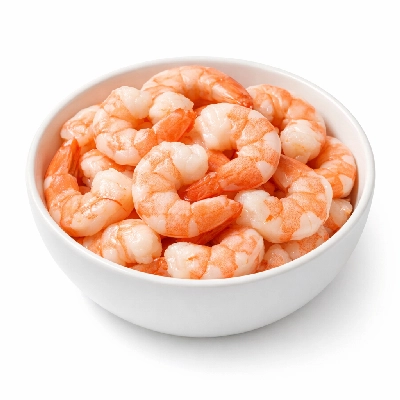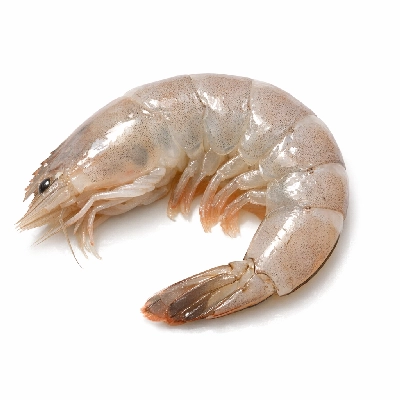
Raw Shrimp
Source of Calories
Nutrition Facts
| Nutrient | Amount | % Daily Value |
|---|---|---|
| Total Carbohydrates | 0 g | 0% |
| Net Carbohydrates | 0 g | 0% |
| Sugars | No data | - |
| Added Sugars | 0 g | 0% |
| Dietary Fiber | No data | - |
| Protein | 20.1 g | 40% |
| Total Fat | 0.51 g | 1% |
| Saturated Fat | 0.1 g | 1% |
| Monounsaturated Fat | 0.09 g | - |
| Polyunsaturated Fat | 0.15 g | - |
| Trans Fat | 0 g | 0% |
| Cholesterol | 161 mg | 54% |
| Vitamins | ||
| Vitamin A | No data | - |
| Vitamin C | No data | - |
| Vitamin D | No data | - |
| Minerals | ||
| Sodium | 119 mg | 5% |
| Potassium | 264 mg | 6% |
| Calcium | 64 mg | 5% |
| Magnesium | 35 mg | 8% |
| Iron | 0.52 mg | 3% |
| Zinc | 1.34 mg | 12% |
% DV refers to how much a single serving of an individually packaged food or supplement contributes nutritionally to your daily diet, based on a 2,000-calorie-a-day diet. Generally, having 5% DV or less of a nutrient per serving is considered low, and 20% DV or more of a nutrient per serving is considered high.
Fat Composition
The suggested total fat consumption should be limited to 30% of total energy intake or less. The type of fat consumed should primarily be unsaturated fatty acids, with no more than 10% of total energy intake coming from saturated fatty acids (about 200 calories on a 2000-calorie diet) and no more than 1% of total energy intake coming from trans-fatty acids.
Mineral Coverage
Calcium
5%
Iron
3%
Magnesium
8%
Phosphorus
17%
Potassium
6%
Sodium
5%
Zinc
12%
Copper
43%
Manganese
1%
Selenium
-
Minerals are micronutrients, of which 13 of them are essential to the human body. The Recommended Dietary Allowance includes Calcium (1,300 mg/d), Phosphorus (1,250 mg/d), Potassium (4,700 mg/d), Sodium (2,300 mg/d), Chloride (1,500 mg/d), Magnesium (420 mg/d), Iron (18 mg/d), Zinc (11 mg/d), Copper (0.9 mg/d), Selenium (55 mcg/d), Molybdenum (45 mcg/d), Manganese (2.3 mg/d) and Iodine (150 mcg/d).
The data provided by eato.health is for informational purposes only and should not be considered medical advice. Please consult your physician before beginning any diet or nutrition plan.
About
How Long to Burn Off 85 Calories?
*Based on this person: 25-year-old female, 5'7", 144 lbs

Swimming
13 min

Jogging
11 min

Cycling
11 min

Walking
20 min
The data provided by eato.health is for informational purposes only and should not be considered medical advice. Please consult your physician before beginning any diet or nutrition plan.
📚 Health Research & Evidence About This Food
Shrimp is a nutritious shellfish, providing a low-calorie, high-protein profile rich in essential nutrients such as iodine, selenium, phosphorus, and vitamin B12, along with potassium, zinc, magnesium, and the antioxidant astaxanthin. Observational evidence suggests it supports weight management by increasing satiety and heart health due to its low saturated fat and omega-3 fatty acids, with Harvard Health noting its dietary cholesterol has only a modest effect on blood cholesterol as the liver adjusts its own cholesterol production. However, research also identifies tropomyosin as a specific protein that is a clinically relevant allergen, capable of triggering reactions in both atopic and nonatopic individuals.
1. Is Shrimp Good for You? Nutrition, Calories & More
Source: Healthline, 2018
Summary: Shrimp is a widely consumed shellfish known for its impressive nutritional profile, offering low calories, high protein, and essential nutrients such as iodine, phosphorus, potassium, zinc, magnesium, and sodium.
Read More: https://www.healthline.com/nutrition/is-shrimp-healthy
2. Ige Binding to Raw and Boiled Shrimp Proteins in Atopic and Nonatopic Patients With Adverse Reactions to Shrimp.
Source: PubMed
Summary: A kD protein was identified as the most frequent IgE-binding protein across all patients, irrespective of CAP-FEIA-RAST results, highlighting its potential as a clinically relevant allergen in both atopic and nonatopic individuals.
Read More: https://pubmed.ncbi.nlm.nih.gov/14976390/
3. Shrimp and Cholesterol: Nutrition and Heart Health Effects
Source: Medical News Today, 2019
Summary: Shrimp can be included in a heart-healthy diet due to its low saturated fat and presence of beneficial nutrients like omega-3 fatty acids, with an analysis even linking its consumption to lower rates of heart failure, stroke, and coronary artery disease.
4. Shrimp: Calories, Nutrition and Health Benefits
Source: Cleveland Clinic
Summary: Shrimp is a nutritious food, low in calories and rich in lean protein and essential nutrients like phosphorus, potassium, selenium, choline, copper, iodine, and vitamin B12.
Read More: https://health.clevelandclinic.org/is-shrimp-healthy
5. Shrimp for Weight Loss: How It Can Help and Recipes to Try
Source: Medical News Today, 2025
Summary: Shrimp is a beneficial food for weight loss diets due to its favorable nutritional profile, characterized by being low in calories and fat, and notably high in protein.
Read More: https://www.medicalnewstoday.com/articles/is-shrimp-healthy-for-weight-loss
6. Seafood Selections That Help Your Heart - and Our Planet - Harvard Health
Source: Harvard Health, 2025
Summary: Dietary cholesterol from shrimp is now understood to have only a modest effect on blood cholesterol.
Read More: https://www.health.harvard.edu/heart-health/seafood-selections-that-help-your-heart-and-our-planet