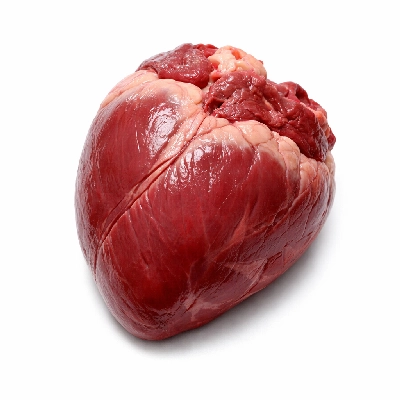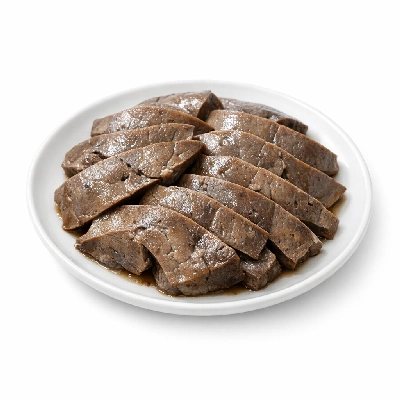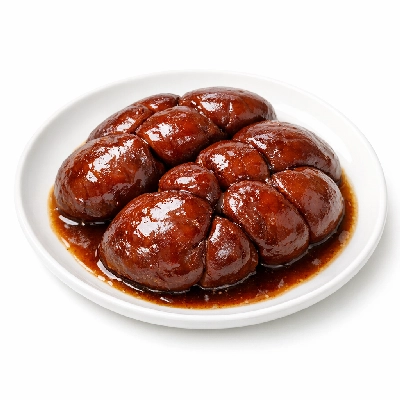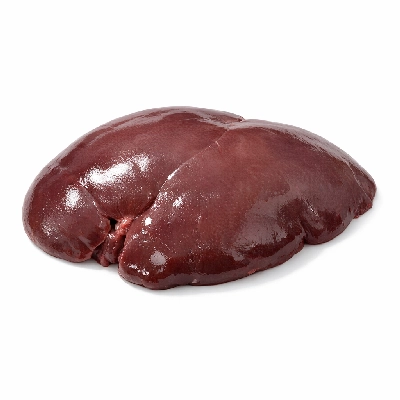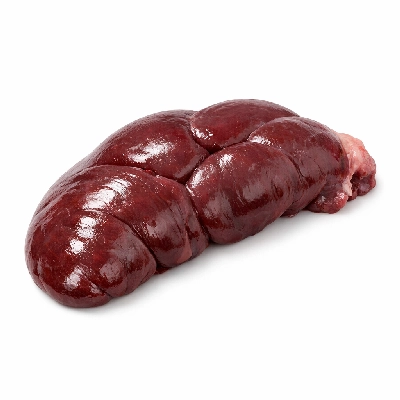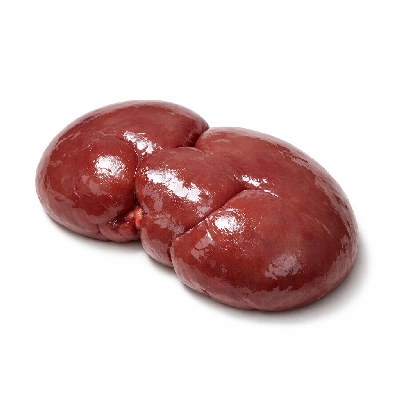
Raw Pork Kidneys
Source of Calories
Nutrition Facts
| Nutrient | Amount | % Daily Value |
|---|---|---|
| Total Carbohydrates | 0 g | 0% |
| Net Carbohydrates | 0 g | 0% |
| Sugars | No data | - |
| Added Sugars | 0 g | 0% |
| Dietary Fiber | 0 g | 0% |
| Protein | 4.67 g | 9% |
| Total Fat | 0.92 g | 1% |
| Saturated Fat | 0.3 g | 1% |
| Monounsaturated Fat | 0.3 g | - |
| Polyunsaturated Fat | 0.07 g | - |
| Trans Fat | No data | - |
| Cholesterol | 90.6 mg | 30% |
| Vitamins | ||
| Vitamin A | 16.87 mcg | 2% |
| Vitamin C | 3.78 mg | 4% |
| Vitamin D | No data | - |
| Minerals | ||
| Sodium | 34.36 mg | 1% |
| Potassium | 65.04 mg | 1% |
| Calcium | 2.56 mg | 0% |
| Magnesium | 4.83 mg | 1% |
| Iron | 1.39 mg | 8% |
| Zinc | 0.78 mg | 7% |
% DV refers to how much a single serving of an individually packaged food or supplement contributes nutritionally to your daily diet, based on a 2,000-calorie-a-day diet. Generally, having 5% DV or less of a nutrient per serving is considered low, and 20% DV or more of a nutrient per serving is considered high.
Fat Composition
The suggested total fat consumption should be limited to 30% of total energy intake or less. The type of fat consumed should primarily be unsaturated fatty acids, with no more than 10% of total energy intake coming from saturated fatty acids (about 200 calories on a 2000-calorie diet) and no more than 1% of total energy intake coming from trans-fatty acids.
Vitamin Coverage
Vitamin A
2%
Vitamin C
4%
Vitamin D
-
Vitamin E
-
Vitamin K
-
Vitamin B1
8%
Vitamin B2
37%
Vitamin B3
15%
Vitamin B5
18%
Vitamin B6
7%
Vitamin B7
-
Vitamin B9
3%
Vitamin B12
100%
There are 13 essential vitamins required for the body to work properly, which are categorised into two categories: fat-soluble and water-soluble vitamins. Vitamins have a Recommended Dietary Allowance (RDA), provided by the Dietary Reference Intakes (DRIs), which vary by age and sex. The %DV indicates how much one serving contributes to the average recommended daily intake.
Mineral Coverage
Calcium
0.2%
Iron
8%
Magnesium
1%
Phosphorus
5%
Potassium
1%
Sodium
1%
Zinc
7%
Copper
20%
Manganese
2%
Selenium
98%
Minerals are micronutrients, of which 13 of them are essential to the human body. The Recommended Dietary Allowance includes Calcium (1,300 mg/d), Phosphorus (1,250 mg/d), Potassium (4,700 mg/d), Sodium (2,300 mg/d), Chloride (1,500 mg/d), Magnesium (420 mg/d), Iron (18 mg/d), Zinc (11 mg/d), Copper (0.9 mg/d), Selenium (55 mcg/d), Molybdenum (45 mcg/d), Manganese (2.3 mg/d) and Iodine (150 mcg/d).
Protein Quality
Leucine
14%
Isoleucine
19%
Valine
16%
Lysine
13%
Tryptophan
17%
Threonine
14%
Phenylalanine
19%
Methionine
15%
Histidine
11%
Guidelines recommend a serving of protein with each meal and 1.2-1.6 g of protein per kg of body weight per day.
The data provided by eato.health is for informational purposes only and should not be considered medical advice. Please consult your physician before beginning any diet or nutrition plan.
About
How Long to Burn Off 28 Calories?
*Based on this person: 25-year-old female, 5'7", 144 lbs

Swimming
5 min

Jogging
4 min

Cycling
4 min

Walking
7 min
The data provided by eato.health is for informational purposes only and should not be considered medical advice. Please consult your physician before beginning any diet or nutrition plan.
FAQ
No. Raw pork, including organs like kidneys, can carry pathogens such as Salmonella, Yersinia enterocolitica, and Trichinella parasites, which are not reliably destroyed unless the meat is cooked to safe internal temperatures. These organisms can survive in raw tissue and lead to gastrointestinal infection, fever, diarrhea, and in the case of Trichinella, systemic illness affecting muscles and organs.
Yes. There is about 30% of the daily value of cholesterol (90.6mg) in 1oz of pork kidneys. Additionally, there is about 0.92g fat and 0.3g saturated fat, which is affects LDL cholesterol more than overall saturated fat intake by cholesterol.
No. There is only 0.92g total fat and 0.3g saturated fat, which makes it a very lean organ meat.
Yes. With 4.67g of protein for just 28kcal, there is a very strong protein to calorie ratio in raw pork kidneys. Consuming higher protein foods have many benefits including increased satiety and improved appetite regulation.
Yes. There is 1.39mg of iron, heme iron to be specific, which is more efficiently absorbed than plant based iron. In fact, heme iron ‘s absorption rate is about 15% to 35% depending on the iron, making it more nutritionally dense.
📚 Health Research & Evidence About This Food
Pork kidneys contain alpha-gal, a sugar molecule that can induce allergic reactions and delayed anaphylaxis in individuals with red meat allergy, as highlighted by the CDC regarding mammal organ meats and confirmed by research identifying specific alpha-gal epitopes in pork kidney proteins as triggers for these reactions. Specifically, porcine angiotensin-I-converting enzyme (ACE I) and aminopeptidase N (AP-N) carrying alpha-gal epitopes in pork kidney are clinically relevant in inducing these reactions. While they are a source for diamine oxidase (DAO) supplements, which help break down histamine, the activity of these supplements can vary substantially. Additionally, pork kidneys exhibited a lower isolation rate of pathogenic Yersinia enterocolitica compared to other pig offal, suggesting less contamination risk due to their position during processing.
1. Fast Facts: Products That May Contain Alpha-Gal
Source: CDC, 2026
Summary: Pork kidneys may contain alpha-gal, a sugar molecule found in mammal meat, which can trigger allergic reactions in individuals with Alpha-gal Syndrome.
Read More: https://www.cdc.gov/alpha-gal-syndrome/data-research/products-containing-alpha-gal/index.html
2. Diamine Oxidase: Do Supplements Help Histamine Intolerance?
Source: WebMD
Summary: Pork kidney is a common source for diamine oxidase (DAO) supplements, but the activity of these supplements can vary significantly between batches.
Read More: https://www.webmd.com/allergies/what-to-know-about-diamine-oxidase-histamine-intolerance
3. Two Galactose-α-1,3-Galactose Carrying Peptidases From Pork Kidney Mediate Anaphylactogenic Responses in Delayed Meat Allergy.
Source: PubMed
Summary: Porcine angiotensin-I-converting enzyme (ACE I) and aminopeptidase N (AP-N) in pork kidney are clinically relevant cell-membrane proteins carrying α-Gal epitopes that induce delayed anaphylaxis in patients with red meat allergy.
Read More: https://pubmed.ncbi.nlm.nih.gov/26728983/
4. High Prevalence of Yersinia Enterocolitica 4:O3 on Pig Offal in Southern Germany: A Slaughtering Technique Problem.
Source: PubMed
Summary: Pork kidneys exhibited the lowest isolation rate of pathogenic *Yersinia enterocolitica* 4:O3 among various pig offal samples, suggesting they are less prone to contamination during slaughtering processes.
Read More: https://pubmed.ncbi.nlm.nih.gov/11822684/