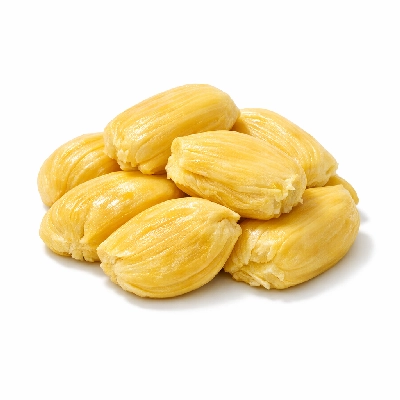
Raw Jackfruit
Source of Calories
Nutrition Facts
| Nutrient | Amount | % Daily Value |
|---|---|---|
| Total Carbohydrates | 38.36 g | 14% |
| Net Carbohydrates | 35.89 g | 15% |
| Sugars | 31.48 g | 90% |
| Added Sugars | 0 g | 0% |
| Dietary Fiber | 2.47 g | 9% |
| Protein | 2.84 g | 6% |
| Total Fat | 1.06 g | 1% |
| Saturated Fat | 0.32 g | 2% |
| Monounsaturated Fat | 0.26 g | - |
| Polyunsaturated Fat | 0.16 g | - |
| Trans Fat | 0 g | 0% |
| Cholesterol | 0 mg | 0% |
| Vitamins | ||
| Vitamin A | 9.14 mcg | 1% |
| Vitamin C | 22.6 mg | 25% |
| Vitamin D | No data | - |
| Minerals | ||
| Sodium | 3.3 mg | 0% |
| Potassium | 739.2 mg | 16% |
| Calcium | 39.6 mg | 3% |
| Magnesium | 47.85 mg | 11% |
| Iron | 0.38 mg | 2% |
| Zinc | 0.21 mg | 2% |
% DV refers to how much a single serving of an individually packaged food or supplement contributes nutritionally to your daily diet, based on a 2,000-calorie-a-day diet. Generally, having 5% DV or less of a nutrient per serving is considered low, and 20% DV or more of a nutrient per serving is considered high.
Fat Composition
The suggested total fat consumption should be limited to 30% of total energy intake or less. The type of fat consumed should primarily be unsaturated fatty acids, with no more than 10% of total energy intake coming from saturated fatty acids (about 200 calories on a 2000-calorie diet) and no more than 1% of total energy intake coming from trans-fatty acids.
Vitamin Coverage
Vitamin A
1%
Vitamin C
25%
Vitamin D
-
Vitamin E
4%
Vitamin K
-
Vitamin B1
14%
Vitamin B2
7%
Vitamin B3
9%
Vitamin B5
8%
Vitamin B6
32%
Vitamin B7
-
Vitamin B9
10%
Vitamin B12
0%
There are 13 essential vitamins required for the body to work properly, which are categorised into two categories: fat-soluble and water-soluble vitamins. Vitamins have a Recommended Dietary Allowance (RDA), provided by the Dietary Reference Intakes (DRIs), which vary by age and sex. The %DV indicates how much one serving contributes to the average recommended daily intake.
Mineral Coverage
Calcium
3%
Iron
2%
Magnesium
11%
Phosphorus
3%
Potassium
16%
Sodium
0.1%
Zinc
2%
Copper
14%
Manganese
3%
Selenium
-
Minerals are micronutrients, of which 13 of them are essential to the human body. The Recommended Dietary Allowance includes Calcium (1,300 mg/d), Phosphorus (1,250 mg/d), Potassium (4,700 mg/d), Sodium (2,300 mg/d), Chloride (1,500 mg/d), Magnesium (420 mg/d), Iron (18 mg/d), Zinc (11 mg/d), Copper (0.9 mg/d), Selenium (55 mcg/d), Molybdenum (45 mcg/d), Manganese (2.3 mg/d) and Iodine (150 mcg/d).
Protein Quality
Leucine
6%
Isoleucine
9%
Valine
8%
Lysine
4%
Tryptophan
16%
Threonine
10%
Phenylalanine
7%
Methionine
8%
Histidine
6%
Guidelines recommend a serving of protein with each meal and 1.2-1.6 g of protein per kg of body weight per day.
The data provided by eato.health is for informational purposes only and should not be considered medical advice. Please consult your physician before beginning any diet or nutrition plan.
About
How Long to Burn Off 157 Calories?
*Based on this person: 25-year-old female, 5'7", 144 lbs

Swimming
23 min

Jogging
20 min

Cycling
21 min

Walking
37 min
The data provided by eato.health is for informational purposes only and should not be considered medical advice. Please consult your physician before beginning any diet or nutrition plan.
📚 Health Research & Evidence About This Food
Jackfruit is a nutrient-dense tropical fruit, providing fiber, protein, vitamins, minerals, and antioxidants, according to WebMD. Observational evidence suggests it may support heart health, aid digestion, and help manage blood sugar, while also exhibiting anti-inflammatory properties. Mechanistic studies on jackfruit seeds and peel polysaccharides indicate potential antioxidant, anti-inflammatory, and gut health benefits.
1. Jackfruit: Nutrition, Health Benefits, & How to Prepare
Source: WebMD
Summary: Jackfruit, the world's largest tree fruit, offers a rich nutritional profile including fiber, protein, vitamins, minerals, and antioxidants, contributing to various health benefits such as reduced inflammation, improved digestion, and potential support for diabetes and heart health.
Read More: https://www.webmd.com/food-recipes/health-benefits-jackfruit
2. Jackfruit: What It Is and Why It’S Healthy
Source: Cleveland Clinic
Summary: Jackfruit, an ancient fruit, offers heart-healthy benefits, may help fight inflammation, and serves as a versatile meat substitute, while also containing vitamins, minerals, and phytochemicals that protect cells from oxidative stress and potentially aid blood sugar management.
Read More: https://health.clevelandclinic.org/what-is-jackfruit-and-is-it-healthy
3. Optimizing Ultrasound-Microwave-Assisted Extraction of Jackfruit Peel Polysaccharides and Evaluating Their Impact on Intestinal Health in Vivo
Source: SpringerLink, 2025
Summary: Jackfruit peel polysaccharides, efficiently extracted using ultrasound-microwave assistance, demonstrate significant therapeutic potential in a DSS-induced colitis mouse model by alleviating symptoms, modulating gut microbiota, increasing beneficial bacteria and short-chain fatty acids, reducing inflammation, and improving intestinal barrier function.
Read More: https://link.springer.com/article/10.1186/s40538-025-00790-2
4. Jackfruit: Benefits and Nutrition
Source: Medical News Today
Summary: Jackfruit, a tropical tree fruit, serves as a healthy source of vitamin C and other essential nutrients, offering potential health benefits such as reducing LDL cholesterol, lowering blood pressure, exhibiting antioxidant and anti-inflammatory properties, and aiding in blood sugar management and wound healing.
5. An Overview on Nutritional Composition, Bioactive Constituents, Health Benefits, and Food Applications of Jackfruit (Artocarpus Heterophyllus) Seeds
Source: SpringerLink, 2026
Summary: Jackfruit seeds, often considered agro-waste, are a highly nutritious and bioactive-rich component, providing substantial potential for functional food development due to their high levels of carbohydrates, proteins, dietary fiber, micronutrients, and bioactive compounds that contribute to antioxidant, anti-inflammatory, antibacterial, and immunomodulatory properties.
Read More: https://link.springer.com/article/10.1007/s44187-026-00945-6