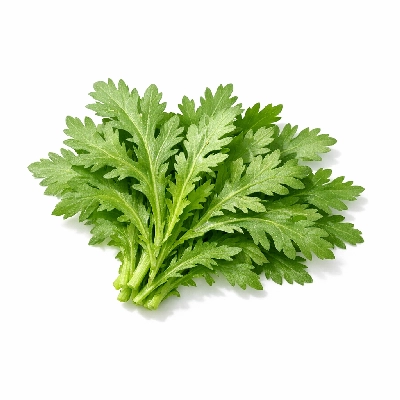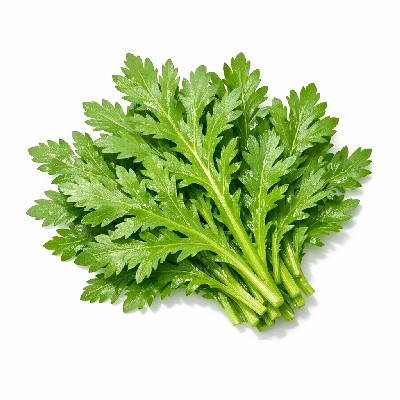
Raw Chrysanthemum Leaves
Source of Calories
Nutrition Facts
| Nutrient | Amount | % Daily Value |
|---|---|---|
| Total Carbohydrates | 1.54 g | 1% |
| Net Carbohydrates | 0.01 g | 0% |
| Sugars | No data | - |
| Added Sugars | No data | - |
| Dietary Fiber | 1.53 g | 5% |
| Protein | 1.71 g | 3% |
| Total Fat | 0.29 g | 0% |
| Saturated Fat | No data | - |
| Monounsaturated Fat | No data | - |
| Polyunsaturated Fat | No data | - |
| Trans Fat | 0 g | 0% |
| Cholesterol | 0 mg | 0% |
| Vitamins | ||
| Vitamin A | 286.11 mcg | 32% |
| Vitamin C | 0.71 mg | 1% |
| Vitamin D | 0 mcg | 0% |
| Minerals | ||
| Sodium | 60.18 mg | 3% |
| Potassium | 289.17 mg | 6% |
| Calcium | 59.67 mg | 5% |
| Magnesium | 16.32 mg | 4% |
| Iron | 1.17 mg | 7% |
| Zinc | 0.36 mg | 3% |
% DV refers to how much a single serving of an individually packaged food or supplement contributes nutritionally to your daily diet, based on a 2,000-calorie-a-day diet. Generally, having 5% DV or less of a nutrient per serving is considered low, and 20% DV or more of a nutrient per serving is considered high.
Fat Composition
The suggested total fat consumption should be limited to 30% of total energy intake or less. The type of fat consumed should primarily be unsaturated fatty acids, with no more than 10% of total energy intake coming from saturated fatty acids (about 200 calories on a 2000-calorie diet) and no more than 1% of total energy intake coming from trans-fatty acids.
Vitamin Coverage
Vitamin A
32%
Vitamin C
0.8%
Vitamin D
0%
Vitamin E
-
Vitamin K
-
Vitamin B1
6%
Vitamin B2
6%
Vitamin B3
2%
Vitamin B5
2%
Vitamin B6
5%
Vitamin B7
-
Vitamin B9
23%
Vitamin B12
0%
There are 13 essential vitamins required for the body to work properly, which are categorised into two categories: fat-soluble and water-soluble vitamins. Vitamins have a Recommended Dietary Allowance (RDA), provided by the Dietary Reference Intakes (DRIs), which vary by age and sex. The %DV indicates how much one serving contributes to the average recommended daily intake.
Mineral Coverage
Calcium
5%
Iron
7%
Magnesium
4%
Phosphorus
2%
Potassium
6%
Sodium
3%
Zinc
3%
Copper
8%
Manganese
21%
Selenium
0.3%
Minerals are micronutrients, of which 13 of them are essential to the human body. The Recommended Dietary Allowance includes Calcium (1,300 mg/d), Phosphorus (1,250 mg/d), Potassium (4,700 mg/d), Sodium (2,300 mg/d), Chloride (1,500 mg/d), Magnesium (420 mg/d), Iron (18 mg/d), Zinc (11 mg/d), Copper (0.9 mg/d), Selenium (55 mcg/d), Molybdenum (45 mcg/d), Manganese (2.3 mg/d) and Iodine (150 mcg/d).
The data provided by eato.health is for informational purposes only and should not be considered medical advice. Please consult your physician before beginning any diet or nutrition plan.
About
How Long to Burn Off 12 Calories?
*Based on this person: 25-year-old female, 5'7", 144 lbs

Swimming
2 min

Jogging
2 min

Cycling
2 min

Walking
3 min
The data provided by eato.health is for informational purposes only and should not be considered medical advice. Please consult your physician before beginning any diet or nutrition plan.
📚 Health Research & Evidence About This Food
Chrysanthemum leaves exhibit both anti-inflammatory and antioxidant properties. Research published in PubMed indicates that extracts from chrysanthemum stem and leaves significantly inhibit inflammatory markers such as IL-1β, IL-8, and MMP9, and upregulate antioxidant activity by modulating inflammatory gene expression in a DSS-induced zebrafish model of inflammatory bowel disease. Furthermore, according to Wiley Online Library, chrysanthemum leaves are rich in β,β‐carotenoids, which are linked to high expression levels of lycopene β‐cyclase.
1. Evaluation of Anti-Inflammatory and Antioxidant Effectsof Chrysanthemum Stem and Leaf Extract on Zebrafish Inflammatory Bowel Disease Model.
Source: PubMed
Summary: Chrysanthemum stem and leaf extracts significantly inhibited the expression of inflammatory markers IL-1β, IL-8, and MMP9, while simultaneously upregulating superoxide dismutase activity, indicating both anti-inflammatory and antioxidant effects in a zebrafish model of inflammatory bowel disease.
Read More: https://pubmed.ncbi.nlm.nih.gov/35408512/
2. Regulation of Carotenoid Biosynthesis in Petals and Leaves of Chrysanthemum ( Chrysanthemum Morifolium )
Source: Wiley Online Library
Summary: Chrysanthemum leaves exhibit a higher ratio of β,β‐carotenoids to total carotenoids, which is linked to high expression levels of lycopene β‐cyclase (LCYB).
Read More: https://onlinelibrary.wiley.com/doi/10.1111/j.1399-3054.2006.00761.x