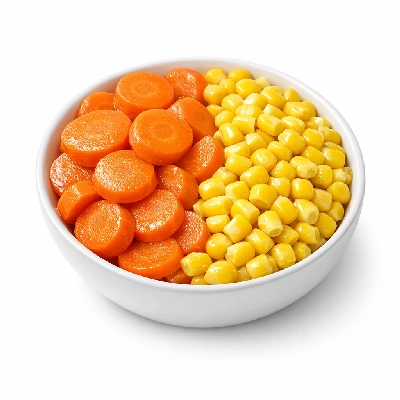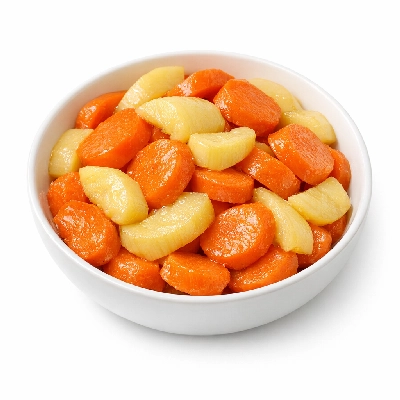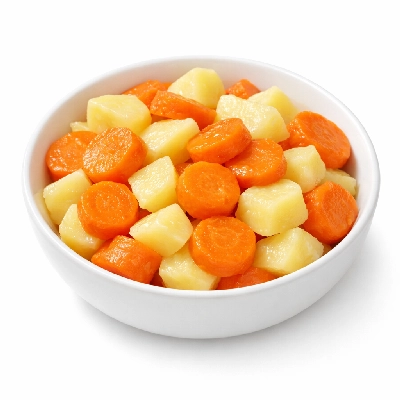
Boiled Carrots and Potatoes
Source of Calories
Nutrition Facts
| Nutrient | Amount | % Daily Value |
|---|---|---|
| Total Carbohydrates | 189.32 g | 69% |
| Net Carbohydrates | 162.1 g | 66% |
| Sugars | 32.09 g | 92% |
| Added Sugars | 0 g | 0% |
| Dietary Fiber | 27.22 g | 97% |
| Protein | 18.75 g | 38% |
| Total Fat | 2.14 g | 3% |
| Saturated Fat | 0.42 g | 2% |
| Monounsaturated Fat | 0.09 g | - |
| Polyunsaturated Fat | 0.92 g | - |
| Trans Fat | 0 g | 0% |
| Cholesterol | 0 mg | 0% |
| Vitamins | ||
| Vitamin A | 3792.28 mcg | 421% |
| Vitamin C | 113.94 mg | 127% |
| Vitamin D | 0 mcg | 0% |
| Minerals | ||
| Sodium | 2743.78 mg | 119% |
| Potassium | 5235.42 mg | 111% |
| Calcium | 277.21 mg | 21% |
| Magnesium | 260.29 mg | 62% |
| Iron | 5.79 mg | 32% |
| Zinc | 3.53 mg | 32% |
% DV refers to how much a single serving of an individually packaged food or supplement contributes nutritionally to your daily diet, based on a 2,000-calorie-a-day diet. Generally, having 5% DV or less of a nutrient per serving is considered low, and 20% DV or more of a nutrient per serving is considered high.
Fat Composition
The suggested total fat consumption should be limited to 30% of total energy intake or less. The type of fat consumed should primarily be unsaturated fatty acids, with no more than 10% of total energy intake coming from saturated fatty acids (about 200 calories on a 2000-calorie diet) and no more than 1% of total energy intake coming from trans-fatty acids.
Vitamin Coverage
Vitamin A
421%
Vitamin C
127%
Vitamin D
0%
Vitamin E
22%
Vitamin K
65%
Vitamin B1
51%
Vitamin B2
42%
Vitamin B3
94%
Vitamin B5
78%
Vitamin B6
123%
Vitamin B7
-
Vitamin B9
0%
Vitamin B12
0%
There are 13 essential vitamins required for the body to work properly, which are categorised into two categories: fat-soluble and water-soluble vitamins. Vitamins have a Recommended Dietary Allowance (RDA), provided by the Dietary Reference Intakes (DRIs), which vary by age and sex. The %DV indicates how much one serving contributes to the average recommended daily intake.
Mineral Coverage
Calcium
21%
Iron
32%
Magnesium
62%
Phosphorus
54%
Potassium
111%
Sodium
119%
Zinc
32%
Copper
141%
Manganese
85%
Selenium
7%
Minerals are micronutrients, of which 13 of them are essential to the human body. The Recommended Dietary Allowance includes Calcium (1,300 mg/d), Phosphorus (1,250 mg/d), Potassium (4,700 mg/d), Sodium (2,300 mg/d), Chloride (1,500 mg/d), Magnesium (420 mg/d), Iron (18 mg/d), Zinc (11 mg/d), Copper (0.9 mg/d), Selenium (55 mcg/d), Molybdenum (45 mcg/d), Manganese (2.3 mg/d) and Iodine (150 mcg/d).
Protein Quality
Leucine
0%
Isoleucine
0%
Valine
0%
Lysine
0%
Tryptophan
0%
Threonine
0%
Phenylalanine
0%
Methionine
0%
Histidine
0%
Guidelines recommend a serving of protein with each meal and 1.2-1.6 g of protein per kg of body weight per day.
The data provided by eato.health is for informational purposes only and should not be considered medical advice. Please consult your physician before beginning any diet or nutrition plan.
About
How Long to Burn Off 823 Calories?
*Based on this person: 25-year-old female, 5'7", 144 lbs

Swimming
2 h 1 min

Jogging
1 h 44 min

Cycling
1 h 47 min

Walking
3 h 14 min
The data provided by eato.health is for informational purposes only and should not be considered medical advice. Please consult your physician before beginning any diet or nutrition plan.
FAQ
They are nutrient-dense (948.07 mcg vitamin A, 28.49 mg vitamin C, and 1,308.86 mg potassium) while average in calories, keeping you full while providing a relatively healthy mix of vitamins and minerals.
It depends. Per serving boiled carrots and potatoes contain 1,308.86 mg potassium and 685.95 mg sodium, which can be high for some people with CKD, and kidney nutrition guidance notes that people with kidney disease may need to monitor potassium intake based on their lab results and stage of kidney disease.
They can fit a weight loss or balanced diet, but portion size may matter because the carbs add up quickly. Per serving: 205.75 kcal, 47.33 g carbs, and 6.81 g fiber, so it may be filling for some people, especially compared with lower fiber sides
Yes, both negatively and positively. The potassium is high (1,308.86 mg per serving), which may support blood pressure control in some people, but the sodium is also high (685.95 mg per serving), which may work against that benefit.
They can raise blood sugar, because they are a carbohydrate rich food. Per serving boiled carrots and potatoes contain 47.33 g total carbs, 40.53 g net carbs, 8.02 g sugars, and 6.81 g fiber, so the fiber may slow the rise somewhat, but the carb amount is still substantial. Diabetes meal planning guidance also notes that carbs raise blood sugar, while eating carbs with protein, fat, or fiber can slow how quickly blood sugar rises.
📚 Health Research & Evidence About This Food
Carrots and potatoes, both root vegetables, provide various vitamins, minerals, and antioxidants, and root vegetables in general are low in calories.
1. The Pros and Cons of Root Vegetables - Harvard Health
Source: Harvard Health, 2018
Summary: Carrots, as tap roots, and potatoes, as tubers, are examples of root vegetables that are generally low in calories and rich in antioxidants, providing essential vitamins and minerals.
Read More: https://www.health.harvard.edu/healthy-aging-and-longevity/the-pros-and-cons-of-root-vegetables
2. What Is the Healthiest Potato?
Source: NutritionFacts.org, 2022
Summary: Colorful potato varieties, especially purple-fleshed potatoes, are healthier due to their antioxidant anthocyanin pigments, which lead to lower insulin and blood sugar spikes compared to yellow or white potatoes.
Read More: https://nutritionfacts.org/questions/what-is-the-healthiest-potato/
3. Influence of Processing and Cooking of Carrots in Mixed Meals on Satiety, Glucose and Hormonal Response.
Source: PubMed
Summary: Raw carrots led to significantly lower glucose, insulin, and C-peptide responses and enhanced satiety compared to microwaved carrots in the first year of the study.
Read More: https://pubmed.ncbi.nlm.nih.gov/7712340/
4. Bioavailability and Nutritional Effects of Carotenoids From Organically and Conventionally Produced Carrots in Healthy Men.
Source: PubMed
Summary: Carrots, whether organically or conventionally grown, do not show statistically significant differences in total carotenoid content, antioxidant capacity, or their effects on plasma carotenoid concentrations and antioxidant status in healthy men.
Read More: https://pubmed.ncbi.nlm.nih.gov/19021920/
5. What to Eat (and Avoid) With Macular Degeneration
Source: Cleveland Clinic
Summary: Carrots are highlighted for their high content of provitamin A carotenoids, particularly beta-carotene, which the body converts into vitamin A, crucial for maintaining and preserving vision.
Read More: https://health.clevelandclinic.org/macular-degeneration-diet