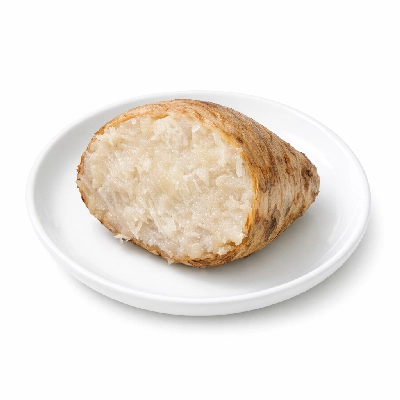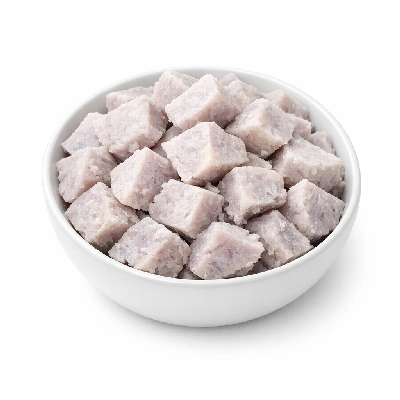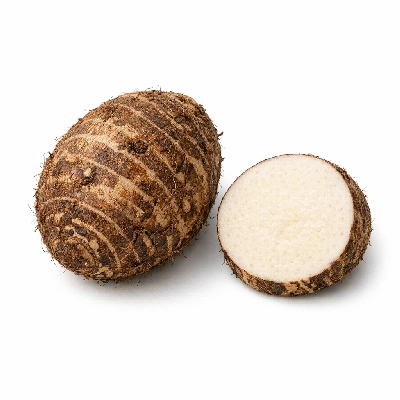
Raw Taro
Source of Calories
Nutrition Facts
| Nutrient | Amount | % Daily Value |
|---|---|---|
| Total Carbohydrates | 27.52 g | 10% |
| Net Carbohydrates | 23.25 g | 9% |
| Sugars | 0.42 g | 1% |
| Added Sugars | 0 g | 0% |
| Dietary Fiber | 4.26 g | 15% |
| Protein | 1.56 g | 3% |
| Total Fat | 0.21 g | 0% |
| Saturated Fat | 0.04 g | 0% |
| Monounsaturated Fat | 0.02 g | - |
| Polyunsaturated Fat | 0.09 g | - |
| Trans Fat | 0 g | 0% |
| Cholesterol | 0 mg | 0% |
| Vitamins | ||
| Vitamin A | 3.9 mcg | 0% |
| Vitamin C | 4.68 mg | 5% |
| Vitamin D | 0 mcg | 0% |
| Minerals | ||
| Sodium | 11.44 mg | 0% |
| Potassium | 614.64 mg | 13% |
| Calcium | 44.72 mg | 3% |
| Magnesium | 34.32 mg | 8% |
| Iron | 0.57 mg | 3% |
| Zinc | 0.24 mg | 2% |
% DV refers to how much a single serving of an individually packaged food or supplement contributes nutritionally to your daily diet, based on a 2,000-calorie-a-day diet. Generally, having 5% DV or less of a nutrient per serving is considered low, and 20% DV or more of a nutrient per serving is considered high.
Fat Composition
The suggested total fat consumption should be limited to 30% of total energy intake or less. The type of fat consumed should primarily be unsaturated fatty acids, with no more than 10% of total energy intake coming from saturated fatty acids (about 200 calories on a 2000-calorie diet) and no more than 1% of total energy intake coming from trans-fatty acids.
Vitamin Coverage
Vitamin A
0.4%
Vitamin C
5%
Vitamin D
0%
Vitamin E
17%
Vitamin K
0.9%
Vitamin B1
8%
Vitamin B2
2%
Vitamin B3
4%
Vitamin B5
6%
Vitamin B6
17%
Vitamin B7
-
Vitamin B9
6%
Vitamin B12
0%
There are 13 essential vitamins required for the body to work properly, which are categorised into two categories: fat-soluble and water-soluble vitamins. Vitamins have a Recommended Dietary Allowance (RDA), provided by the Dietary Reference Intakes (DRIs), which vary by age and sex. The %DV indicates how much one serving contributes to the average recommended daily intake.
Mineral Coverage
Calcium
3%
Iron
3%
Magnesium
8%
Phosphorus
7%
Potassium
13%
Sodium
0.5%
Zinc
2%
Copper
20%
Manganese
17%
Selenium
1%
Minerals are micronutrients, of which 13 of them are essential to the human body. The Recommended Dietary Allowance includes Calcium (1,300 mg/d), Phosphorus (1,250 mg/d), Potassium (4,700 mg/d), Sodium (2,300 mg/d), Chloride (1,500 mg/d), Magnesium (420 mg/d), Iron (18 mg/d), Zinc (11 mg/d), Copper (0.9 mg/d), Selenium (55 mcg/d), Molybdenum (45 mcg/d), Manganese (2.3 mg/d) and Iodine (150 mcg/d).
Protein Quality
Leucine
4%
Isoleucine
4%
Valine
5%
Lysine
3%
Tryptophan
7%
Threonine
5%
Phenylalanine
7%
Methionine
3%
Histidine
4%
Guidelines recommend a serving of protein with each meal and 1.2-1.6 g of protein per kg of body weight per day.
The data provided by eato.health is for informational purposes only and should not be considered medical advice. Please consult your physician before beginning any diet or nutrition plan.
About
How Long to Burn Off 116 Calories?
*Based on this person: 25-year-old female, 5'7", 144 lbs

Swimming
18 min

Jogging
15 min

Cycling
16 min

Walking
28 min
The data provided by eato.health is for informational purposes only and should not be considered medical advice. Please consult your physician before beginning any diet or nutrition plan.
📚 Health Research & Evidence About This Food
Taro is a substantial source of starch, dietary fiber, and resistant starch, which supports digestive health and promotes satiety. Research further demonstrates its potential as a strain-specific prebiotic to positively modulate a healthy gut microbiota by promoting the growth and metabolic activity of certain Lactobacillus species. Additionally, taro corms contain valuable bioactive molecules offering anticancer and immunomodulatory benefits by targeting carcinogens, oxidative stress, and inflammation, and it provides essential vitamins and minerals like potassium, manganese, and vitamins C, B6, and E.
1. Assessing the Prebiotic Potential of Taro (Colocasia Esculenta) With Probiotic Lactobacillus Species in an in Vitro Human Digestion System (P20-022-19) - Pmc
Source: NCBI
Summary: Taro significantly promotes the growth and metabolic activity of certain Lactobacillus species, indicating its potential as a prebiotic to positively modulate a healthy gut microbiota.
Read More: https://www.ncbi.nlm.nih.gov/pmc/articles/PMC6574052/
2. Taro Root: Health Benefits, Recommended Dosage, Uses, Safety Information, and More
Source: WebMD
Summary: Taro root is rich in dietary fiber and beneficial carbohydrates, specifically resistant starch, which supports digestive health and weight management by promoting satiety.
Read More: https://www.webmd.com/diet/health-benefits-taro-root
3. Anticancer and Immunomodulatory Properties of Taro Corms
Source: PubMed
Summary: Taro corms contain valuable bioactive molecules that offer significant anticancer and immunomodulatory benefits, effective against cancer and related risk factors while also helping to control metabolic dysfunctions and enhance immunological responses.
Read More: https://pubmed.ncbi.nlm.nih.gov/33383887/
4. 7 Surprising Benefits of Taro Root
Source: Healthline, 2018
Summary: Taro root is an excellent source of dietary fiber, resistant starch, potassium, magnesium, and vitamins B6, E, and C, which are often lacking in typical diets.
Read More: https://www.healthline.com/nutrition/taro-root-benefits
5. Taro Starch: Isolation, Morphology, Modification and Novel Applications Concern - a Review.
Source: PubMed
Summary: Taro corms are a significant source of starch, containing 70-80% starch, which is a considerable amount, even surpassing that of potatoes, sweet potatoes, and cassava.
Read More: https://pubmed.ncbi.nlm.nih.gov/32673724/
6. Exploring the Potential of Taro (Colocasia Esculenta) Starch: Recent Developments in Modification, Health Benefits, and Food Industry Applications
Source: Wiley Online Library
Summary: Taro starch is recognized for its substantial carbohydrate content, comprising 70%–80% starch on a dry basis, and its versatility has led to increasing incorporation into a wide range of food products.
Read More: https://onlinelibrary.wiley.com/doi/full/10.1002/fbe2.12103