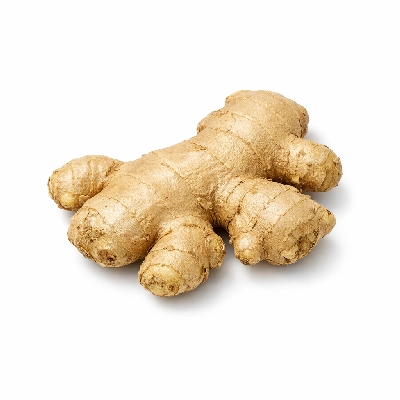
Raw Ginger Root
Source of Calories
Nutrition Facts
| Nutrient | Amount | % Daily Value |
|---|---|---|
| Total Carbohydrates | 0.36 g | 0% |
| Net Carbohydrates | 0.32 g | 0% |
| Sugars | 0.03 g | 0% |
| Added Sugars | 0 g | 0% |
| Dietary Fiber | 0.04 g | 0% |
| Protein | 0.04 g | 0% |
| Total Fat | 0.02 g | 0% |
| Saturated Fat | 0 g | 0% |
| Monounsaturated Fat | 0 g | - |
| Polyunsaturated Fat | 0 g | - |
| Trans Fat | 0 g | 0% |
| Cholesterol | 0 mg | 0% |
| Vitamins | ||
| Vitamin A | 0 mcg | 0% |
| Vitamin C | 0.1 mg | 0% |
| Vitamin D | 0 mcg | 0% |
| Minerals | ||
| Sodium | 0.26 mg | 0% |
| Potassium | 8.3 mg | 0% |
| Calcium | 0.32 mg | 0% |
| Magnesium | 0.86 mg | 0% |
| Iron | 0.01 mg | 0% |
| Zinc | 0.01 mg | 0% |
% DV refers to how much a single serving of an individually packaged food or supplement contributes nutritionally to your daily diet, based on a 2,000-calorie-a-day diet. Generally, having 5% DV or less of a nutrient per serving is considered low, and 20% DV or more of a nutrient per serving is considered high.
Fat Composition
The suggested total fat consumption should be limited to 30% of total energy intake or less. The type of fat consumed should primarily be unsaturated fatty acids, with no more than 10% of total energy intake coming from saturated fatty acids (about 200 calories on a 2000-calorie diet) and no more than 1% of total energy intake coming from trans-fatty acids.
Vitamin Coverage
Vitamin A
0%
Vitamin C
0.1%
Vitamin D
0%
Vitamin E
0%
Vitamin K
0%
Vitamin B1
0%
Vitamin B2
0.1%
Vitamin B3
0.1%
Vitamin B5
0.1%
Vitamin B6
0.2%
Vitamin B7
-
Vitamin B9
0.1%
Vitamin B12
0%
There are 13 essential vitamins required for the body to work properly, which are categorised into two categories: fat-soluble and water-soluble vitamins. Vitamins have a Recommended Dietary Allowance (RDA), provided by the Dietary Reference Intakes (DRIs), which vary by age and sex. The %DV indicates how much one serving contributes to the average recommended daily intake.
Mineral Coverage
Calcium
0%
Iron
0.1%
Magnesium
0.2%
Phosphorus
0.1%
Potassium
0.2%
Sodium
0%
Zinc
0.1%
Copper
0.5%
Manganese
0.2%
Selenium
0%
Minerals are micronutrients, of which 13 of them are essential to the human body. The Recommended Dietary Allowance includes Calcium (1,300 mg/d), Phosphorus (1,250 mg/d), Potassium (4,700 mg/d), Sodium (2,300 mg/d), Chloride (1,500 mg/d), Magnesium (420 mg/d), Iron (18 mg/d), Zinc (11 mg/d), Copper (0.9 mg/d), Selenium (55 mcg/d), Molybdenum (45 mcg/d), Manganese (2.3 mg/d) and Iodine (150 mcg/d).
Protein Quality
Leucine
0.1%
Isoleucine
0.1%
Valine
0.1%
Lysine
0%
Tryptophan
0.1%
Threonine
0.1%
Phenylalanine
0.1%
Methionine
0%
Histidine
0.1%
Guidelines recommend a serving of protein with each meal and 1.2-1.6 g of protein per kg of body weight per day.
The data provided by eato.health is for informational purposes only and should not be considered medical advice. Please consult your physician before beginning any diet or nutrition plan.
About
How Long to Burn Off 2 Calories?
*Based on this person: 25-year-old female, 5'7", 144 lbs

Swimming
< 1 min

Jogging
< 1 min

Cycling
< 1 min

Walking
< 1 min
The data provided by eato.health is for informational purposes only and should not be considered medical advice. Please consult your physician before beginning any diet or nutrition plan.
📚 Health Research & Evidence About This Food
Clinical evidence demonstrates ginger root's effectiveness in alleviating nausea and vomiting, including chemotherapy-induced and pregnancy-related nausea, by exerting antiserotonergic and 5-HT3 receptor antagonistic effects, as supported by PubMed and Healthline. Furthermore, ginger root supports digestive health by improving indigestion symptoms and promoting gastric motility through compounds like gingerol, while also showing therapeutic applications in reducing pain and inflammation, such as in knee osteoarthritis, according to NCBI.
1. Effect of a Standardized Ginger Root Powder Regimen on Chemotherapy-Induced Nausea and Vomiting: A Multicenter, Double-Blind, Placebo-Controlled Randomized Trial.
Source: PubMed
Summary: Ginger root powder significantly improved nausea-related quality of life as an adjuvant therapy for chemotherapy-induced nausea and vomiting.
Read More: https://pubmed.ncbi.nlm.nih.gov/37699474/
2. Ginger Root - Statpearls - Ncbi Bookshelf
Source: NCBI
Summary: Ginger root is a widely recognized plant-based spice and nutraceutical with extensive therapeutic applications, including reducing nausea during pregnancy and alleviating pain and inflammation in knee osteoarthritis.
Read More: https://www.ncbi.nlm.nih.gov/sites/books/NBK565886/
3. Health Benefits of Ginger and Simple Ways to Incorporate This Zesty Root Into Your Diet - Harvard Health
Source: Harvard Health, 2024
Summary: Gingerol, a bioactive compound in ginger, accelerates gastric emptying and movement through the digestive process, alleviating upset stomach, nausea, and vomiting.
4. Ginger for Nausea: Effectiveness, Safety, and Uses
Source: Healthline, 2019
Summary: Ginger may help alleviate nausea and vomiting during pregnancy, with doses appearing safe.
Read More: https://www.healthline.com/nutrition/ginger-for-nausea
5. Effect of Ginger Root Powder on Gastrointestinal Bacteria Composition, Gastrointestinal Symptoms, Mental Health, Fatigue, and Quality of Life: A Double-Blind Placebo-Controlled Trial.
Source: PubMed
Summary: Ginger root powder supplementation significantly increased the relative abundance of the phylum Actinobacteria and improved indigestion symptoms in healthy adults.
Read More: https://pubmed.ncbi.nlm.nih.gov/37690779/
6. Ginger Health Benefits: Digestion, Nausea, and More
Source: Healthline, 2020
Summary: Ginger may support digestive health in people with irritable bowel syndrome (IBS) and inflammatory bowel disease (IBD) by promoting gastric motility, reducing inflammation, alleviating pain, bloating, and gas, and improving the gut barrier.
Read More: https://www.healthline.com/nutrition/11-proven-benefits-of-ginger