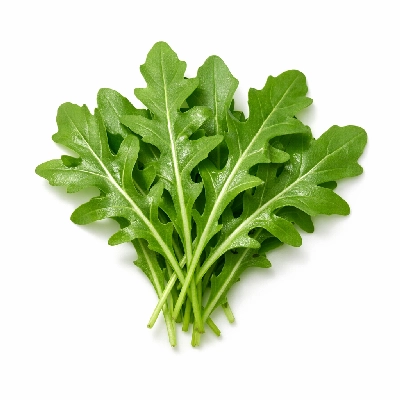
Raw Arugula or Rocket
Source of Calories
Nutrition Facts
| Nutrient | Amount | % Daily Value |
|---|---|---|
| Total Carbohydrates | 0.07 g | 0% |
| Net Carbohydrates | 0.04 g | 0% |
| Sugars | 0.04 g | 0% |
| Added Sugars | 0 g | 0% |
| Dietary Fiber | 0.03 g | 0% |
| Protein | 0.05 g | 0% |
| Total Fat | 0.01 g | 0% |
| Saturated Fat | 0 g | 0% |
| Monounsaturated Fat | 0 g | - |
| Polyunsaturated Fat | 0.01 g | - |
| Trans Fat | 0 g | 0% |
| Cholesterol | 0 mg | 0% |
| Vitamins | ||
| Vitamin A | 2.37 mcg | 0% |
| Vitamin C | 0.3 mg | 0% |
| Vitamin D | 0 mcg | 0% |
| Minerals | ||
| Sodium | 0.54 mg | 0% |
| Potassium | 7.38 mg | 0% |
| Calcium | 3.2 mg | 0% |
| Magnesium | 0.94 mg | 0% |
| Iron | 0.03 mg | 0% |
| Zinc | 0.01 mg | 0% |
% DV refers to how much a single serving of an individually packaged food or supplement contributes nutritionally to your daily diet, based on a 2,000-calorie-a-day diet. Generally, having 5% DV or less of a nutrient per serving is considered low, and 20% DV or more of a nutrient per serving is considered high.
Fat Composition
The suggested total fat consumption should be limited to 30% of total energy intake or less. The type of fat consumed should primarily be unsaturated fatty acids, with no more than 10% of total energy intake coming from saturated fatty acids (about 200 calories on a 2000-calorie diet) and no more than 1% of total energy intake coming from trans-fatty acids.
Vitamin Coverage
Vitamin A
0.3%
Vitamin C
0.3%
Vitamin D
0%
Vitamin E
0.1%
Vitamin K
2%
Vitamin B1
0.1%
Vitamin B2
0.1%
Vitamin B3
0%
Vitamin B5
0.2%
Vitamin B6
0.1%
Vitamin B7
-
Vitamin B9
0.5%
Vitamin B12
0%
There are 13 essential vitamins required for the body to work properly, which are categorised into two categories: fat-soluble and water-soluble vitamins. Vitamins have a Recommended Dietary Allowance (RDA), provided by the Dietary Reference Intakes (DRIs), which vary by age and sex. The %DV indicates how much one serving contributes to the average recommended daily intake.
Mineral Coverage
Calcium
0.2%
Iron
0.2%
Magnesium
0.2%
Phosphorus
0.1%
Potassium
0.2%
Sodium
0%
Zinc
0.1%
Copper
0.2%
Manganese
0.3%
Selenium
0%
Minerals are micronutrients, of which 13 of them are essential to the human body. The Recommended Dietary Allowance includes Calcium (1,300 mg/d), Phosphorus (1,250 mg/d), Potassium (4,700 mg/d), Sodium (2,300 mg/d), Chloride (1,500 mg/d), Magnesium (420 mg/d), Iron (18 mg/d), Zinc (11 mg/d), Copper (0.9 mg/d), Selenium (55 mcg/d), Molybdenum (45 mcg/d), Manganese (2.3 mg/d) and Iodine (150 mcg/d).
The data provided by eato.health is for informational purposes only and should not be considered medical advice. Please consult your physician before beginning any diet or nutrition plan.
About
How Long to Burn Off 1 Calories?
*Based on this person: 25-year-old female, 5'7", 144 lbs

Swimming
< 1 min

Jogging
< 1 min

Cycling
< 1 min

Walking
< 1 min
The data provided by eato.health is for informational purposes only and should not be considered medical advice. Please consult your physician before beginning any diet or nutrition plan.
📚 Health Research & Evidence About This Food
Arugula is a nutrient-dense leafy green, providing a rich array of vitamins and minerals, including vitamins K, C, A, and folate, along with antioxidants and glucosinolates. These compounds, particularly glucosinolates, which break down into cancer-preventing compounds, may be associated with a reduced risk of various cancers, such as breast, colorectal, lung, and prostate cancer. Additionally, arugula's fiber content supports gut health and its potassium contributes to heart health, with a diet rich in leafy greens like arugula also offering benefits for brain health and overall disease prevention.
1. Arugula: Health Benefits, Facts, and Research
Source: Medical News Today, 2020
Summary: Arugula is rich in glucosinolates, sulfur-containing compounds linked to a reduced risk of various cancers, including breast, colorectal, lung, and prostate cancer.
2. Arugula: Nutrition, Benefits, Risks, & More
Source: WebMD
Summary: Raw arugula is a nutrient-dense leafy green, providing a rich array of vitamins and minerals including vitamins A, C, and K, folate, calcium, magnesium, and potassium, and is particularly noted for its high antioxidant content and the presence of glucosinolates.
Read More: https://www.webmd.com/food-recipes/benefits-arugula
3. Dark Green Leafy Vegetables : Usda Ars
Source: USDA ARS
Summary: Dark green leafy vegetables are excellent sources of nutrition, providing significant amounts of folate and vitamin K, and contribute to cancer prevention due to their high antioxidant content.
Read More: https://www.ars.usda.gov/plains-area/gfnd/gfhnrc/docs/news-articles/2013/dark-green-leafy-vegetables
4. 5 Health Benefits of Arugula
Source: Cleveland Clinic
Summary: Arugula can help fight cancer due to its glucosinolates, which break down into compounds with cancer-preventing properties against breast, prostate, lung, and colon cancers.
Read More: https://health.clevelandclinic.org/arugula-benefits
5. The 13 Healthiest Leafy Green Vegetables
Source: Healthline, 2023
Summary: Arugula is a nutrient-dense leafy green vegetable, rich in vitamins K, C, and A, as well as folate, calcium, and nitrates, contributing to brain health and disease prevention.
Read More: https://www.healthline.com/nutrition/leafy-green-vegetables