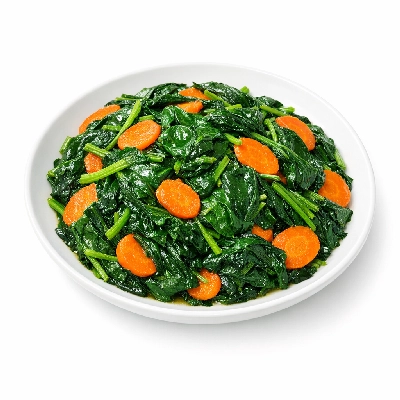
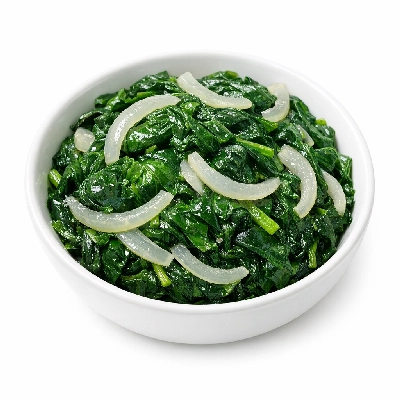
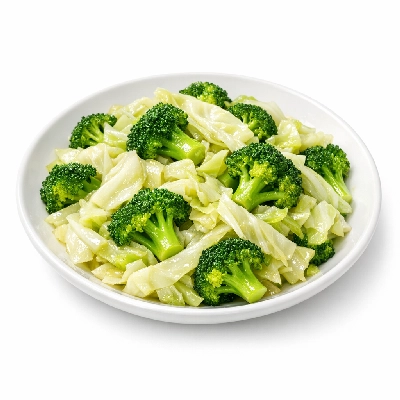
Green Vegetable Puree
Source of Calories
Nutrition Facts
| Nutrient | Amount | % Daily Value |
|---|---|---|
| Total Carbohydrates | 34.48 g | 13% |
| Net Carbohydrates | 20.21 g | 8% |
| Sugars | 10.36 g | 30% |
| Added Sugars | 0.69 g | 1% |
| Dietary Fiber | 14.28 g | 51% |
| Protein | 16.05 g | 32% |
| Total Fat | 15.46 g | 20% |
| Saturated Fat | 2.31 g | 12% |
| Monounsaturated Fat | 9.95 g | - |
| Polyunsaturated Fat | 2.12 g | - |
| Trans Fat | 0 g | 0% |
| Cholesterol | 0 mg | 0% |
| Vitamins | ||
| Vitamin A | 1050.42 mcg | 117% |
| Vitamin C | 230.92 mg | 257% |
| Vitamin D | 0 mcg | 0% |
| Minerals | ||
| Sodium | 3219.88 mg | 140% |
| Potassium | 1892.31 mg | 40% |
| Calcium | 306.63 mg | 24% |
| Magnesium | 226.66 mg | 54% |
| Iron | 8.29 mg | 46% |
| Zinc | 3.01 mg | 27% |
% DV refers to how much a single serving of an individually packaged food or supplement contributes nutritionally to your daily diet, based on a 2,000-calorie-a-day diet. Generally, having 5% DV or less of a nutrient per serving is considered low, and 20% DV or more of a nutrient per serving is considered high.
Fat Composition
The suggested total fat consumption should be limited to 30% of total energy intake or less. The type of fat consumed should primarily be unsaturated fatty acids, with no more than 10% of total energy intake coming from saturated fatty acids (about 200 calories on a 2000-calorie diet) and no more than 1% of total energy intake coming from trans-fatty acids.
Vitamin Coverage
Vitamin A
117%
Vitamin C
257%
Vitamin D
0%
Vitamin E
49%
Vitamin K
962%
Vitamin B1
46%
Vitamin B2
59%
Vitamin B3
30%
Vitamin B5
25%
Vitamin B6
50%
Vitamin B7
-
Vitamin B9
0%
Vitamin B12
0%
There are 13 essential vitamins required for the body to work properly, which are categorised into two categories: fat-soluble and water-soluble vitamins. Vitamins have a Recommended Dietary Allowance (RDA), provided by the Dietary Reference Intakes (DRIs), which vary by age and sex. The %DV indicates how much one serving contributes to the average recommended daily intake.
Mineral Coverage
Calcium
24%
Iron
46%
Magnesium
54%
Phosphorus
25%
Potassium
40%
Sodium
140%
Zinc
27%
Copper
61%
Manganese
116%
Selenium
14%
Minerals are micronutrients, of which 13 of them are essential to the human body. The Recommended Dietary Allowance includes Calcium (1,300 mg/d), Phosphorus (1,250 mg/d), Potassium (4,700 mg/d), Sodium (2,300 mg/d), Chloride (1,500 mg/d), Magnesium (420 mg/d), Iron (18 mg/d), Zinc (11 mg/d), Copper (0.9 mg/d), Selenium (55 mcg/d), Molybdenum (45 mcg/d), Manganese (2.3 mg/d) and Iodine (150 mcg/d).
Protein Quality
Leucine
0.4%
Isoleucine
0.3%
Valine
0.3%
Lysine
0.1%
Tryptophan
0.2%
Threonine
0.2%
Phenylalanine
0.4%
Methionine
0.2%
Histidine
0.2%
Guidelines recommend a serving of protein with each meal and 1.2-1.6 g of protein per kg of body weight per day.
The data provided by eato.health is for informational purposes only and should not be considered medical advice. Please consult your physician before beginning any diet or nutrition plan.
About
How Long to Burn Off 311 Calories?
*Based on this person: 25-year-old female, 5'7", 144 lbs

Swimming
46 min

Jogging
40 min

Cycling
41 min

Walking
1 h 14 min
The data provided by eato.health is for informational purposes only and should not be considered medical advice. Please consult your physician before beginning any diet or nutrition plan.
📚 Health Research & Evidence About This Food
Green vegetables are a foundational component of heart-healthy eating, as emphasized by the National Heart, Lung, and Blood Institute, and are associated with a reduced risk of cardiovascular disease. Clinical evidence from a Japanese Elderly Intervention Trial published on PubMed demonstrates that increased green vegetable intake significantly decreases body mass index, triglyceride levels, and waist circumference in elderly type 2 diabetic patients, while a randomized controlled trial in pregnant women also showed a reduced risk of gestational diabetes. Furthermore, in vitro studies indicate that green leafy vegetables delay glucose release by modulating starch digestion and inhibiting alpha-amylase activity.
1. Heart-Healthy Living - Choose Heart-Healthy Foods
Source: NHLBI, NIH, 2025
Summary: Leafy greens, broccoli, and carrots are among the vegetables that form the foundation of heart-healthy eating plans, as emphasized by the National Heart, Lung, and Blood Institute.
Read More: https://www.nhlbi.nih.gov/health/heart-healthy-living/healthy-foods
2. Effects of Total and Green Vegetable Intakes on Glycated Hemoglobin A1c and Triglycerides in Elderly Patients With Type 2 Diabetes Mellitus: The Japanese Elderly Intervention Trial.
Source: PubMed
Summary: Increased green vegetable intake significantly decreased body mass index, triglyceride levels, and waist circumference in elderly type 2 diabetic patients.
Read More: https://pubmed.ncbi.nlm.nih.gov/22435940/
3. A Daily Snack Containing Leafy Green Vegetables, Fruit, and Milk Before and During Pregnancy Prevents Gestational Diabetes in a Randomized, Controlled Trial in Mumbai, India.
Source: PubMed
Summary: Increased dietary intake of leafy green vegetables, fruit, and milk before and during pregnancy significantly reduced the risk of gestational diabetes mellitus in women living in low-income settings.
Read More: https://pubmed.ncbi.nlm.nih.gov/27281802/
4. Heart-Healthy Foods: What to Eat and What to Avoid - Harvard Health
Source: Harvard Health, 2023
Summary: Diets abundant in fruits and vegetables are consistently associated with a reduced risk of cardiovascular disease.
Read More: https://www.health.harvard.edu/heart-health/heart-healthy-foods-what-to-eat-and-what-to-avoid
5. Effects of Incorporating Green Leafy Vegetables With Meals on Starch and Lipid Digestibility Under Simulated Gastrointestinal Digestion
Source: Nature, 2025
Summary: Incorporating green leafy vegetables significantly decreased rapidly digestible starch and slowly digestible starch fractions, while increasing undigestible starch, leading to a dose-dependent delay in glucose release.
Read More: https://www.nature.com/articles/s41598-025-89573-1