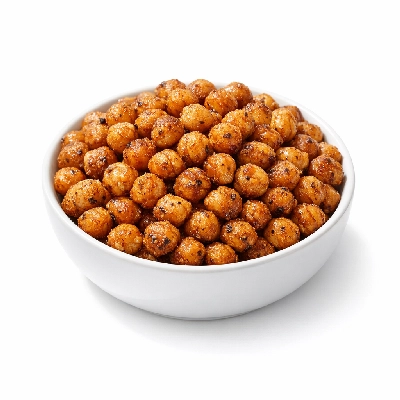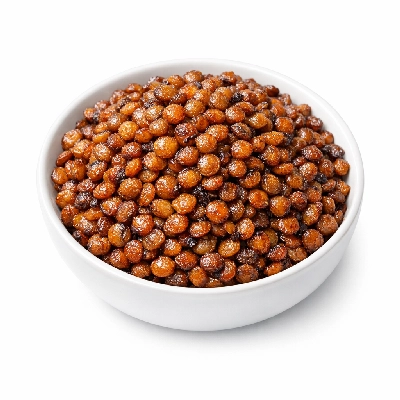
Fried Lentils
Source of Calories
Nutrition Facts
| Nutrient | Amount | % Daily Value |
|---|---|---|
| Total Carbohydrates | 53.61 g | 19% |
| Net Carbohydrates | 35.37 g | 14% |
| Sugars | 8.38 g | 24% |
| Added Sugars | 0 g | 0% |
| Dietary Fiber | 18.24 g | 65% |
| Protein | 20.17 g | 40% |
| Total Fat | 28.42 g | 36% |
| Saturated Fat | 3.93 g | 20% |
| Monounsaturated Fat | 20.15 g | - |
| Polyunsaturated Fat | 3.31 g | - |
| Trans Fat | 0 g | 0% |
| Cholesterol | 0 mg | 0% |
| Vitamins | ||
| Vitamin A | 9.32 mcg | 1% |
| Vitamin C | 14.62 mg | 16% |
| Vitamin D | 0 mcg | 0% |
| Minerals | ||
| Sodium | 2807.85 mg | 122% |
| Potassium | 989.98 mg | 21% |
| Calcium | 106.46 mg | 8% |
| Magnesium | 94.59 mg | 23% |
| Iron | 8.68 mg | 48% |
| Zinc | 2.93 mg | 27% |
% DV refers to how much a single serving of an individually packaged food or supplement contributes nutritionally to your daily diet, based on a 2,000-calorie-a-day diet. Generally, having 5% DV or less of a nutrient per serving is considered low, and 20% DV or more of a nutrient per serving is considered high.
Fat Composition
The suggested total fat consumption should be limited to 30% of total energy intake or less. The type of fat consumed should primarily be unsaturated fatty acids, with no more than 10% of total energy intake coming from saturated fatty acids (about 200 calories on a 2000-calorie diet) and no more than 1% of total energy intake coming from trans-fatty acids.
Vitamin Coverage
Vitamin A
1%
Vitamin C
16%
Vitamin D
0%
Vitamin E
28%
Vitamin K
24%
Vitamin B1
34%
Vitamin B2
15%
Vitamin B3
15%
Vitamin B5
30%
Vitamin B6
36%
Vitamin B7
-
Vitamin B9
0.5%
Vitamin B12
0%
There are 13 essential vitamins required for the body to work properly, which are categorised into two categories: fat-soluble and water-soluble vitamins. Vitamins have a Recommended Dietary Allowance (RDA), provided by the Dietary Reference Intakes (DRIs), which vary by age and sex. The %DV indicates how much one serving contributes to the average recommended daily intake.
Mineral Coverage
Calcium
8%
Iron
48%
Magnesium
23%
Phosphorus
33%
Potassium
21%
Sodium
122%
Zinc
27%
Copper
67%
Manganese
65%
Selenium
14%
Minerals are micronutrients, of which 13 of them are essential to the human body. The Recommended Dietary Allowance includes Calcium (1,300 mg/d), Phosphorus (1,250 mg/d), Potassium (4,700 mg/d), Sodium (2,300 mg/d), Chloride (1,500 mg/d), Magnesium (420 mg/d), Iron (18 mg/d), Zinc (11 mg/d), Copper (0.9 mg/d), Selenium (55 mcg/d), Molybdenum (45 mcg/d), Manganese (2.3 mg/d) and Iodine (150 mcg/d).
Protein Quality
Leucine
1%
Isoleucine
2%
Valine
2%
Lysine
1%
Tryptophan
2%
Threonine
1%
Phenylalanine
2%
Methionine
1%
Histidine
1%
Guidelines recommend a serving of protein with each meal and 1.2-1.6 g of protein per kg of body weight per day.
The data provided by eato.health is for informational purposes only and should not be considered medical advice. Please consult your physician before beginning any diet or nutrition plan.
About
How Long to Burn Off 533 Calories?
*Based on this person: 25-year-old female, 5'7", 144 lbs

Swimming
1 h 18 min

Jogging
1 h 8 min

Cycling
1 h 9 min

Walking
2 h 6 min
The data provided by eato.health is for informational purposes only and should not be considered medical advice. Please consult your physician before beginning any diet or nutrition plan.
FAQ
Per serving, fried lentils have about 133 kcal, 13.4 g carbs, 5.0 g protein, 7.1 g fat, and 4.8 g fiber, eating about 1 serving of legumes a day has been linked with about 8.0 mg/dL lower LDL cholesterol in a meta analysis, but benefits may be negated due to the lentils bring fried, which adds added oil.
They are mainly a carb plus protein food, not a pure protein food. Per serving, they provide about 13.4 g carbs and 5.0 g protein, so they act more like a mixed plant food than a high protein item.
The downsides are added fat and sodium. Per serving, they have about 7.1 g fat and 362 mg sodium, so they may be less heart friendly than boiled or lightly cooked lentils if you eat them often. Some people may also notice bloating, especially if they are not used to legumes or eat a large portion.
Fried lentils may be the better choice if you want more protein and fiber, since this serving gives about 5.0 g protein and 4.8 g fiber, while chickpeas are also nutritious but are often chosen more for texture and crunch than for a clear nutrition advantage. In general, both are legumes, so the healthier choice usually comes down to how much oil and salt were used.
They may help a little, but the effect is probably less clear than with less oily lentil dishes. Per serving, fried lentils still provide about 4.8 g fiber and only 0.3 mg cholesterol. Non-soy legumes also lower LDL by about 8.0 mg/dL on average, so lentils can support cholesterol control, but frying may reduce some of that advantage if the dish becomes much higher in fat or salt.
📚 Health Research & Evidence About This Food
Lentils are a highly nutritious source of dietary fiber and plant-based protein, with polyphenols and various B vitamins, folate, iron, and potassium. Clinical evidence from a randomized controlled trial demonstrates that incorporating lentils into a low glycemic index diet significantly improves glycemic control by reducing hemoglobin A1c values and reduces coronary heart disease risk, primarily due to a decrease in systolic blood pressure, in adults with type 2 diabetes. Harvard Health notes their role in lowering cholesterol and mitigating other factors contributing to heart disease, attributing these benefits to soluble fiber and resistant starch.
1. Isolation and Characterization of Relevant Allergens From Boiled Lentils.
Source: PubMed
Summary: Boiled lentils contain two distinct types of allergens, gamma-vicilin subunits (Len c 1) and a seed-specific biotinylated protein (Len c 2), which are major IgE-binding proteins.
Read More: https://pubmed.ncbi.nlm.nih.gov/11080720/
2. Lentils: Health Benefits, Nutrients per Serving, Preparation Information, and More
Source: WebMD
Summary: Lentils are an excellent source of dietary fiber, lectins, and polyphenols, which collectively contribute to reducing the risk of conditions such as heart disease, obesity, diabetes, and certain cancers.
Read More: https://www.webmd.com/diet/health-benefits-lentils
3. Effect of Legumes as Part of a Low Glycemic Index Diet on Glycemic Control and Cardiovascular Risk Factors in Type 2 Diabetes Mellitus: A Randomized Controlled Trial.
Source: PubMed
Summary: Incorporating legumes, including lentils, into a low glycemic index diet significantly improves glycemic control and reduces the calculated coronary heart disease risk score in individuals with type 2 diabetes.
Read More: https://pubmed.ncbi.nlm.nih.gov/23089999/
4. Legumes: Are They Good for Your Heart? - Harvard Health
Source: Harvard Health, 2026
Summary: Lentils are an excellent source of plant-based protein and are rich in nutrients that help lower cholesterol and mitigate other factors contributing to heart disease.
Read More: https://www.health.harvard.edu/heart-health/legumes-are-they-good-for-your-heart
5. Lentils: Benefits and Nutrition
Source: Medical News Today, 2019
Summary: Lentils are highly nutritious, offering a wide array of health benefits as an accessible and affordable source of high-quality protein and fiber globally.
6. A Blended- Rather Than Whole-Lentil Meal With or Without α-Galactosidase Mildly Increases Healthy Adults' Appetite but Not Their Glycemic Response.
Source: PubMed
Summary: Blending lentils mildly increased appetite but did not affect the glycemic response compared to whole lentils.
Read More: https://pubmed.ncbi.nlm.nih.gov/25411033/