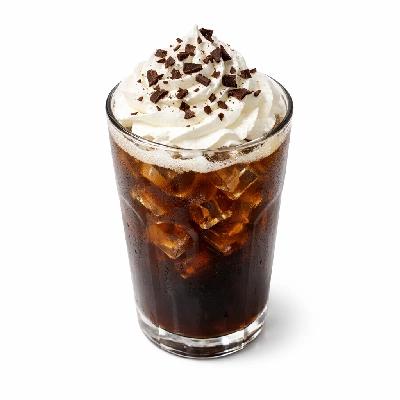
Chocolate Iced Coffee, Whipped Cream
Source of Calories
Nutrition Facts
| Nutrient | Amount | % Daily Value |
|---|---|---|
| Total Carbohydrates | 13.06 g | 5% |
| Net Carbohydrates | 12.57 g | 5% |
| Sugars | 10.19 g | 29% |
| Added Sugars | 9.24 g | 18% |
| Dietary Fiber | 0.49 g | 2% |
| Protein | 1.53 g | 3% |
| Total Fat | 11.09 g | 14% |
| Saturated Fat | 7.01 g | 35% |
| Monounsaturated Fat | 2.82 g | - |
| Polyunsaturated Fat | 0.48 g | - |
| Trans Fat | 0.37 g | 100% |
| Cholesterol | 33.9 mg | 11% |
| Vitamins | ||
| Vitamin A | 123.3 mcg | 14% |
| Vitamin C | 0.22 mg | 0% |
| Vitamin D | 0.47 mcg | 2% |
| Minerals | ||
| Sodium | 26.34 mg | 1% |
| Potassium | 186.63 mg | 4% |
| Calcium | 27.16 mg | 2% |
| Magnesium | 21.4 mg | 5% |
| Iron | 0.45 mg | 2% |
| Zinc | 0.26 mg | 2% |
% DV refers to how much a single serving of an individually packaged food or supplement contributes nutritionally to your daily diet, based on a 2,000-calorie-a-day diet. Generally, having 5% DV or less of a nutrient per serving is considered low, and 20% DV or more of a nutrient per serving is considered high.
Fat Composition
The suggested total fat consumption should be limited to 30% of total energy intake or less. The type of fat consumed should primarily be unsaturated fatty acids, with no more than 10% of total energy intake coming from saturated fatty acids (about 200 calories on a 2000-calorie diet) and no more than 1% of total energy intake coming from trans-fatty acids.
Vitamin Coverage
Vitamin A
14%
Vitamin C
0.2%
Vitamin D
2%
Vitamin E
2%
Vitamin K
1%
Vitamin B1
3%
Vitamin B2
19%
Vitamin B3
3%
Vitamin B5
15%
Vitamin B6
0.7%
Vitamin B7
1%
Vitamin B9
0.4%
Vitamin B12
2%
There are 13 essential vitamins required for the body to work properly, which are categorised into two categories: fat-soluble and water-soluble vitamins. Vitamins have a Recommended Dietary Allowance (RDA), provided by the Dietary Reference Intakes (DRIs), which vary by age and sex. The %DV indicates how much one serving contributes to the average recommended daily intake.
Mineral Coverage
Calcium
2%
Iron
2%
Magnesium
5%
Phosphorus
4%
Potassium
4%
Sodium
1%
Zinc
2%
Copper
11%
Manganese
5%
Selenium
2%
Minerals are micronutrients, of which 13 of them are essential to the human body. The Recommended Dietary Allowance includes Calcium (1,300 mg/d), Phosphorus (1,250 mg/d), Potassium (4,700 mg/d), Sodium (2,300 mg/d), Chloride (1,500 mg/d), Magnesium (420 mg/d), Iron (18 mg/d), Zinc (11 mg/d), Copper (0.9 mg/d), Selenium (55 mcg/d), Molybdenum (45 mcg/d), Manganese (2.3 mg/d) and Iodine (150 mcg/d).
Protein Quality
Leucine
2%
Isoleucine
3%
Valine
3%
Lysine
1%
Tryptophan
6%
Threonine
3%
Phenylalanine
3%
Methionine
3%
Histidine
2%
Guidelines recommend a serving of protein with each meal and 1.2-1.6 g of protein per kg of body weight per day.
The data provided by eato.health is for informational purposes only and should not be considered medical advice. Please consult your physician before beginning any diet or nutrition plan.
About
How Long to Burn Off 157 Calories?
*Based on this person: 25-year-old female, 5'7", 144 lbs

Swimming
23 min

Jogging
20 min

Cycling
21 min

Walking
37 min
The data provided by eato.health is for informational purposes only and should not be considered medical advice. Please consult your physician before beginning any diet or nutrition plan.
📚 Health Research & Evidence About This Food
Iced coffee contains caffeine, with its concentration influenced by factors such as bean type, roast, and brewing method, according to Medical News Today. While moderate caffeine intake is generally considered safe for healthy adults and may be associated with enhanced alertness and a lower risk of arrhythmias, individual responses can vary significantly due to genetic factors, as noted by NCBI. High consumption, however, may lead to adverse effects such as anxiety or sleep disturbances, as indicated by the American Heart Association.
1. The Effect of Time, Roasting Temperature, and Grind Size on Caffeine and Chlorogenic Acid Concentrations in Cold Brew Coffee
Source: Nature, 2017
Summary: Iced coffee, specifically cold brew, exhibits varying concentrations of caffeine and 3-chlorogenic acid depending on roast temperature and brewing duration, with equilibrium reached within 6-7 hours, challenging claims of lower acidity compared to hot brew.
Read More: https://www.nature.com/articles/s41598-017-18247-4
2. Caffeine in Tea Vs. Coffee: How Do They Compare?
Source: Healthline, 2019
Summary: Iced coffee, is identified as a high-caffeine beverage, with caffeine acting as a stimulant linked to enhanced alertness and metabolism, though excessive intake may lead to anxiety and sleep difficulties.
Read More: https://www.healthline.com/nutrition/caffeine-in-tea-vs-coffee
3. Caffeine Effects on the Cardiovascular System - Caffeine in Food and Dietary Supplements: Examining Safety - Ncbi Bookshelf
Source: NCBI
Summary: Iced coffee cardiovascular health is influenced by caffeine's effects on vascular function and arrhythmia risk, with individual responses varying based on genetic factors, and rapid consumption of cold beverages potentially leading to higher peak plasma caffeine concentrations.
4. How Much Caffeine Is in a Cup of Coffee?
Source: Medical News Today, 2019
Summary: Iced coffee, particularly cold brew, contains varying amounts of caffeine, which differs from regular brewed coffee served over ice, with overall caffeine content influenced by bean type, roast, and brewing method.
5. Is Caffeine a Friend or Foe?
Source: American Heart Association, 2022
Summary: Iced coffee cardiovascular health is indirectly addressed through a discussion of caffeine's general effects, noting that moderate caffeine intake from sources like coffee is generally not detrimental to health, but individual responses vary, and those with abnormal heart rhythms or sleep issues should consider their intake.
Read More: https://www.heart.org/en/news/2022/08/08/is-caffeine-a-friend-or-foe
6. Association of Coffee, Tea, and Caffeine Consumption With All-Cause Risk and Specific Mortality for Cardiovascular Disease Patients.
Source: PubMed
Summary: Iced coffee cardiovascular health is directly relevant to this study's aim, which examines the relationship between coffee, tea, and caffeine consumption and the risk of all-cause death and cardiovascular disease mortality in patients with existing cardiovascular disease.
Read More: https://pubmed.ncbi.nlm.nih.gov/35811963/