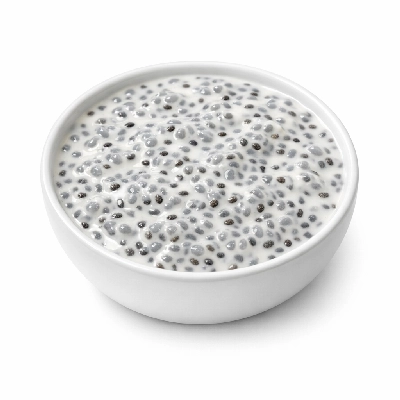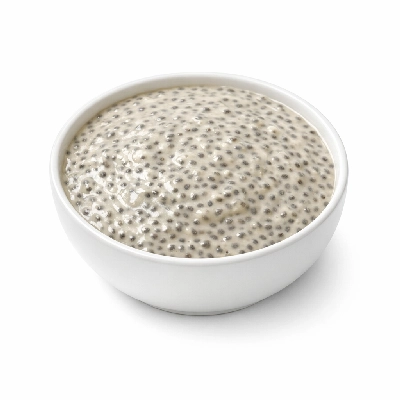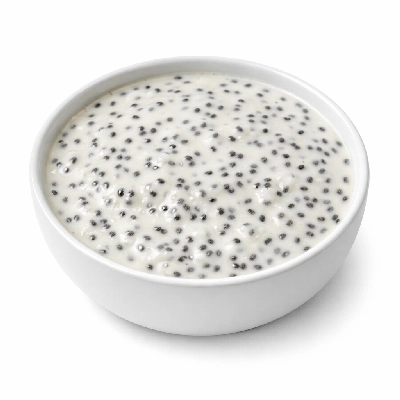
Chia Seeds in Almond Milk
Source of Calories
Nutrition Facts
| Nutrient | Amount | % Daily Value |
|---|---|---|
| Total Carbohydrates | 11.11 g | 4% |
| Net Carbohydrates | 1.85 g | 1% |
| Sugars | 0 g | 0% |
| Added Sugars | 0 g | 0% |
| Dietary Fiber | 9.26 g | 33% |
| Protein | 4.97 g | 10% |
| Total Fat | 9.88 g | 13% |
| Saturated Fat | 0.8 g | 4% |
| Monounsaturated Fat | 2.05 g | - |
| Polyunsaturated Fat | 6.18 g | - |
| Trans Fat | 0.03 g | 100% |
| Cholesterol | 0 mg | 0% |
| Vitamins | ||
| Vitamin A | 153.89 mcg | 17% |
| Vitamin C | 0.38 mg | 0% |
| Vitamin D | 5 mcg | 25% |
| Minerals | ||
| Sodium | 173.84 mg | 8% |
| Potassium | 257.68 mg | 5% |
| Calcium | 601.44 mg | 46% |
| Magnesium | 95.4 mg | 23% |
| Iron | 2.57 mg | 14% |
| Zinc | 1.1 mg | 10% |
% DV refers to how much a single serving of an individually packaged food or supplement contributes nutritionally to your daily diet, based on a 2,000-calorie-a-day diet. Generally, having 5% DV or less of a nutrient per serving is considered low, and 20% DV or more of a nutrient per serving is considered high.
Fat Composition
The suggested total fat consumption should be limited to 30% of total energy intake or less. The type of fat consumed should primarily be unsaturated fatty acids, with no more than 10% of total energy intake coming from saturated fatty acids (about 200 calories on a 2000-calorie diet) and no more than 1% of total energy intake coming from trans-fatty acids.
Vitamin Coverage
Vitamin A
17%
Vitamin C
0.4%
Vitamin D
25%
Vitamin E
52%
Vitamin K
-
Vitamin B1
12%
Vitamin B2
3%
Vitamin B3
13%
Vitamin B5
-
Vitamin B6
-
Vitamin B7
-
Vitamin B9
3%
Vitamin B12
0%
There are 13 essential vitamins required for the body to work properly, which are categorised into two categories: fat-soluble and water-soluble vitamins. Vitamins have a Recommended Dietary Allowance (RDA), provided by the Dietary Reference Intakes (DRIs), which vary by age and sex. The %DV indicates how much one serving contributes to the average recommended daily intake.
Mineral Coverage
Calcium
46%
Iron
14%
Magnesium
23%
Phosphorus
18%
Potassium
5%
Sodium
8%
Zinc
10%
Copper
25%
Manganese
28%
Selenium
24%
Minerals are micronutrients, of which 13 of them are essential to the human body. The Recommended Dietary Allowance includes Calcium (1,300 mg/d), Phosphorus (1,250 mg/d), Potassium (4,700 mg/d), Sodium (2,300 mg/d), Chloride (1,500 mg/d), Magnesium (420 mg/d), Iron (18 mg/d), Zinc (11 mg/d), Copper (0.9 mg/d), Selenium (55 mcg/d), Molybdenum (45 mcg/d), Manganese (2.3 mg/d) and Iodine (150 mcg/d).
Protein Quality
Leucine
11%
Isoleucine
14%
Valine
14%
Lysine
9%
Tryptophan
30%
Threonine
12%
Phenylalanine
21%
Methionine
21%
Histidine
13%
Guidelines recommend a serving of protein with each meal and 1.2-1.6 g of protein per kg of body weight per day.
The data provided by eato.health is for informational purposes only and should not be considered medical advice. Please consult your physician before beginning any diet or nutrition plan.
About
How Long to Burn Off 147 Calories?
*Based on this person: 25-year-old female, 5'7", 144 lbs

Swimming
22 min

Jogging
19 min

Cycling
19 min

Walking
35 min
The data provided by eato.health is for informational purposes only and should not be considered medical advice. Please consult your physician before beginning any diet or nutrition plan.
FAQ
For the best texture of a smooth, pudding-like consistency, soaking your chia seeds in almond milk needs about 8-12 hours, or overnight. However, for a time-crunch, 2 hours works enough to ensure that the chia seeds have absorbed some moisture.
The research is still mixed. One 2023 trial suggested chia may improve HDL, while a 2024 meta analysis found no significant overall change in LDL, HDL, total cholesterol, or triglycerides across pooled trials.
No. What they may do is support better cardiovascular health over time because chia contains fiber and plant omega 3 fats. Chia seed supplementation was associated with modest improvements in total cholesterol, but is very different from removing plaque directly.
Chia seeds in almond milk may support metabolic health in some people, but the evidence is still early and stronger for specific groups, such as people with fatty liver disease, not for general liver “detox.” In one study of people with NAFLD, chia supplementation was linked to regression of Non-alcoholic fatty liver disease in about 52% of participants, but that does not mean chia milk detoxes the liver in healthy people.
Yes, they can in rare cases, especially if eaten dry or by someone with swallowing problems. Chia seeds absorb a lot of liquid and expand quickly, and a reported esophageal impaction case showed they may become stuck if consumed improperly. It is usually safer to soak them well first and start with moderate portions.
📚 Health Research & Evidence About This Food
Research, including systematic reviews, demonstrates that chia seeds can positively impact metabolic factors such as blood pressure, body composition, and glycemic control. Rich in fiber, omega-3 fatty acids, and antioxidants, chia seeds are also recognized for supporting cardiovascular health, aiding digestive health, and promoting satiety, which may assist with weight management, according to Cleveland Clinic and the American Heart Association.
1. 8 Chia Seed Benefits
Source: Cleveland Clinic
Summary: Chia seeds are packed with fiber, antioxidants, omega-3 fatty acids, and protein, offering benefits for gut health, constipation relief, potential weight management, and possibly contributing to the prevention of chronic conditions.
Read More: https://health.clevelandclinic.org/benefits-of-chia-seeds
2. The Effect of Chia Seed on Blood Pressure, Body Composition, and Glycemic Control: A Grade-Assessed Systematic Review and Dose-Response Meta-Analysis of Randomized Controlled Trials.
Source: PubMed
Summary: Chia seeds have demonstrated positive effects on metabolic factors, including blood pressure, body composition, and glycemic control, as evidenced by a GRADE-assessed systematic review and dose-response meta-analysis of randomized controlled trials.
Read More: https://pubmed.ncbi.nlm.nih.gov/39225983/
3. Know the Flax (and the Chia): A Little Seed May Be What Your Diet Needs
Source: American Heart Association, 2019
Summary: Chia seeds provide alpha-linolenic acid (ALA) for heart health and can lower blood sugar response, but require careful consumption due to high fiber, swelling properties, caloric density, and potential issues for those with irritable bowel disease or diverticulitis.
4. A Chia Pet for Diabetes? - Harvard Health
Source: Harvard Health, 2010
Summary: Chia seeds, specifically Salba, show preliminary potential to help people with diabetes control blood sugar and protect their hearts, though their benefits are part of a broader recommendation to increase whole grain consumption.
Read More: https://www.health.harvard.edu/blog/a-chia-pet-for-diabetes-20101217923