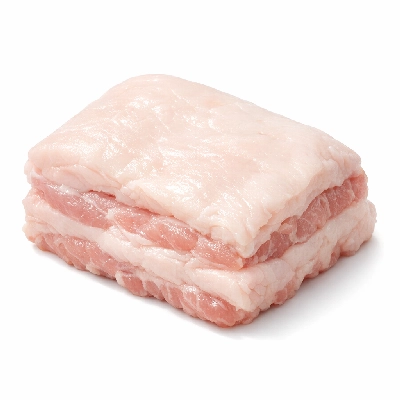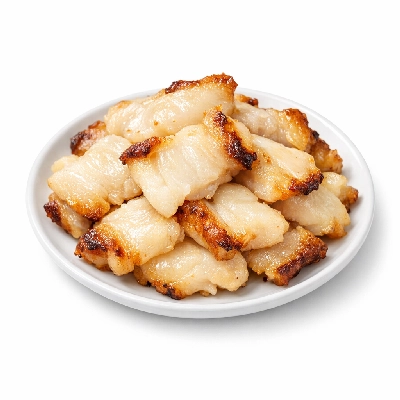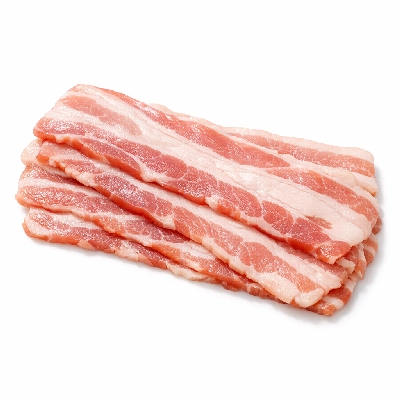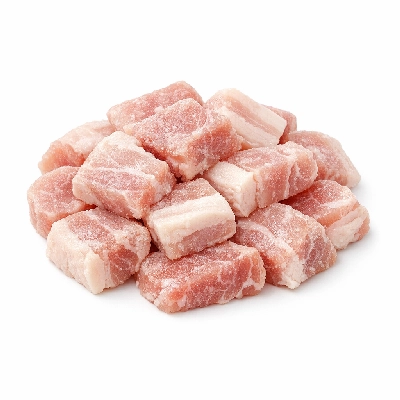
Salt Cured Raw Pork
Source of Calories
Nutrition Facts
| Nutrient | Amount | % Daily Value |
|---|---|---|
| Total Carbohydrates | 0 g | 0% |
| Net Carbohydrates | 0 g | 0% |
| Sugars | 0 g | 0% |
| Added Sugars | No data | - |
| Dietary Fiber | 0 g | 0% |
| Protein | 11.46 g | 23% |
| Total Fat | 182.74 g | 234% |
| Saturated Fat | 66.69 g | 333% |
| Monounsaturated Fat | 86.12 g | - |
| Polyunsaturated Fat | 21.34 g | - |
| Trans Fat | No data | - |
| Cholesterol | 195.22 mg | 65% |
| Vitamins | ||
| Vitamin A | 0 mcg | 0% |
| Vitamin C | 0 mg | 0% |
| Vitamin D | 0.51 mcg | 3% |
| Minerals | ||
| Sodium | 6092.68 mg | 265% |
| Potassium | 149.82 mg | 3% |
| Calcium | 13.62 mg | 1% |
| Magnesium | 15.89 mg | 4% |
| Iron | 1 mg | 6% |
| Zinc | 2.04 mg | 19% |
% DV refers to how much a single serving of an individually packaged food or supplement contributes nutritionally to your daily diet, based on a 2,000-calorie-a-day diet. Generally, having 5% DV or less of a nutrient per serving is considered low, and 20% DV or more of a nutrient per serving is considered high.
Fat Composition
The suggested total fat consumption should be limited to 30% of total energy intake or less. The type of fat consumed should primarily be unsaturated fatty acids, with no more than 10% of total energy intake coming from saturated fatty acids (about 200 calories on a 2000-calorie diet) and no more than 1% of total energy intake coming from trans-fatty acids.
Vitamin Coverage
Vitamin A
0%
Vitamin C
0%
Vitamin D
3%
Vitamin E
0%
Vitamin K
0%
Vitamin B1
41%
Vitamin B2
11%
Vitamin B3
23%
Vitamin B5
9%
Vitamin B6
11%
Vitamin B7
-
Vitamin B9
0.6%
Vitamin B12
27%
There are 13 essential vitamins required for the body to work properly, which are categorised into two categories: fat-soluble and water-soluble vitamins. Vitamins have a Recommended Dietary Allowance (RDA), provided by the Dietary Reference Intakes (DRIs), which vary by age and sex. The %DV indicates how much one serving contributes to the average recommended daily intake.
Mineral Coverage
Calcium
1%
Iron
6%
Magnesium
4%
Phosphorus
9%
Potassium
3%
Sodium
265%
Zinc
19%
Copper
13%
Manganese
0.5%
Selenium
24%
Minerals are micronutrients, of which 13 of them are essential to the human body. The Recommended Dietary Allowance includes Calcium (1,300 mg/d), Phosphorus (1,250 mg/d), Potassium (4,700 mg/d), Sodium (2,300 mg/d), Chloride (1,500 mg/d), Magnesium (420 mg/d), Iron (18 mg/d), Zinc (11 mg/d), Copper (0.9 mg/d), Selenium (55 mcg/d), Molybdenum (45 mcg/d), Manganese (2.3 mg/d) and Iodine (150 mcg/d).
Protein Quality
Leucine
27%
Isoleucine
23%
Valine
33%
Lysine
36%
Tryptophan
11%
Threonine
27%
Phenylalanine
37%
Methionine
26%
Histidine
13%
Guidelines recommend a serving of protein with each meal and 1.2-1.6 g of protein per kg of body weight per day.
The data provided by eato.health is for informational purposes only and should not be considered medical advice. Please consult your physician before beginning any diet or nutrition plan.
About
How Long to Burn Off 1698 Calories?
*Based on this person: 25-year-old female, 5'7", 144 lbs

Swimming
4 h 9 min

Jogging
3 h 35 min

Cycling
3 h 40 min

Walking
6 h 39 min
The data provided by eato.health is for informational purposes only and should not be considered medical advice. Please consult your physician before beginning any diet or nutrition plan.
FAQ
It can be very heavy in sodium and fat, so it may be one of the less heart friendly pork options if eaten often. Per serving, it contains about 1,698 kcal, 182.74 g fat, 66.69 g saturated fat, 195.22 mg cholesterol, and 6,092.68 mg sodium, which is far above a full day of sodium for most people. The biggest concern is usually the sodium and saturated fat load, not carbs (it has 0 g carbs).
Usually, uncured raw pork is the healthier baseline, especially for sodium. For example, a raw pork belly weighing 1 oz has about 147 kcal, 15.03 g fat, 5.48 g saturated fat, and only 9.07 mg sodium, while the cured salt pork has much higher levels in sodium because it is salt cured.
It depends on the cut, not just the animal. A lean raw beef top sirloin entry has about 38 kcal and 1.31 g fat per 1 oz, while a raw pork belly entry has about 147 kcal and 15.03 g fat per 1 oz, so in that comparison the pork cut is much more calorie dense. Lean pork cuts can be closer to lean beef, but fatty pork cuts can be much higher.
"Cured with salt" can sometimes mean mainly salt curing, but many processed meats use curing agents like nitrite or nitrate, and health agencies describe processed meats as meats preserved by curing, salting, smoking, or chemical preservatives. The safest way to know is to check the ingredient list for terms like sodium nitrite, sodium nitrate, or celery powder/juice (a natural nitrate source).
IARC classifies processed meat as Group 1 carcinogenic to humans (meaning the evidence that it can cause cancer is strong), and WHO notes the clearest link is with colorectal cancer. A commonly cited estimate is that eating 50 g of processed meat daily is associated with about an 18% higher risk of colorectal cancer.
📚 Health Research & Evidence About This Food
Processed pork, particularly due to nitrite and its interaction with total sodium intake, is linked to increased diastolic blood pressure, as indicated by PubMed research in a study of adult processed meat consumers. Frequent consumption of cured meats, including pork, is also associated with an increased risk of newly diagnosed Chronic Obstructive Pulmonary Disease among women who smoke, potentially due to nitrites generating oxidative-nitrative stress. As a red meat, pork is additionally associated with an elevated risk of cancer, especially colorectal cancer, according to the American Cancer Society, partly due to heme iron content.
1. Red and Processed Meat and Cancer
Source: American Cancer Society, 2025
Summary: Pork, as a red meat, is associated with an elevated risk of cancer, particularly colorectal cancer, due to factors like heme iron content and saturated fats.
2. Nitrite and Nitrate Intake From Processed Meat Is Associated With Elevated Diastolic Blood Pressure (Dbp).
Source: PubMed
Summary: Diastolic blood pressure increased with higher nitrite intake from processed meat, and this effect was significantly amplified by the interaction with total sodium intake.
Read More: https://pubmed.ncbi.nlm.nih.gov/37023524/
3. Meals Based on Vegetable Protein Sources (Beans and Peas) Are More Satiating Than Meals Based on Animal Protein Sources (Veal and Pork) - a Randomized Cross-Over Meal Test Study.
Source: PubMed
Summary: High-protein animal meat meals, including pork, resulted in higher composite appetite scores, hunger, and prospective food consumption, and lower fullness compared to high-protein legume meals.
Read More: https://pubmed.ncbi.nlm.nih.gov/27765144/
4. Consumption of Cured Meats and Prospective Risk of Chronic Obstructive Pulmonary Disease in Women.
Source: PubMed
Summary: Frequent consumption of cured meats is associated with an increased risk of newly diagnosed Chronic Obstructive Pulmonary Disease among women who smoke.
Read More: https://pubmed.ncbi.nlm.nih.gov/18400725/