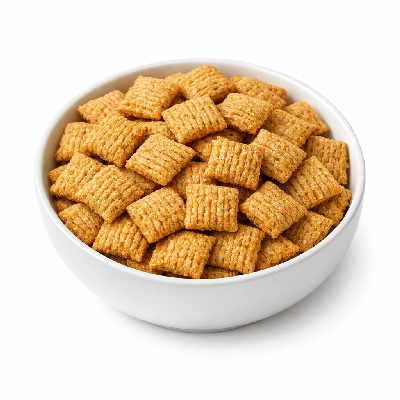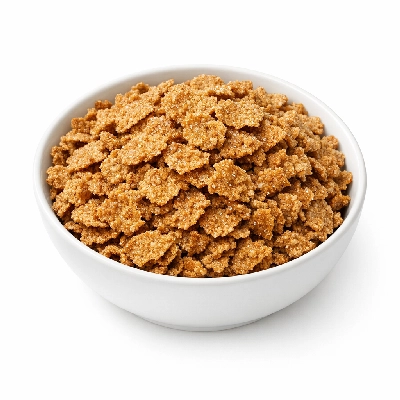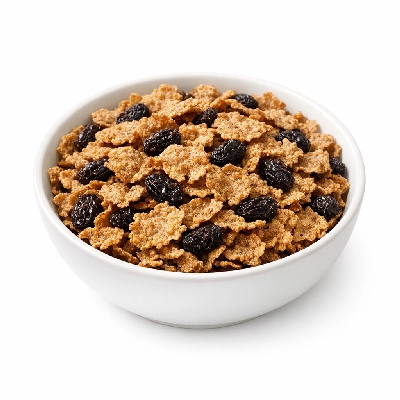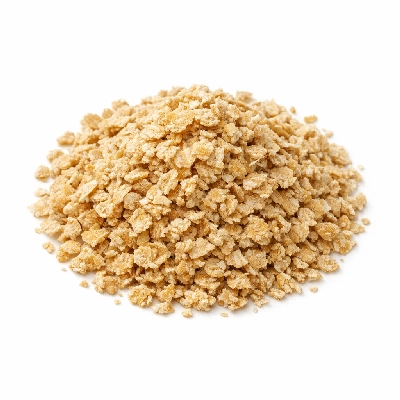
Quaker Ready-to-eat Oat Bran Cereal
Source of Calories
Nutrition Facts
| Nutrient | Amount | % Daily Value |
|---|---|---|
| Total Carbohydrates | 42.69 g | 16% |
| Net Carbohydrates | 36.88 g | 15% |
| Sugars | 9.31 g | 27% |
| Added Sugars | No data | - |
| Dietary Fiber | 5.81 g | 21% |
| Protein | 7.06 g | 14% |
| Total Fat | 2.91 g | 4% |
| Saturated Fat | 0.52 g | 3% |
| Monounsaturated Fat | 0.9 g | - |
| Polyunsaturated Fat | 1.16 g | - |
| Trans Fat | 0 g | 0% |
| Cholesterol | 0 mg | 0% |
| Vitamins | ||
| Vitamin A | 204.94 mcg | 23% |
| Vitamin C | 6.56 mg | 7% |
| Vitamin D | 0 mcg | 0% |
| Minerals | ||
| Sodium | 208.05 mg | 9% |
| Potassium | 249.66 mg | 5% |
| Calcium | 137.94 mg | 11% |
| Magnesium | 95.76 mg | 23% |
| Iron | 17.04 mg | 95% |
| Zinc | 4.4 mg | 40% |
% DV refers to how much a single serving of an individually packaged food or supplement contributes nutritionally to your daily diet, based on a 2,000-calorie-a-day diet. Generally, having 5% DV or less of a nutrient per serving is considered low, and 20% DV or more of a nutrient per serving is considered high.
Fat Composition
The suggested total fat consumption should be limited to 30% of total energy intake or less. The type of fat consumed should primarily be unsaturated fatty acids, with no more than 10% of total energy intake coming from saturated fatty acids (about 200 calories on a 2000-calorie diet) and no more than 1% of total energy intake coming from trans-fatty acids.
Vitamin Coverage
Vitamin A
23%
Vitamin C
7%
Vitamin D
0%
Vitamin E
12%
Vitamin K
1%
Vitamin B1
34%
Vitamin B2
36%
Vitamin B3
35%
Vitamin B5
10%
Vitamin B6
30%
Vitamin B7
-
Vitamin B9
177%
Vitamin B12
0%
There are 13 essential vitamins required for the body to work properly, which are categorised into two categories: fat-soluble and water-soluble vitamins. Vitamins have a Recommended Dietary Allowance (RDA), provided by the Dietary Reference Intakes (DRIs), which vary by age and sex. The %DV indicates how much one serving contributes to the average recommended daily intake.
Mineral Coverage
Calcium
11%
Iron
95%
Magnesium
23%
Phosphorus
24%
Potassium
5%
Sodium
9%
Zinc
40%
Copper
20%
Manganese
95%
Selenium
7%
Minerals are micronutrients, of which 13 of them are essential to the human body. The Recommended Dietary Allowance includes Calcium (1,300 mg/d), Phosphorus (1,250 mg/d), Potassium (4,700 mg/d), Sodium (2,300 mg/d), Chloride (1,500 mg/d), Magnesium (420 mg/d), Iron (18 mg/d), Zinc (11 mg/d), Copper (0.9 mg/d), Selenium (55 mcg/d), Molybdenum (45 mcg/d), Manganese (2.3 mg/d) and Iodine (150 mcg/d).
The data provided by eato.health is for informational purposes only and should not be considered medical advice. Please consult your physician before beginning any diet or nutrition plan.
About
How Long to Burn Off 212 Calories?
*Based on this person: 25-year-old female, 5'7", 144 lbs

Swimming
32 min

Jogging
27 min

Cycling
28 min

Walking
50 min
The data provided by eato.health is for informational purposes only and should not be considered medical advice. Please consult your physician before beginning any diet or nutrition plan.
📚 Health Research & Evidence About This Food
Research demonstrates that oat bran cereal, rich in beta-glucan soluble fiber, effectively contributes to lowering cholesterol levels and supporting cardiovascular health. This key fiber, according to Healthline and WebMD, also helps manage blood sugar by reducing post-meal spikes and promotes satiety, which may assist with weight management.
1. Oatmeal: Health Benefits, Nutrients per Serving, Preparation Information, and More
Source: WebMD
Summary: Oat bran cereal, derived from oatmeal, offers numerous health benefits including improved gut health, lower cholesterol, enhanced heart health, better blood sugar control, and support for weight management, primarily due to its beta-glucan soluble fiber and unique antioxidants.
Read More: https://www.webmd.com/diet/health-benefits-oatmeal
2. 9 Health Benefits of Eating Oats and Oatmeal
Source: Healthline
Summary: Oat bran cereal, derived from oats, provides numerous evidence-based health benefits, including support for weight loss, lower blood sugar levels, reduced risk of heart disease through cholesterol reduction, and improved satiety, largely attributed to its rich content of beta-glucan soluble fiber and antioxidants.
Read More: https://www.healthline.com/nutrition/9-benefits-oats-oatmeal
3. Randomized, Controlled, Crossover Trial of Oat Bran in Hypercholesterolemic Subjects.
Source: PubMed
Summary: Oat bran cereal was investigated in a randomized, controlled, crossover trial to assess its cholesterol-lowering benefits in hypercholesterolemic subjects, addressing a gap in convincing controlled studies on free-living individuals despite supportive animal and metabolic ward research.
Read More: https://pubmed.ncbi.nlm.nih.gov/1660530/
4. Rheological Properties of Beta-Glucans in Oat Groats and Their Cholesterol-Lowering Implications
Source: USDA ARS
Summary: Oat bran cereal, through its beta-glucans, has been indicated in studies to lower blood cholesterol and reduce the risk of heart disease, with research focusing on the rheological properties of these beta-glucans from various oat groat preparations.
Read More: https://www.ars.usda.gov/research/publications/publication/?seqNo115=85911
5. Effect of 6 Weeks' Consumption of β-Glucan-Rich Oat Products on Cholesterol Levels in Mildly Hypercholesterolaemic Overweight Adults
Source: Cambridge University Press
Summary: Oat bran cereal, delivered in β-glucan-rich products, showed a trend towards greater LDL-cholesterol reduction in an exploratory responder analysis of mildly hypercholesterolaemic overweight adults, with its physiological activity critically dependent on the physico-chemical properties and soluble β-glucan dose rather than total content.
6. The Hypocholesterolemic Effects of Beta-Glucan in Oatmeal and Oat Bran. A Dose-Controlled Study.
Source: PubMed
Summary: Oat bran cereal, rich in water-soluble fiber beta-glucan, has been studied in dose-controlled investigations as a dietary therapy for its hypocholesterolemic effects in individuals with hypercholesterolemia.
Read More: https://pubmed.ncbi.nlm.nih.gov/2005733/