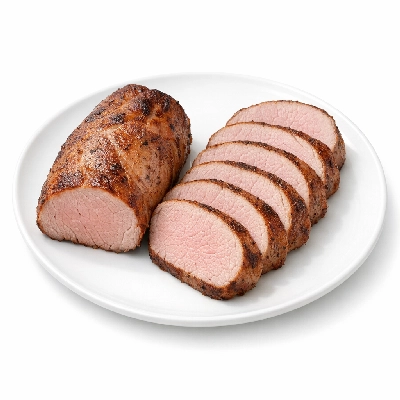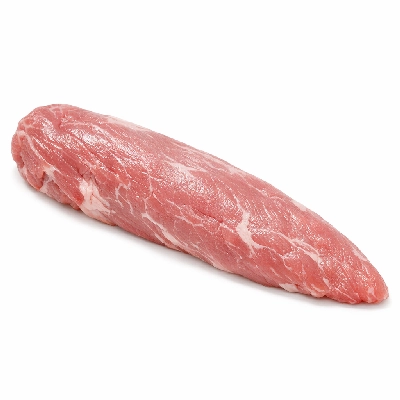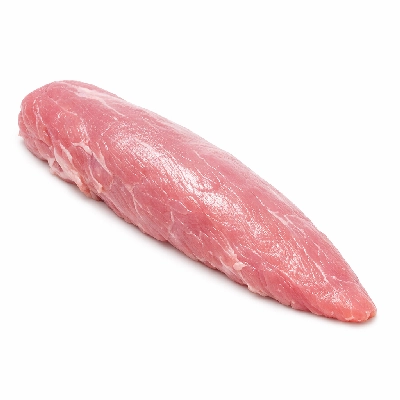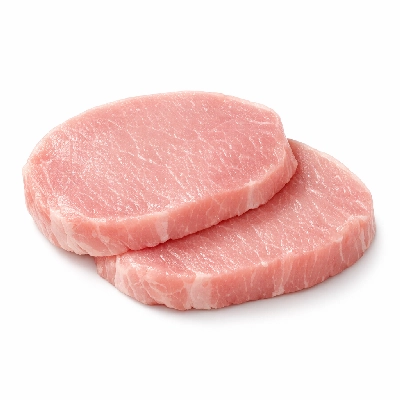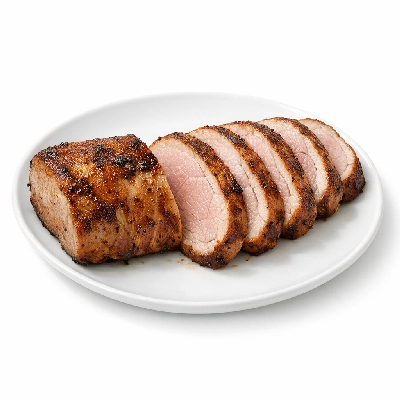
Pork Tenderloin, Roasted, Lean Meat and Fat
Source of Calories
Nutrition Facts
| Nutrient | Amount | % Daily Value |
|---|---|---|
| Total Carbohydrates | 0.26 g | 0% |
| Net Carbohydrates | 0.26 g | 0% |
| Sugars | 0 g | 0% |
| Added Sugars | No data | - |
| Dietary Fiber | 0 g | 0% |
| Protein | 18.28 g | 37% |
| Total Fat | 3.15 g | 4% |
| Saturated Fat | 1.08 g | 5% |
| Monounsaturated Fat | 1.21 g | - |
| Polyunsaturated Fat | 0.45 g | - |
| Trans Fat | 0.03 g | 100% |
| Cholesterol | 48.45 mg | 16% |
| Vitamins | ||
| Vitamin A | 0 mcg | 0% |
| Vitamin C | 0 mg | 0% |
| Vitamin D | 0.19 mcg | 1% |
| Minerals | ||
| Sodium | 195.5 mg | 9% |
| Potassium | 478.55 mg | 10% |
| Calcium | 4.25 mg | 0% |
| Magnesium | 21.25 mg | 5% |
| Iron | 0.82 mg | 5% |
| Zinc | 1.69 mg | 15% |
% DV refers to how much a single serving of an individually packaged food or supplement contributes nutritionally to your daily diet, based on a 2,000-calorie-a-day diet. Generally, having 5% DV or less of a nutrient per serving is considered low, and 20% DV or more of a nutrient per serving is considered high.
Fat Composition
The suggested total fat consumption should be limited to 30% of total energy intake or less. The type of fat consumed should primarily be unsaturated fatty acids, with no more than 10% of total energy intake coming from saturated fatty acids (about 200 calories on a 2000-calorie diet) and no more than 1% of total energy intake coming from trans-fatty acids.
Vitamin Coverage
Vitamin A
0%
Vitamin C
0%
Vitamin D
1%
Vitamin E
0.4%
Vitamin K
0%
Vitamin B1
56%
Vitamin B2
23%
Vitamin B3
39%
Vitamin B5
14%
Vitamin B6
30%
Vitamin B7
-
Vitamin B9
0%
Vitamin B12
17%
There are 13 essential vitamins required for the body to work properly, which are categorised into two categories: fat-soluble and water-soluble vitamins. Vitamins have a Recommended Dietary Allowance (RDA), provided by the Dietary Reference Intakes (DRIs), which vary by age and sex. The %DV indicates how much one serving contributes to the average recommended daily intake.
Mineral Coverage
Calcium
0.3%
Iron
5%
Magnesium
5%
Phosphorus
21%
Potassium
10%
Sodium
9%
Zinc
15%
Copper
10%
Manganese
0.4%
Selenium
70%
Minerals are micronutrients, of which 13 of them are essential to the human body. The Recommended Dietary Allowance includes Calcium (1,300 mg/d), Phosphorus (1,250 mg/d), Potassium (4,700 mg/d), Sodium (2,300 mg/d), Chloride (1,500 mg/d), Magnesium (420 mg/d), Iron (18 mg/d), Zinc (11 mg/d), Copper (0.9 mg/d), Selenium (55 mcg/d), Molybdenum (45 mcg/d), Manganese (2.3 mg/d) and Iodine (150 mcg/d).
Protein Quality
Leucine
53%
Isoleucine
68%
Valine
57%
Lysine
64%
Tryptophan
55%
Threonine
59%
Phenylalanine
67%
Methionine
76%
Histidine
81%
Guidelines recommend a serving of protein with each meal and 1.2-1.6 g of protein per kg of body weight per day.
The data provided by eato.health is for informational purposes only and should not be considered medical advice. Please consult your physician before beginning any diet or nutrition plan.
About
How Long to Burn Off 103 Calories?
*Based on this person: 25-year-old female, 5'7", 144 lbs

Swimming
16 min

Jogging
13 min

Cycling
14 min

Walking
25 min
The data provided by eato.health is for informational purposes only and should not be considered medical advice. Please consult your physician before beginning any diet or nutrition plan.
📚 Health Research & Evidence About This Food
Pork tenderloin is a lean and efficient source of high-quality protein, providing a complete profile of essential amino acids crucial for growth and repair, according to Nature, and pork loin, of which tenderloin is a type, has shown high Digestible Indispensable Amino Acid Scores when appropriately heated. However, pork, as a red meat, is linked to an increased risk of cancer, particularly colorectal cancer, due to factors like heme iron and carcinogens formed during processing, with the American Cancer Society advising consumers to frequently choose alternative protein sources.
1. Meat, Poultry & Seafood (Food Safety for Moms-To-Be)
Source: FDA, 2024
Summary: Pork should be cooked to a safe internal temperature for roasts, steaks, and chops, with a rest time, or for ground pork, to ensure safety during pregnancy.
Read More: https://www.fda.gov/food/people-risk-foodborne-illness/meat-poultry-seafood-food-safety-moms-be
2. Heart-Healthy Living - Choose Heart-Healthy Foods
Source: NHLBI, NIH, 2025
Summary: Choosing leaner, lower-fat, and skinless meats is recommended as part of a heart-healthy eating plan to limit saturated fat intake.
Read More: https://www.nhlbi.nih.gov/health/heart-healthy-living/healthy-foods
3. Pork Products Have Digestible Indispensable Amino Acid Scores (Diaas) That Are Greater Than 100 When Determined in Pigs, but Processing Does Not Always Increase Diaas.
Source: PubMed
Summary: Loin heated to an appropriate temperature showed the highest Digestible Indispensable Amino Acid Scores (DIAAS) for young children among the tested pork products.
Read More: https://pubmed.ncbi.nlm.nih.gov/31758187/
4. Red and Processed Meat and Cancer
Source: American Cancer Society, 2025
Summary: Pork consumption is linked to an increased risk of cancer, particularly colorectal cancer, due to factors like heme iron and carcinogens formed during processing.
5. Beyond Red and White: Pork’S Nutritional Secrets Revealed
Source: Nature
Summary: Pork, particularly lean cuts like tenderloin, is a unique and efficient source of high-quality protein and essential vitamins, providing a complete profile of essential amino acids crucial for the body's growth and repair processes.
Read More: https://www.nature.com/articles/d42473-025-00215-6