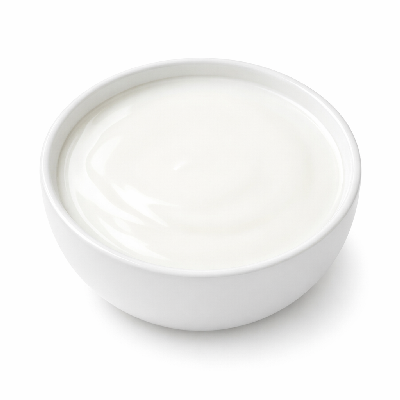
Plain Greek Yogurt, Nonfat
Source of Calories
Nutrition Facts
| Nutrient | Amount | % Daily Value |
|---|---|---|
| Total Carbohydrates | 6.12 g | 2% |
| Net Carbohydrates | 6.12 g | 2% |
| Sugars | 5.51 g | 16% |
| Added Sugars | 0 g | 0% |
| Dietary Fiber | 0 g | 0% |
| Protein | 17.32 g | 35% |
| Total Fat | 0.66 g | 1% |
| Saturated Fat | 0.2 g | 1% |
| Monounsaturated Fat | 0.09 g | - |
| Polyunsaturated Fat | 0.02 g | - |
| Trans Fat | 0.01 g | 100% |
| Cholesterol | 8.5 mg | 3% |
| Vitamins | ||
| Vitamin A | 1.7 mcg | 0% |
| Vitamin C | 0 mg | 0% |
| Vitamin D | 0 mcg | 0% |
| Minerals | ||
| Sodium | 61.2 mg | 3% |
| Potassium | 239.7 mg | 5% |
| Calcium | 187 mg | 14% |
| Magnesium | 18.7 mg | 4% |
| Iron | 0.12 mg | 1% |
| Zinc | 0.88 mg | 8% |
% DV refers to how much a single serving of an individually packaged food or supplement contributes nutritionally to your daily diet, based on a 2,000-calorie-a-day diet. Generally, having 5% DV or less of a nutrient per serving is considered low, and 20% DV or more of a nutrient per serving is considered high.
Fat Composition
The suggested total fat consumption should be limited to 30% of total energy intake or less. The type of fat consumed should primarily be unsaturated fatty acids, with no more than 10% of total energy intake coming from saturated fatty acids (about 200 calories on a 2000-calorie diet) and no more than 1% of total energy intake coming from trans-fatty acids.
Vitamin Coverage
Vitamin A
0.2%
Vitamin C
0%
Vitamin D
0%
Vitamin E
0.1%
Vitamin K
0%
Vitamin B1
3%
Vitamin B2
36%
Vitamin B3
2%
Vitamin B5
11%
Vitamin B6
6%
Vitamin B7
-
Vitamin B9
3%
Vitamin B12
53%
There are 13 essential vitamins required for the body to work properly, which are categorised into two categories: fat-soluble and water-soluble vitamins. Vitamins have a Recommended Dietary Allowance (RDA), provided by the Dietary Reference Intakes (DRIs), which vary by age and sex. The %DV indicates how much one serving contributes to the average recommended daily intake.
Mineral Coverage
Calcium
14%
Iron
0.7%
Magnesium
4%
Phosphorus
18%
Potassium
5%
Sodium
3%
Zinc
8%
Copper
3%
Manganese
0.7%
Selenium
30%
Minerals are micronutrients, of which 13 of them are essential to the human body. The Recommended Dietary Allowance includes Calcium (1,300 mg/d), Phosphorus (1,250 mg/d), Potassium (4,700 mg/d), Sodium (2,300 mg/d), Chloride (1,500 mg/d), Magnesium (420 mg/d), Iron (18 mg/d), Zinc (11 mg/d), Copper (0.9 mg/d), Selenium (55 mcg/d), Molybdenum (45 mcg/d), Manganese (2.3 mg/d) and Iodine (150 mcg/d).
Protein Quality
Leucine
60%
Isoleucine
67%
Valine
67%
Lysine
53%
Tryptophan
65%
Threonine
50%
Phenylalanine
76%
Methionine
75%
Histidine
51%
Guidelines recommend a serving of protein with each meal and 1.2-1.6 g of protein per kg of body weight per day.
The data provided by eato.health is for informational purposes only and should not be considered medical advice. Please consult your physician before beginning any diet or nutrition plan.
About
How Long to Burn Off 100 Calories?
*Based on this person: 25-year-old female, 5'7", 144 lbs

Swimming
15 min

Jogging
13 min

Cycling
13 min

Walking
24 min
The data provided by eato.health is for informational purposes only and should not be considered medical advice. Please consult your physician before beginning any diet or nutrition plan.
📚 Health Research & Evidence About This Food
Research demonstrates that Greek yogurt, notably rich in protein due to its straining process, effectively reduces hunger and increases fullness, with studies in healthy women showing that higher protein content in snacks leads to greater satiety and delayed subsequent eating. It also contains gut-friendly probiotics and active bacterial colonies, including lactic acid and Bifidobacterium species, which mechanistic studies indicate enhance microbiota diversity, promote beneficial bacteria, and strengthen the intestinal lining, supporting digestive health by stabilizing gut lining function and improving lactose tolerance. Greek yogurt further provides essential nutrients like calcium, crucial for bone health.
1. Fermented Dairy Products as Modulators of the Gut Microbiome: Greek Yogurt as a Model System
Source: Wiley Online Library
Summary: Greek yogurt contains reduced lactose and a high concentration of active bacterial colonies, including lactic acid and Bifidobacterium species, which enhance microbiota diversity, promote butyrate-producing bacteria, and strengthen the intestinal lining.
Read More: https://onlinelibrary.wiley.com/doi/full/10.1002/fsn3.71872
2. Greek Yogurt: Health Benefits, Protein Content, and How to Choose the Best Option - Harvard Health
Source: Harvard Health
Summary: Greek yogurt is a good source of protein and contains gut-friendly probiotics, which are associated with a balanced gut microbiome and improved digestive health.
3. Greek Yogurt Vs. Regular Yogurt: What's the Difference?
Source: Healthline
Summary: Greek yogurt is distinguished from regular yogurt by its thicker, tangier, and more protein-rich profile, primarily due to a straining process that removes whey and other liquids.
Read More: https://www.healthline.com/nutrition/greek-yogurt-vs-yogurt
4. 8 Health Benefits of Greek Yogurt
Source: Medical News Today
Summary: Greek yogurt is rich in essential nutrients such as calcium, protein, and probiotics, contributing to improved bone health, enhanced satiety, and beneficial gut health.
5. Is Greek Yogurt Healthy? Dietitians Share Their Honest Thoughts
Source: prevention.com
Summary: Greek yogurt is recognized for its content of probiotics and calcium, which are crucial for gut, bone, and heart health, and it offers nearly double the protein of conventional American-style yogurt due to its straining process.
Read More: https://www.prevention.com/food-nutrition/a73345566/is-greek-yogurt-healthy/
6. Low, Moderate, or High Protein Yogurt Snacks on Appetite Control and Subsequent Eating in Healthy Women.
Source: PubMed
Summary: An afternoon snack of Greek yogurt containing protein effectively reduced hunger, increased fullness, and delayed subsequent eating in healthy women, surpassing the effects of lower protein snacks.
Read More: https://pubmed.ncbi.nlm.nih.gov/23022602/
7. French Women's Diet Secret: Yogurt
Source: WebMD
Summary: Yogurt is an excellent source of calcium, crucial for maintaining strong bones and teeth and preventing osteoporosis.
Read More: https://www.webmd.com/diet/features/french-womens-diet-secret-yogurt