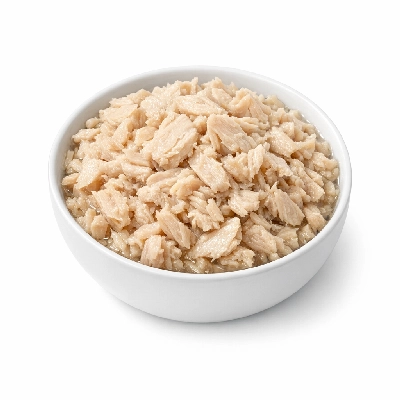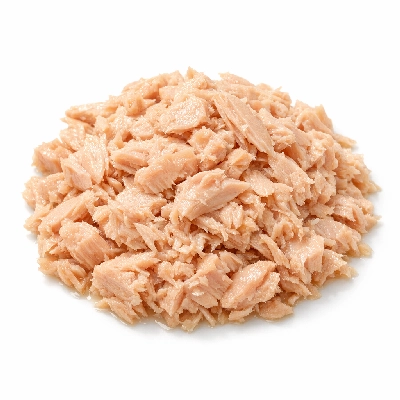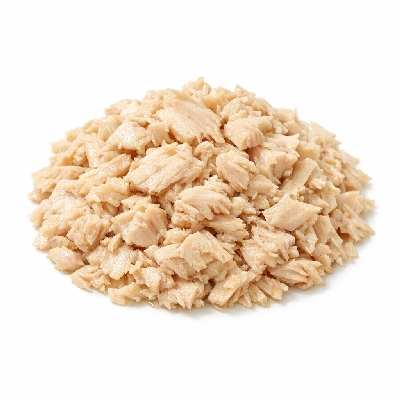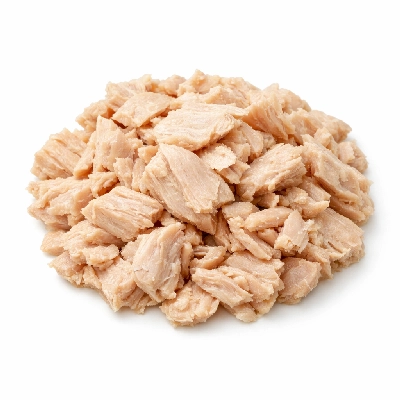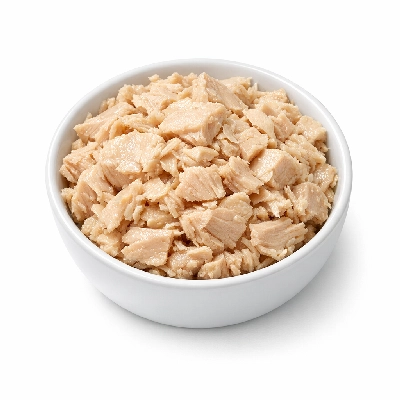
Canned White Albacore Tuna, in Oil
Source of Calories
Nutrition Facts
| Nutrient | Amount | % Daily Value |
|---|---|---|
| Total Carbohydrates | 0 g | 0% |
| Net Carbohydrates | 0 g | 0% |
| Sugars | 0 g | 0% |
| Added Sugars | 0 g | 0% |
| Dietary Fiber | 0 g | 0% |
| Protein | 47.22 g | 94% |
| Total Fat | 14.38 g | 18% |
| Saturated Fat | 2.28 g | 11% |
| Monounsaturated Fat | 5.81 g | - |
| Polyunsaturated Fat | 5.29 g | - |
| Trans Fat | No data | - |
| Cholesterol | 55.18 mg | 18% |
| Vitamins | ||
| Vitamin A | 8.9 mcg | 1% |
| Vitamin C | 0 mg | 0% |
| Vitamin D | No data | - |
| Minerals | ||
| Sodium | 704.88 mg | 31% |
| Potassium | 592.74 mg | 13% |
| Calcium | 7.12 mg | 1% |
| Magnesium | 60.52 mg | 14% |
| Iron | 1.16 mg | 6% |
| Zinc | 0.84 mg | 8% |
% DV refers to how much a single serving of an individually packaged food or supplement contributes nutritionally to your daily diet, based on a 2,000-calorie-a-day diet. Generally, having 5% DV or less of a nutrient per serving is considered low, and 20% DV or more of a nutrient per serving is considered high.
Fat Composition
The suggested total fat consumption should be limited to 30% of total energy intake or less. The type of fat consumed should primarily be unsaturated fatty acids, with no more than 10% of total energy intake coming from saturated fatty acids (about 200 calories on a 2000-calorie diet) and no more than 1% of total energy intake coming from trans-fatty acids.
Vitamin Coverage
Vitamin A
1%
Vitamin C
0%
Vitamin D
-
Vitamin E
27%
Vitamin K
10%
Vitamin B1
3%
Vitamin B2
11%
Vitamin B3
130%
Vitamin B5
13%
Vitamin B6
45%
Vitamin B7
-
Vitamin B9
2%
Vitamin B12
163%
There are 13 essential vitamins required for the body to work properly, which are categorised into two categories: fat-soluble and water-soluble vitamins. Vitamins have a Recommended Dietary Allowance (RDA), provided by the Dietary Reference Intakes (DRIs), which vary by age and sex. The %DV indicates how much one serving contributes to the average recommended daily intake.
Mineral Coverage
Calcium
0.5%
Iron
6%
Magnesium
14%
Phosphorus
38%
Potassium
13%
Sodium
31%
Zinc
8%
Copper
26%
Manganese
1%
Selenium
195%
Minerals are micronutrients, of which 13 of them are essential to the human body. The Recommended Dietary Allowance includes Calcium (1,300 mg/d), Phosphorus (1,250 mg/d), Potassium (4,700 mg/d), Sodium (2,300 mg/d), Chloride (1,500 mg/d), Magnesium (420 mg/d), Iron (18 mg/d), Zinc (11 mg/d), Copper (0.9 mg/d), Selenium (55 mcg/d), Molybdenum (45 mcg/d), Manganese (2.3 mg/d) and Iodine (150 mcg/d).
Protein Quality
Leucine
131%
Isoleucine
164%
Valine
145%
Lysine
163%
Tryptophan
151%
Threonine
148%
Phenylalanine
160%
Methionine
210%
Histidine
142%
Guidelines recommend a serving of protein with each meal and 1.2-1.6 g of protein per kg of body weight per day.
The data provided by eato.health is for informational purposes only and should not be considered medical advice. Please consult your physician before beginning any diet or nutrition plan.
About
How Long to Burn Off 331 Calories?
*Based on this person: 25-year-old female, 5'7", 144 lbs

Swimming
49 min

Jogging
42 min

Cycling
43 min

Walking
1 h 18 min
The data provided by eato.health is for informational purposes only and should not be considered medical advice. Please consult your physician before beginning any diet or nutrition plan.
📚 Health Research & Evidence About This Food
Albacore tuna is a notable source of omega-3 fatty acids and protein, which are essential for heart health and brain function, according to MedlinePlus and the American Heart Association. However, observational evidence suggests that albacore tuna generally contains higher mercury levels compared to other tuna species, leading to recommendations for moderate consumption, as Healthline notes. Research also investigates chemical contaminants in albacore tuna.
1. Omega-3 Fats - Good for Your Heart: Medlineplus Medical Encyclopedia
Source: MedlinePlus
Summary: Albacore tuna, as a type of oily fish, is a source of omega-3 fatty acids beneficial for heart health and brain function, though consumption should consider potential mercury levels.
Read More: https://medlineplus.gov/ency/patientinstructions/000767.htm
2. Picking Healthy Proteins
Source: American Heart Association, 2024
Summary: Albacore tuna is explicitly recommended by the American Heart Association as a healthy protein source high in omega-3 fatty acids, though consumers should be mindful of potential mercury or other environmental contaminants.
3. Tuna Health Benefits, Nutrients per Serving, Preparation Information, and More
Source: WebMD
Summary: Albacore tuna, legally known as 'white meat tuna,' is a popular seafood rich in vitamin B12, vitamin D, and omega-3 fatty acids, offering benefits for heart health, vision, and cancer risk reduction, but its consumption should be limited to one serving per week for typical adults due to potential mercury content.
4. Top 10 Brain Foods for Children
Source: WebMD
Summary: Albacore tuna, while a good source of lean protein and containing some omega-3s, is not considered as rich in brain-essential omega-3 fatty acids like DHA and EPA as salmon, according to this source.
Read More: https://www.webmd.com/parenting/features/brain-foods-for-children
5. Chemical Contaminants (Trace Metals, Persistent Organic Pollutants) in Albacore Tuna From Western Indian and South-Eastern Atlantic Oceans: Trophic Influence and Potential as Tracers of Populations.
Source: PubMed
Summary: Albacore tuna (Thunnus alalunga), a highly commercial fish species, is studied for chemical contaminants like trace metals and persistent organic pollutants in the western Indian and south-eastern Atlantic Oceans to understand trophic influence and population tracing.
Read More: https://pubmed.ncbi.nlm.nih.gov/28458223/
6. Mercury in Tuna: Is This Fish Safe to Eat?
Source: Healthline, 2018
Summary: Albacore tuna, while nutritious, contains higher levels of mercury compared to skipjack or canned light tuna, necessitating moderation in consumption, especially for vulnerable populations like pregnant women and children, to mitigate risks of impaired brain function and developmental issues.
Read More: https://www.healthline.com/nutrition/mercury-in-tuna