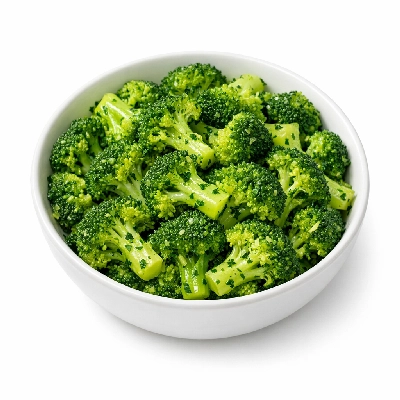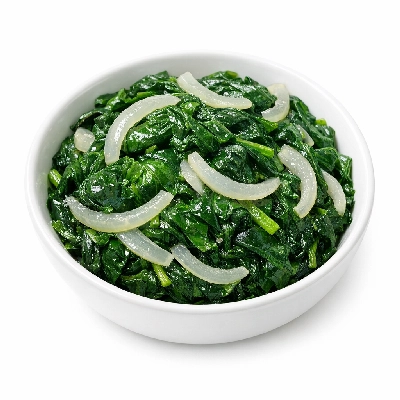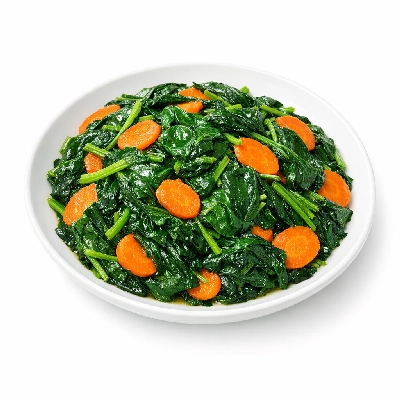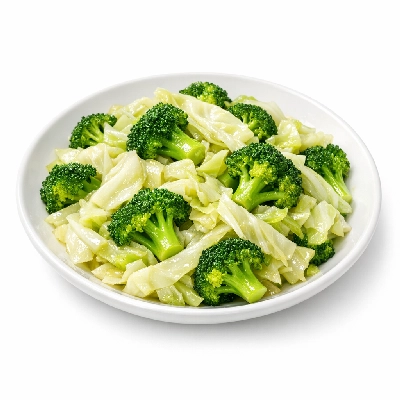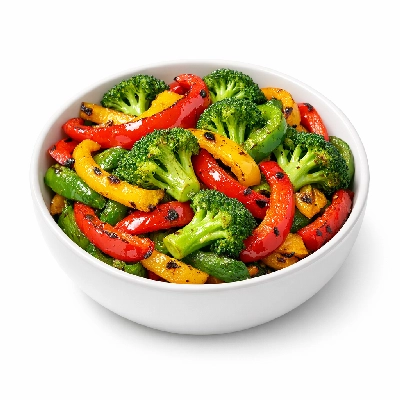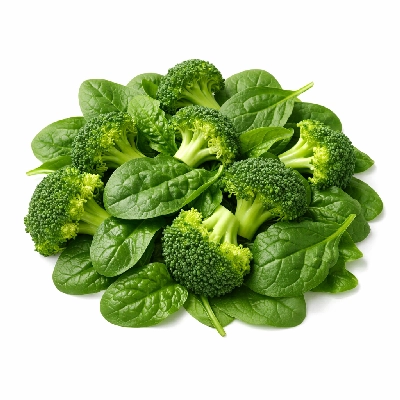
Broccoli and Spinach Blend
Source of Calories
Nutrition Facts
| Nutrient | Amount | % Daily Value |
|---|---|---|
| Total Carbohydrates | 31.05 g | 11% |
| Net Carbohydrates | 17.21 g | 7% |
| Sugars | 5.43 g | 16% |
| Added Sugars | 0 g | 0% |
| Dietary Fiber | 13.84 g | 49% |
| Protein | 16.83 g | 34% |
| Total Fat | 29.29 g | 38% |
| Saturated Fat | 4.23 g | 21% |
| Monounsaturated Fat | 19.78 g | - |
| Polyunsaturated Fat | 3.69 g | - |
| Trans Fat | 0 g | 0% |
| Cholesterol | 0 mg | 0% |
| Vitamins | ||
| Vitamin A | 1665.03 mcg | 185% |
| Vitamin C | 300.65 mg | 334% |
| Vitamin D | 0 mcg | 0% |
| Minerals | ||
| Sodium | 2671.2 mg | 116% |
| Potassium | 2664.67 mg | 57% |
| Calcium | 465.85 mg | 36% |
| Magnesium | 320.33 mg | 76% |
| Iron | 11.25 mg | 63% |
| Zinc | 2.86 mg | 26% |
% DV refers to how much a single serving of an individually packaged food or supplement contributes nutritionally to your daily diet, based on a 2,000-calorie-a-day diet. Generally, having 5% DV or less of a nutrient per serving is considered low, and 20% DV or more of a nutrient per serving is considered high.
Fat Composition
The suggested total fat consumption should be limited to 30% of total energy intake or less. The type of fat consumed should primarily be unsaturated fatty acids, with no more than 10% of total energy intake coming from saturated fatty acids (about 200 calories on a 2000-calorie diet) and no more than 1% of total energy intake coming from trans-fatty acids.
Vitamin Coverage
Vitamin A
185%
Vitamin C
334%
Vitamin D
0%
Vitamin E
84%
Vitamin K
1,575%
Vitamin B1
33%
Vitamin B2
74%
Vitamin B3
25%
Vitamin B5
32%
Vitamin B6
70%
Vitamin B7
-
Vitamin B9
0%
Vitamin B12
0%
There are 13 essential vitamins required for the body to work properly, which are categorised into two categories: fat-soluble and water-soluble vitamins. Vitamins have a Recommended Dietary Allowance (RDA), provided by the Dietary Reference Intakes (DRIs), which vary by age and sex. The %DV indicates how much one serving contributes to the average recommended daily intake.
Mineral Coverage
Calcium
36%
Iron
63%
Magnesium
76%
Phosphorus
27%
Potassium
57%
Sodium
116%
Zinc
26%
Copper
66%
Manganese
166%
Selenium
19%
Minerals are micronutrients, of which 13 of them are essential to the human body. The Recommended Dietary Allowance includes Calcium (1,300 mg/d), Phosphorus (1,250 mg/d), Potassium (4,700 mg/d), Sodium (2,300 mg/d), Chloride (1,500 mg/d), Magnesium (420 mg/d), Iron (18 mg/d), Zinc (11 mg/d), Copper (0.9 mg/d), Selenium (55 mcg/d), Molybdenum (45 mcg/d), Manganese (2.3 mg/d) and Iodine (150 mcg/d).
Protein Quality
Leucine
0.4%
Isoleucine
0.3%
Valine
0.3%
Lysine
0.1%
Tryptophan
0.2%
Threonine
0.2%
Phenylalanine
0.4%
Methionine
0.2%
Histidine
0.2%
Guidelines recommend a serving of protein with each meal and 1.2-1.6 g of protein per kg of body weight per day.
The data provided by eato.health is for informational purposes only and should not be considered medical advice. Please consult your physician before beginning any diet or nutrition plan.
About
How Long to Burn Off 410 Calories?
*Based on this person: 25-year-old female, 5'7", 144 lbs

Swimming
60 min

Jogging
52 min

Cycling
54 min

Walking
1 h 37 min
The data provided by eato.health is for informational purposes only and should not be considered medical advice. Please consult your physician before beginning any diet or nutrition plan.
📚 Health Research & Evidence About This Food
Broccoli and spinach are rich sources of essential vitamins and minerals, including Vitamin C, Vitamin K, Vitamin A, folate, and magnesium, according to Harvard Health and MedlinePlus. These vegetables are foundational for heart-healthy eating, with research demonstrating that steam-cooked broccoli enhances bile acid binding, which is associated with cholesterol-lowering potential. Additionally, UCLA Health notes that cruciferous vegetables like broccoli contain compounds that may reduce cancer risk.
1. Heart-Healthy Living - Choose Heart-Healthy Foods
Source: NHLBI, NIH, 2022
Summary: Broccoli and spinach, alongside other leafy greens and carrots, that form the foundation of a heart-healthy eating plan recommended by the NHLBI, NIH, which also emphasizes limiting sodium, saturated fats, and added sugars.
Read More: https://www.nhlbi.nih.gov/health/heart-healthy-living/healthy-foods
2. The Best Foods for Vitamins and Minerals - Harvard Health
Source: Harvard Health, 2016
Summary: Broccoli and spinach are excellent food sources for multiple essential nutrients, with broccoli providing Vitamin B-5, B-9, C, K, and magnesium, and spinach contributing Vitamin B-9, C, A, K, and magnesium, according to Harvard Health.
Read More: https://www.health.harvard.edu/healthy-aging-and-longevity/the-best-foods-for-vitamins-and-minerals
3. Tasty Cancer Fighters: Cauliflower, Cabbage and Other Cruciferous Vegetables
Source: UCLA Health
Summary: Broccoli, as a cruciferous vegetable, contains glucosinolates that break down into isothiocyanates, offering benefits such as reducing cancer risk, slowing cancer growth, and protecting against heart disease, with optimal bioactivity achieved by chopping the vegetable 40 minutes before cooking.
Read More: https://www.uclahealth.org/news/article/tasty-cancer-fighters-cauliflower-cabbage-and-other
4. Vitamins: Medlineplus Medical Encyclopedia
Source: MedlinePlus
Summary: Broccoli and spinach are identified as sources of essential vitamins, with broccoli providing Vitamin C and pantothenic acid (B5), and spinach contributing Vitamin C and folate, according to MedlinePlus.
5. Steam Cooking Significantly Improves in Vitro Bile Acid Binding of Collard Greens, Kale, Mustard Greens, Broccoli, Green Bell Pepper, and Cabbage.
Source: PubMed
Summary: Broccoli's in vitro bile acid binding capacity, which is related to the cholesterol-lowering potential of foods, is significantly improved by steam cooking, according to a PubMed abstract.
Read More: https://pubmed.ncbi.nlm.nih.gov/19083431/
6. Vitamin Retention in Eight Fruits and Vegetables - Pubmed
Source: PubMed
Summary: Broccoli and spinach blend, as a combination of vegetables, is relevant to this comparison of vitamin retention in fresh versus frozen produce.
Read More: https://pubmed.ncbi.nlm.nih.gov/25526594/