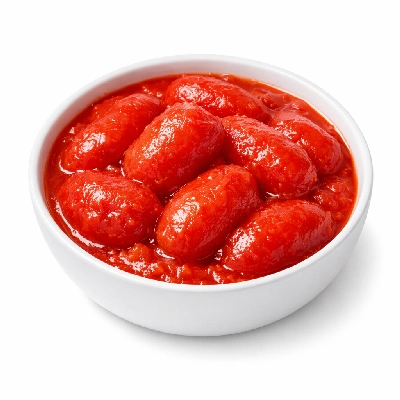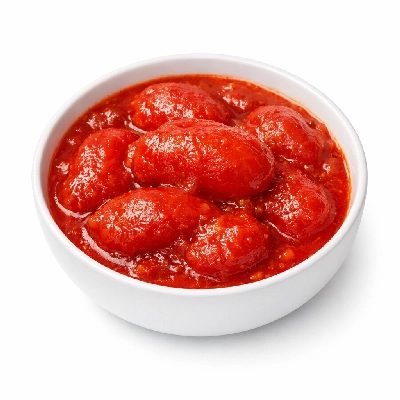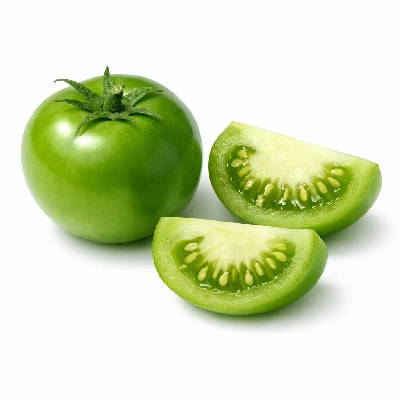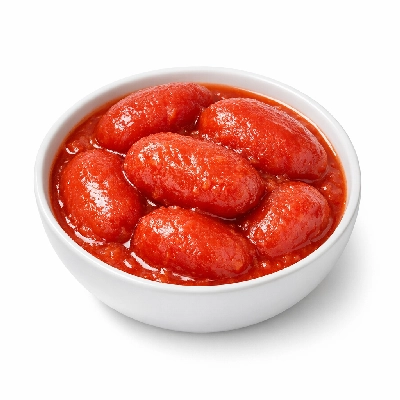
Whole Canned Tomatoes
Source of Calories
Nutrition Facts
| Nutrient | Amount | % Daily Value |
|---|---|---|
| Total Carbohydrates | 8.33 g | 3% |
| Net Carbohydrates | 3.77 g | 2% |
| Sugars | 6.12 g | 17% |
| Added Sugars | 0 g | 0% |
| Dietary Fiber | 4.56 g | 16% |
| Protein | 1.9 g | 4% |
| Total Fat | 0.6 g | 1% |
| Saturated Fat | 0.08 g | 0% |
| Monounsaturated Fat | 0.1 g | - |
| Polyunsaturated Fat | 0.24 g | - |
| Trans Fat | 0 g | 0% |
| Cholesterol | 0 mg | 0% |
| Vitamins | ||
| Vitamin A | 49 mcg | 5% |
| Vitamin C | 30.24 mg | 34% |
| Vitamin D | 0 mcg | 0% |
| Minerals | ||
| Sodium | 276 mg | 12% |
| Potassium | 458.4 mg | 10% |
| Calcium | 79.2 mg | 6% |
| Magnesium | 24 mg | 6% |
| Iron | 1.37 mg | 8% |
| Zinc | 0.29 mg | 3% |
% DV refers to how much a single serving of an individually packaged food or supplement contributes nutritionally to your daily diet, based on a 2,000-calorie-a-day diet. Generally, having 5% DV or less of a nutrient per serving is considered low, and 20% DV or more of a nutrient per serving is considered high.
Fat Composition
The suggested total fat consumption should be limited to 30% of total energy intake or less. The type of fat consumed should primarily be unsaturated fatty acids, with no more than 10% of total energy intake coming from saturated fatty acids (about 200 calories on a 2000-calorie diet) and no more than 1% of total energy intake coming from trans-fatty acids.
Vitamin Coverage
Vitamin A
5%
Vitamin C
34%
Vitamin D
0%
Vitamin E
9%
Vitamin K
5%
Vitamin B1
115%
Vitamin B2
10%
Vitamin B3
11%
Vitamin B5
6%
Vitamin B6
16%
Vitamin B7
-
Vitamin B9
5%
Vitamin B12
0%
There are 13 essential vitamins required for the body to work properly, which are categorised into two categories: fat-soluble and water-soluble vitamins. Vitamins have a Recommended Dietary Allowance (RDA), provided by the Dietary Reference Intakes (DRIs), which vary by age and sex. The %DV indicates how much one serving contributes to the average recommended daily intake.
Mineral Coverage
Calcium
6%
Iron
8%
Magnesium
6%
Phosphorus
3%
Potassium
10%
Sodium
12%
Zinc
3%
Copper
14%
Manganese
7%
Selenium
3%
Minerals are micronutrients, of which 13 of them are essential to the human body. The Recommended Dietary Allowance includes Calcium (1,300 mg/d), Phosphorus (1,250 mg/d), Potassium (4,700 mg/d), Sodium (2,300 mg/d), Chloride (1,500 mg/d), Magnesium (420 mg/d), Iron (18 mg/d), Zinc (11 mg/d), Copper (0.9 mg/d), Selenium (55 mcg/d), Molybdenum (45 mcg/d), Manganese (2.3 mg/d) and Iodine (150 mcg/d).
Protein Quality
Leucine
2%
Isoleucine
4%
Valine
2%
Lysine
3%
Tryptophan
5%
Threonine
7%
Phenylalanine
6%
Methionine
3%
Histidine
4%
Guidelines recommend a serving of protein with each meal and 1.2-1.6 g of protein per kg of body weight per day.
The data provided by eato.health is for informational purposes only and should not be considered medical advice. Please consult your physician before beginning any diet or nutrition plan.
About
How Long to Burn Off 38 Calories?
*Based on this person: 25-year-old female, 5'7", 144 lbs

Swimming
6 min

Jogging
5 min

Cycling
5 min

Walking
10 min
The data provided by eato.health is for informational purposes only and should not be considered medical advice. Please consult your physician before beginning any diet or nutrition plan.
📚 Health Research & Evidence About This Food
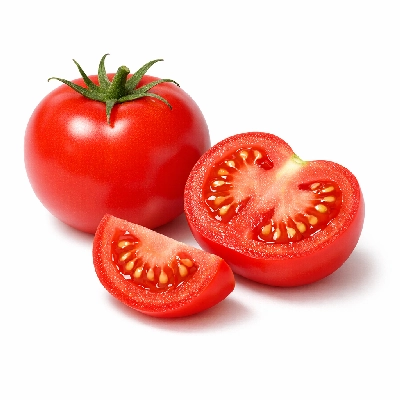
Tomatoes are a significant dietary source of the antioxidant lycopene, which is strongly associated with a reduced risk of various cancers, including prostate, lung, and stomach, and supports cardiovascular health by reducing LDL-cholesterol and improving endothelial function. As a low-calorie, nutrient-rich food, tomatoes are classified as powerhouse fruits and vegetables by the CDC based on their nutrient density, providing vitamin C and contributing to overall immune, eye, and skin health.
1. Tomatoes 101: Nutrition Facts and Health Benefits
Source: Healthline, 2019
Summary: Tomatoes are a significant dietary source of the antioxidant lycopene, which is associated with numerous health benefits, including a reduced risk of heart disease and certain cancers.
Read More: https://www.healthline.com/nutrition/foods/tomatoes
2. Foods That Are Very Low in Calories: 22 Options
Source: Healthline, 2018
Summary: Tomatoes are a versatile, low-calorie food that can be served raw, cooked, or puréed in sauces, and are a good source of vitamin C and antioxidants.
Read More: https://www.healthline.com/nutrition/zero-calorie-foods
3. Preventing Chronic Disease
Source: CDC
Summary: Tomatoes are classified as powerhouse fruits and vegetables, meaning they provide a significant portion of the daily value per serving for many qualifying nutrients.
4. The Health Benefits of Tomatoes
Source: WebMD
Summary: Tomatoes offer diverse health benefits, including strengthening the immune system, supporting cardiovascular health, promoting eye health, and benefiting lung function, blood vessel integrity, oral health, and skin health.
Read More: https://www.webmd.com/food-recipes/ss/slideshow-tomato-health-benefits
5. Tomatoes, Tomato-Based Products, Lycopene, and Cancer: Review of the Epidemiologic Literature.
Source: PubMed
Summary: Tomatoes and tomato-based products are inversely associated with the risk of various cancers, particularly prostate, lung, and stomach cancers, with no study indicating an increased cancer risk from higher consumption.
Read More: https://pubmed.ncbi.nlm.nih.gov/10050865/
6. Tomato and Lycopene Supplementation and Cardiovascular Risk Factors: A Systematic Review and Meta-Analysis.
Source: PubMed
Summary: Tomato supplementation is significantly associated with reductions in LDL-cholesterol and IL-6, and improvements in flow-mediated dilation.
Read More: https://pubmed.ncbi.nlm.nih.gov/28129549/