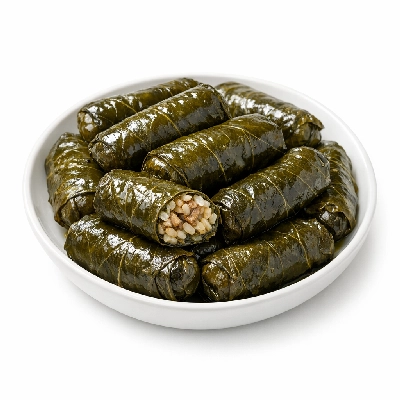
UAE Warag Enap, Stuffed Grape Leaves with Meat & Vegetables
Source of Calories
Nutrition Facts
| Nutrient | Amount | % Daily Value |
|---|---|---|
| Total Carbohydrates | 16.11 g | 6% |
| Net Carbohydrates | 12.21 g | 5% |
| Sugars | No data | - |
| Added Sugars | No data | - |
| Dietary Fiber | 3.9 g | 14% |
| Protein | 7.47 g | 15% |
| Total Fat | 2.73 g | 3% |
| Saturated Fat | 1.03 g | 5% |
| Monounsaturated Fat | 1.1 g | - |
| Polyunsaturated Fat | 0.5 g | - |
| Trans Fat | 0.07 g | 100% |
| Cholesterol | 19 mg | 6% |
| Vitamins | ||
| Vitamin A | 870 mcg | 97% |
| Vitamin C | 0.6 mg | 1% |
| Vitamin D | No data | - |
| Minerals | ||
| Sodium | 589 mg | 26% |
| Potassium | 155 mg | 3% |
| Calcium | 560 mg | 43% |
| Magnesium | 48 mg | 11% |
| Iron | 0.36 mg | 2% |
| Zinc | 0.15 mg | 1% |
% DV refers to how much a single serving of an individually packaged food or supplement contributes nutritionally to your daily diet, based on a 2,000-calorie-a-day diet. Generally, having 5% DV or less of a nutrient per serving is considered low, and 20% DV or more of a nutrient per serving is considered high.
Fat Composition
The suggested total fat consumption should be limited to 30% of total energy intake or less. The type of fat consumed should primarily be unsaturated fatty acids, with no more than 10% of total energy intake coming from saturated fatty acids (about 200 calories on a 2000-calorie diet) and no more than 1% of total energy intake coming from trans-fatty acids.
Vitamin Coverage
Vitamin A
97%
Vitamin C
0.7%
Vitamin D
-
Vitamin E
1%
Vitamin K
-
Vitamin B1
0%
Vitamin B2
0%
Vitamin B3
3%
Vitamin B5
0%
Vitamin B6
0%
Vitamin B7
-
Vitamin B9
-
Vitamin B12
0%
There are 13 essential vitamins required for the body to work properly, which are categorised into two categories: fat-soluble and water-soluble vitamins. Vitamins have a Recommended Dietary Allowance (RDA), provided by the Dietary Reference Intakes (DRIs), which vary by age and sex. The %DV indicates how much one serving contributes to the average recommended daily intake.
Mineral Coverage
Calcium
43%
Iron
2%
Magnesium
11%
Phosphorus
57%
Potassium
3%
Sodium
26%
Zinc
1%
Copper
0%
Manganese
0%
Selenium
5%
Minerals are micronutrients, of which 13 of them are essential to the human body. The Recommended Dietary Allowance includes Calcium (1,300 mg/d), Phosphorus (1,250 mg/d), Potassium (4,700 mg/d), Sodium (2,300 mg/d), Chloride (1,500 mg/d), Magnesium (420 mg/d), Iron (18 mg/d), Zinc (11 mg/d), Copper (0.9 mg/d), Selenium (55 mcg/d), Molybdenum (45 mcg/d), Manganese (2.3 mg/d) and Iodine (150 mcg/d).
The data provided by eato.health is for informational purposes only and should not be considered medical advice. Please consult your physician before beginning any diet or nutrition plan.
About
How Long to Burn Off 125 Calories?
*Based on this person: 25-year-old female, 5'7", 144 lbs

Swimming
19 min

Jogging
16 min

Cycling
17 min

Walking
30 min
The data provided by eato.health is for informational purposes only and should not be considered medical advice. Please consult your physician before beginning any diet or nutrition plan.
📚 Health Research & Evidence About This Food
Grape leaves, a primary component of stuffed grape leaves, possess significant therapeutic effects against various diseases, including cancer, diabetes, and neurodegenerative disorders, by mitigating factors such as diminished immunity, reduced cellular functionality, DNA damage, and heightened inflammation, according to PubMed. However, stuffed grape leaves, if they contain red or processed meat, would include components whose high consumption is positively linked to colorectal cancer risk, as observed in a large prospective cohort study in European populations.
1. Meat, Fish, and Colorectal Cancer Risk: The European Prospective Investigation Into Cancer and Nutrition.
Source: PubMed
Summary: High consumption of red and processed meat is positively linked to colorectal cancer risk, while fish intake is inversely associated.
Read More: https://pubmed.ncbi.nlm.nih.gov/15956652/
2. Effect of Natural Leaf Extracts as Phytomedicine in Curing Geriatrics.
Source: PubMed
Summary: Grape leaves possess significant therapeutic effects against a range of diseases prevalent in the elderly, including cancer, diabetes, immunosuppression, hepatic damage, and neurodegenerative disorders.
Read More: https://pubmed.ncbi.nlm.nih.gov/33894308/
3. Integrating Cbam and Squeeze‐and‐Excitation Networks for Accurate Grapevine Leaf Disease Diagnosis
Source: Wiley Online Library
Summary: Advanced deep learning techniques, specifically the integration of the Convolutional Block Attention Module and Squeeze-and-Excitation Networks, significantly improve the accuracy of classifying healthy and diseased grape leaves, which helps preserve their culinary value.
Read More: https://onlinelibrary.wiley.com/doi/full/10.1002/fsn3.70377