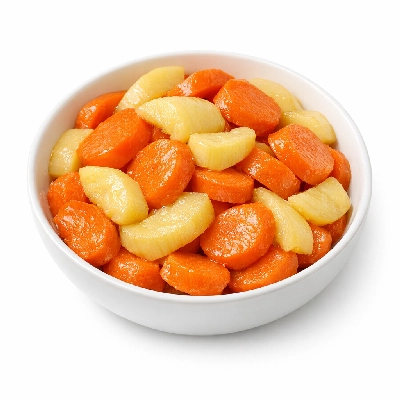
Steamed Purple Carrots
Source of Calories
Nutrition Facts
| Nutrient | Amount | % Daily Value |
|---|---|---|
| Total Carbohydrates | 30.6 g | 11% |
| Net Carbohydrates | 13.43 g | 5% |
| Sugars | 20.15 g | 58% |
| Added Sugars | 0 g | 0% |
| Dietary Fiber | 17.16 g | 61% |
| Protein | 6.72 g | 13% |
| Total Fat | 1.49 g | 2% |
| Saturated Fat | 0 g | 0% |
| Monounsaturated Fat | 0 g | - |
| Polyunsaturated Fat | 0 g | - |
| Trans Fat | 0 g | 0% |
| Cholesterol | 0 mg | 0% |
| Vitamins | ||
| Vitamin A | 0 mcg | 0% |
| Vitamin C | 0 mg | 0% |
| Vitamin D | 0 mcg | 0% |
| Minerals | ||
| Sodium | 3056.71 mg | 133% |
| Potassium | 5.42 mg | 0% |
| Calcium | 16.25 mg | 1% |
| Magnesium | 5 mg | 1% |
| Iron | 0.02 mg | 0% |
| Zinc | 0.01 mg | 0% |
% DV refers to how much a single serving of an individually packaged food or supplement contributes nutritionally to your daily diet, based on a 2,000-calorie-a-day diet. Generally, having 5% DV or less of a nutrient per serving is considered low, and 20% DV or more of a nutrient per serving is considered high.
Fat Composition
The suggested total fat consumption should be limited to 30% of total energy intake or less. The type of fat consumed should primarily be unsaturated fatty acids, with no more than 10% of total energy intake coming from saturated fatty acids (about 200 calories on a 2000-calorie diet) and no more than 1% of total energy intake coming from trans-fatty acids.
Vitamin Coverage
Vitamin A
0%
Vitamin C
0%
Vitamin D
0%
Vitamin E
0%
Vitamin K
0%
Vitamin B1
0%
Vitamin B2
0%
Vitamin B3
0%
Vitamin B5
0%
Vitamin B6
0%
Vitamin B7
-
Vitamin B9
0%
Vitamin B12
0%
There are 13 essential vitamins required for the body to work properly, which are categorised into two categories: fat-soluble and water-soluble vitamins. Vitamins have a Recommended Dietary Allowance (RDA), provided by the Dietary Reference Intakes (DRIs), which vary by age and sex. The %DV indicates how much one serving contributes to the average recommended daily intake.
Mineral Coverage
Calcium
1%
Iron
0.1%
Magnesium
1%
Phosphorus
0%
Potassium
0.1%
Sodium
133%
Zinc
0.1%
Copper
5%
Manganese
0.3%
Selenium
0%
Minerals are micronutrients, of which 13 of them are essential to the human body. The Recommended Dietary Allowance includes Calcium (1,300 mg/d), Phosphorus (1,250 mg/d), Potassium (4,700 mg/d), Sodium (2,300 mg/d), Chloride (1,500 mg/d), Magnesium (420 mg/d), Iron (18 mg/d), Zinc (11 mg/d), Copper (0.9 mg/d), Selenium (55 mcg/d), Molybdenum (45 mcg/d), Manganese (2.3 mg/d) and Iodine (150 mcg/d).
Protein Quality
Leucine
0%
Isoleucine
0%
Valine
0%
Lysine
0%
Tryptophan
0%
Threonine
0%
Phenylalanine
0%
Methionine
0%
Histidine
0%
Guidelines recommend a serving of protein with each meal and 1.2-1.6 g of protein per kg of body weight per day.
The data provided by eato.health is for informational purposes only and should not be considered medical advice. Please consult your physician before beginning any diet or nutrition plan.
About
How Long to Burn Off 200 Calories?
*Based on this person: 25-year-old female, 5'7", 144 lbs

Swimming
30 min

Jogging
26 min

Cycling
26 min

Walking
47 min
The data provided by eato.health is for informational purposes only and should not be considered medical advice. Please consult your physician before beginning any diet or nutrition plan.
📚 Health Research & Evidence About This Food
Purple carrots are particularly rich in anthocyanins, which are powerful polyphenol antioxidants crucial for protecting the body from oxidative stress by reducing pro-inflammatory compounds like cytokines. Research also demonstrates that purple carrots contain substantially higher levels of alpha-carotene and beta-carotene compared to orange varieties, with studies showing they can have more than double the amount of these carotenoids, and like other carrots, they provide dietary fiber, vitamin K1, and potassium. These anthocyanins are accumulated in the taproots of purple carrots through the activity of specific structural genes, a process that occurs independently of light.
1. New Carrots Offer Colorful Surprises--and Health Benefits : Usda Ars
Source: USDA ARS, 2004
Summary: Purple carrots derive their distinct color from anthocyanins, which are beneficial compounds.
2. Transcript Profiling of Structural Genes Involved in Cyanidin-Based Anthocyanin Biosynthesis Between Purple and Non-Purple Carrot (Daucus Carota L.) Cultivars Reveals Distinct Patterns.
Source: PubMed
Summary: Purple carrots exhibit significantly higher expression levels of genes such as PAL3/PAL4, CA4H1, and 4CL1 compared to non-purple varieties, which contributes to their unique accumulation of cyanidin-based anthocyanins.
Read More: https://pubmed.ncbi.nlm.nih.gov/25269413/
3. Carrots 101: Nutrition Facts and Health Benefits
Source: Healthline, 2019
Summary: Carrots are particularly rich in beta-carotene, which the body converts into vitamin A, along with significant amounts of fiber, vitamin K1, potassium, and a diverse array of antioxidants.
Read More: https://www.healthline.com/nutrition/foods/carrots
4. Are Purple Carrots Healthier? Nutrition, Benefits, and Uses
Source: Healthline, 2019
Summary: Purple carrots are particularly notable for their exceptionally rich content of anthocyanins, which are powerful polyphenol antioxidants crucial for protecting the body from oxidative stress.
Read More: https://www.healthline.com/nutrition/purple-carrots
5. Comparison of Volatiles, Phenolics, Sugars, Antioxidant Vitamins, and Sensory Quality of Different Colored Carrot Varieties.
Source: PubMed
Summary: Purple carrots contain substantially higher carotenoid content, with more alpha-carotene and beta-carotene than orange carrots.
Read More: https://pubmed.ncbi.nlm.nih.gov/11312873/