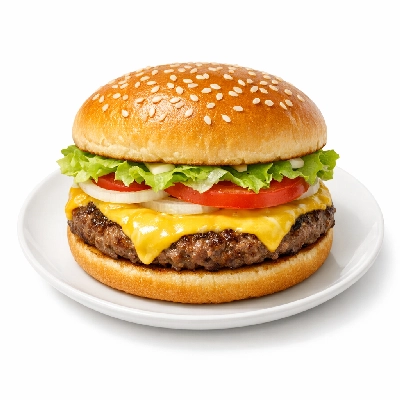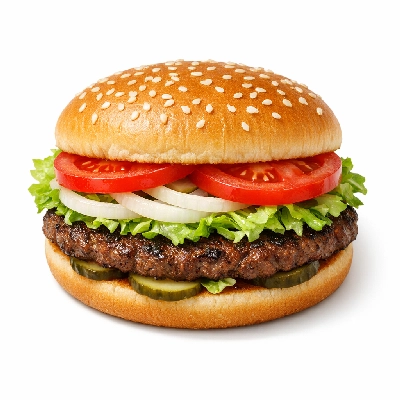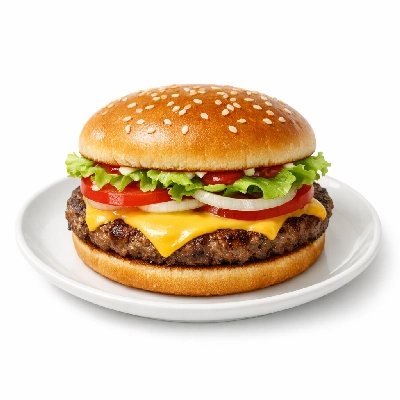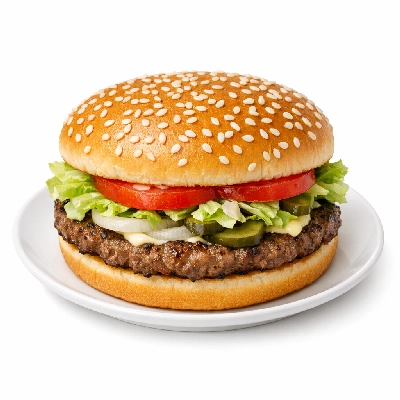
Mcdonald's, Big 'n Tasty, Big 'n Tasty
Source of Calories
Nutrition Facts
| Nutrient | Amount | % Daily Value |
|---|---|---|
| Total Carbohydrates | 38.51 g | 14% |
| Net Carbohydrates | 35.26 g | 14% |
| Sugars | 8.79 g | 25% |
| Added Sugars | No data | - |
| Dietary Fiber | 3.25 g | 12% |
| Protein | 24.68 g | 49% |
| Total Fat | 31.74 g | 41% |
| Saturated Fat | 8.64 g | 43% |
| Monounsaturated Fat | 9.73 g | - |
| Polyunsaturated Fat | 6.95 g | - |
| Trans Fat | 1.29 g | 100% |
| Cholesterol | 76.56 mg | 26% |
| Vitamins | ||
| Vitamin A | 111.36 mcg | 12% |
| Vitamin C | 4.41 mg | 5% |
| Vitamin D | No data | - |
| Minerals | ||
| Sodium | 735.44 mg | 32% |
| Potassium | 464 mg | 10% |
| Calcium | 150.8 mg | 12% |
| Magnesium | 41.76 mg | 10% |
| Iron | 4.36 mg | 24% |
| Zinc | 4.78 mg | 43% |
% DV refers to how much a single serving of an individually packaged food or supplement contributes nutritionally to your daily diet, based on a 2,000-calorie-a-day diet. Generally, having 5% DV or less of a nutrient per serving is considered low, and 20% DV or more of a nutrient per serving is considered high.
Fat Composition
The suggested total fat consumption should be limited to 30% of total energy intake or less. The type of fat consumed should primarily be unsaturated fatty acids, with no more than 10% of total energy intake coming from saturated fatty acids (about 200 calories on a 2000-calorie diet) and no more than 1% of total energy intake coming from trans-fatty acids.
Vitamin Coverage
Vitamin A
12%
Vitamin C
5%
Vitamin D
-
Vitamin E
-
Vitamin K
-
Vitamin B1
28%
Vitamin B2
46%
Vitamin B3
48%
Vitamin B5
-
Vitamin B6
-
Vitamin B7
-
Vitamin B9
-
Vitamin B12
95%
There are 13 essential vitamins required for the body to work properly, which are categorised into two categories: fat-soluble and water-soluble vitamins. Vitamins have a Recommended Dietary Allowance (RDA), provided by the Dietary Reference Intakes (DRIs), which vary by age and sex. The %DV indicates how much one serving contributes to the average recommended daily intake.
Mineral Coverage
Calcium
12%
Iron
24%
Magnesium
10%
Phosphorus
18%
Potassium
10%
Sodium
32%
Zinc
43%
Copper
23%
Manganese
18%
Selenium
-
Minerals are micronutrients, of which 13 of them are essential to the human body. The Recommended Dietary Allowance includes Calcium (1,300 mg/d), Phosphorus (1,250 mg/d), Potassium (4,700 mg/d), Sodium (2,300 mg/d), Chloride (1,500 mg/d), Magnesium (420 mg/d), Iron (18 mg/d), Zinc (11 mg/d), Copper (0.9 mg/d), Selenium (55 mcg/d), Molybdenum (45 mcg/d), Manganese (2.3 mg/d) and Iodine (150 mcg/d).
The data provided by eato.health is for informational purposes only and should not be considered medical advice. Please consult your physician before beginning any diet or nutrition plan.
About
How Long to Burn Off 524 Calories?
*Based on this person: 25-year-old female, 5'7", 144 lbs

Swimming
1 h 17 min

Jogging
1 h 7 min

Cycling
1 h 8 min

Walking
2 h 4 min
The data provided by eato.health is for informational purposes only and should not be considered medical advice. Please consult your physician before beginning any diet or nutrition plan.
📚 Health Research & Evidence About This Food
Fast food items, such as McDonald's burgers, are generally high in calories, saturated fat, and sodium, and often contain refined carbohydrates and added sugars. Observational evidence suggests that frequent consumption of such foods may contribute to weight gain, elevated blood pressure, and an increased risk of cardiovascular disease, as noted by Healthline and Harvard Health.
1. Calorie Count - Fast Food: Medlineplus Medical Encyclopedia
Source: MedlinePlus
Summary: Fast food burger options, as detailed in calorie count tables from various popular chains, range significantly in caloric content, with examples like a McDonald's Hamburger and a Wendy's Dave's Triple, underscoring the importance of informed choices.
Read More: https://medlineplus.gov/ency/patientinstructions/000887.htm
2. Fast Food's Effects on 8 Areas of the Body
Source: Healthline
Summary: McDonald’s Big ’n Tasty is a fast food burger. Fast food burgers are often high in calories, sugar, unhealthy fats, and sodium, and frequent intake may negatively affect multiple body systems and contribute to conditions such as weight gain, type 2 diabetes, high blood pressure, and heart disease.
Read More: https://www.healthline.com/health/fast-food-effects-on-body
3. The Sweet Danger of Sugar - Harvard Health
Source: Harvard Health, 2017
Summary: McDonald’s Big ’n Tasty is a fast-food menu item. As part of a processed-food diet, it can contribute to excess added sugar intake. Excess added sugar intake is linked to increased risks of obesity, diabetes, high blood pressure, chronic inflammation, and ultimately heart attack and stroke.
Read More: https://www.health.harvard.edu/diabetes-and-metabolic-health/the-sweet-danger-of-sugar
4. Fast Food Effects: Short-Term, Long-Term, and How to Eat Less
Source: Medical News Today, 2019
Summary: As a fast food burger, McDonald’s Big ’n Tasty belongs to a category of foods that is often high in sugar, salt, saturated or trans fats, and refined carbohydrates. Frequent fast food consumption may contribute to blood sugar spikes, inflammation, and longer-term health problems such as heart disease, obesity, digestive issues, and mental health concerns.
5. Fats in Foods
Source: American Heart Association, 2026
Summary: Fast food burgers, often containing saturated and artificial trans fats from ingredients like beef and partially hydrogenated oils, contributes to unhealthy dietary fat intake, which the American Heart Association recommends limiting or avoiding to reduce the risk of heart disease and stroke.
Read More: https://www.heart.org/en/healthy-living/healthy-eating/eat-smart/fats/fats-in-foods
6. Can You Make up for Years of Poor Eating? - Harvard Health
Source: Harvard Health, 2018
Summary: Fast food burger consumption in earlier years, contributing to unhealthy eating habits, may not be fully reversible in terms of arterial damage, but adopting a healthful diet and other lifestyle changes can substantially reduce the risk of heart attack and stroke.
Read More: https://www.health.harvard.edu/healthy-aging-and-longevity/can-you-make-up-for-years-of-poor-eating