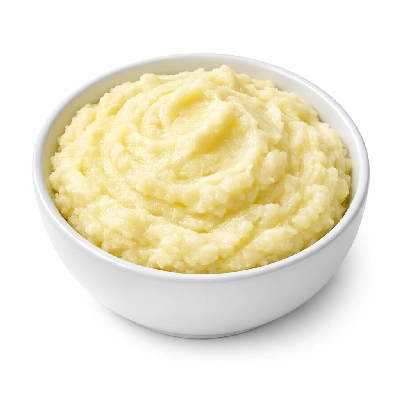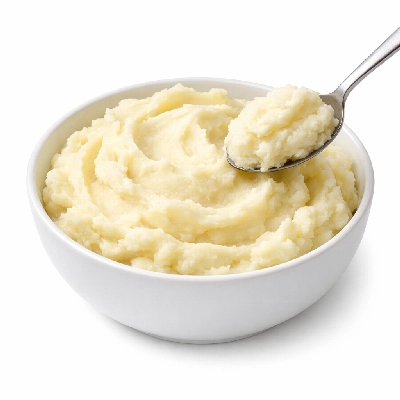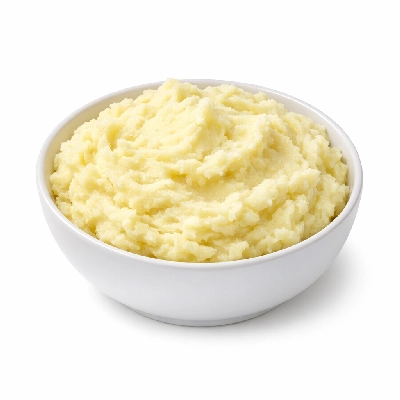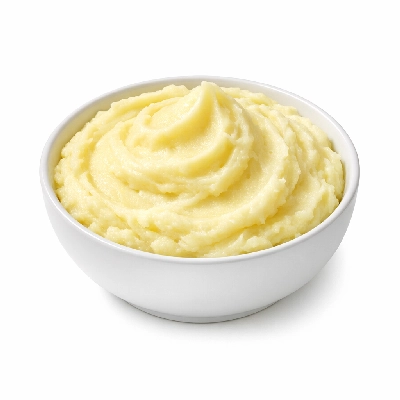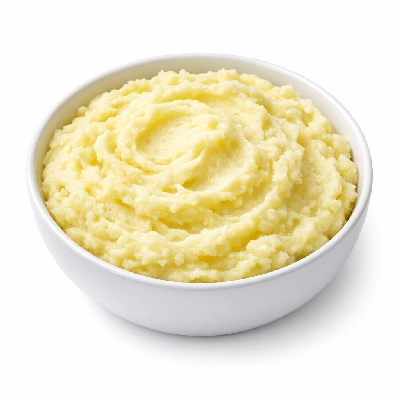
Homemade Mashed Potatoes with Whole Milk and Butter
Source of Calories
Nutrition Facts
| Nutrient | Amount | % Daily Value |
|---|---|---|
| Total Carbohydrates | 35.3 g | 13% |
| Net Carbohydrates | 32.15 g | 13% |
| Sugars | 3 g | 9% |
| Added Sugars | 0 g | 0% |
| Dietary Fiber | 3.15 g | 11% |
| Protein | 3.91 g | 8% |
| Total Fat | 8.86 g | 11% |
| Saturated Fat | 5.49 g | 27% |
| Monounsaturated Fat | 2.25 g | - |
| Polyunsaturated Fat | 0.42 g | - |
| Trans Fat | 0.31 g | 100% |
| Cholesterol | 23.1 mg | 8% |
| Vitamins | ||
| Vitamin A | 79.27 mcg | 9% |
| Vitamin C | 12.6 mg | 14% |
| Vitamin D | 0.53 mcg | 3% |
| Minerals | ||
| Sodium | 665.7 mg | 29% |
| Potassium | 596.4 mg | 13% |
| Calcium | 50.4 mg | 4% |
| Magnesium | 37.8 mg | 9% |
| Iron | 0.55 mg | 3% |
| Zinc | 0.57 mg | 5% |
% DV refers to how much a single serving of an individually packaged food or supplement contributes nutritionally to your daily diet, based on a 2,000-calorie-a-day diet. Generally, having 5% DV or less of a nutrient per serving is considered low, and 20% DV or more of a nutrient per serving is considered high.
Fat Composition
The suggested total fat consumption should be limited to 30% of total energy intake or less. The type of fat consumed should primarily be unsaturated fatty acids, with no more than 10% of total energy intake coming from saturated fatty acids (about 200 calories on a 2000-calorie diet) and no more than 1% of total energy intake coming from trans-fatty acids.
Vitamin Coverage
Vitamin A
9%
Vitamin C
14%
Vitamin D
3%
Vitamin E
2%
Vitamin K
4%
Vitamin B1
15%
Vitamin B2
7%
Vitamin B3
14%
Vitamin B5
20%
Vitamin B6
27%
Vitamin B7
-
Vitamin B9
4%
Vitamin B12
6%
There are 13 essential vitamins required for the body to work properly, which are categorised into two categories: fat-soluble and water-soluble vitamins. Vitamins have a Recommended Dietary Allowance (RDA), provided by the Dietary Reference Intakes (DRIs), which vary by age and sex. The %DV indicates how much one serving contributes to the average recommended daily intake.
Mineral Coverage
Calcium
4%
Iron
3%
Magnesium
9%
Phosphorus
8%
Potassium
13%
Sodium
29%
Zinc
5%
Copper
32%
Manganese
10%
Selenium
3%
Minerals are micronutrients, of which 13 of them are essential to the human body. The Recommended Dietary Allowance includes Calcium (1,300 mg/d), Phosphorus (1,250 mg/d), Potassium (4,700 mg/d), Sodium (2,300 mg/d), Chloride (1,500 mg/d), Magnesium (420 mg/d), Iron (18 mg/d), Zinc (11 mg/d), Copper (0.9 mg/d), Selenium (55 mcg/d), Molybdenum (45 mcg/d), Manganese (2.3 mg/d) and Iodine (150 mcg/d).
Protein Quality
Leucine
9%
Isoleucine
13%
Valine
13%
Lysine
8%
Tryptophan
20%
Threonine
11%
Phenylalanine
15%
Methionine
10%
Histidine
9%
Guidelines recommend a serving of protein with each meal and 1.2-1.6 g of protein per kg of body weight per day.
The data provided by eato.health is for informational purposes only and should not be considered medical advice. Please consult your physician before beginning any diet or nutrition plan.
About
How Long to Burn Off 237 Calories?
*Based on this person: 25-year-old female, 5'7", 144 lbs

Swimming
35 min

Jogging
30 min

Cycling
31 min

Walking
56 min
The data provided by eato.health is for informational purposes only and should not be considered medical advice. Please consult your physician before beginning any diet or nutrition plan.
📚 Health Research & Evidence About This Food
Mashed potatoes, as a form of potato, can contribute to significant blood sugar spikes, particularly in individuals with insulin resistance or beta cell dysfunction, as demonstrated in a Stanford Medicine study published in *Nature Medicine*. This is consistent with potatoes being considered complex carbohydrates that are digested relatively fast, placing them in the high glycemic index category, as noted by WebMD, which explains that the digestive system converts carbohydrates into sugar, leading to increased blood sugar. Conversely, observational evidence suggests that boiled mashed potatoes are among the most satiating foods due to their low calorie density, according to NutritionFacts.org, which references a study identifying potato protease inhibitor 2 as an appetite-suppressing protein.
1. Potato Flakes. A New Form of Dehydrated Mashed Potatoes
Source: SpringerLink
Summary: Potato flakes are introduced as a novel form of dehydrated mashed potatoes, focusing on the innovation and properties of this food product.
Read More: https://link.springer.com/article/10.1007/BF02846541
2. Carbs in Potatoes: How Do They Affect Blood Sugar?
Source: WebMD
Summary: Potatoes are considered complex carbohydrates but are digested faster than many other complex carbohydrates, placing them in the high glycemic index category.
Read More: https://www.webmd.com/diabetes/carbs-potatoes-blood-sugar
3. Blood Sugar Response to Various Carbohydrates Can Point to Metabolic Health Subtypes, Study Finds
Source: Stanford Medicine, 2025
Summary: Potatoes caused the highest blood sugar spikes in individuals with insulin resistance or beta cell dysfunction, according to a Stanford Medicine study.
Read More: https://med.stanford.edu/news/all-news/2025/06/carb-sugar-spikes.html
4. What Is the Healthiest Potato?
Source: NutritionFacts.org, 2022
Summary: Mashed potatoes, when boiled, are identified as among the most satiating foods due to their low calorie density.
Read More: https://nutritionfacts.org/questions/what-is-the-healthiest-potato/