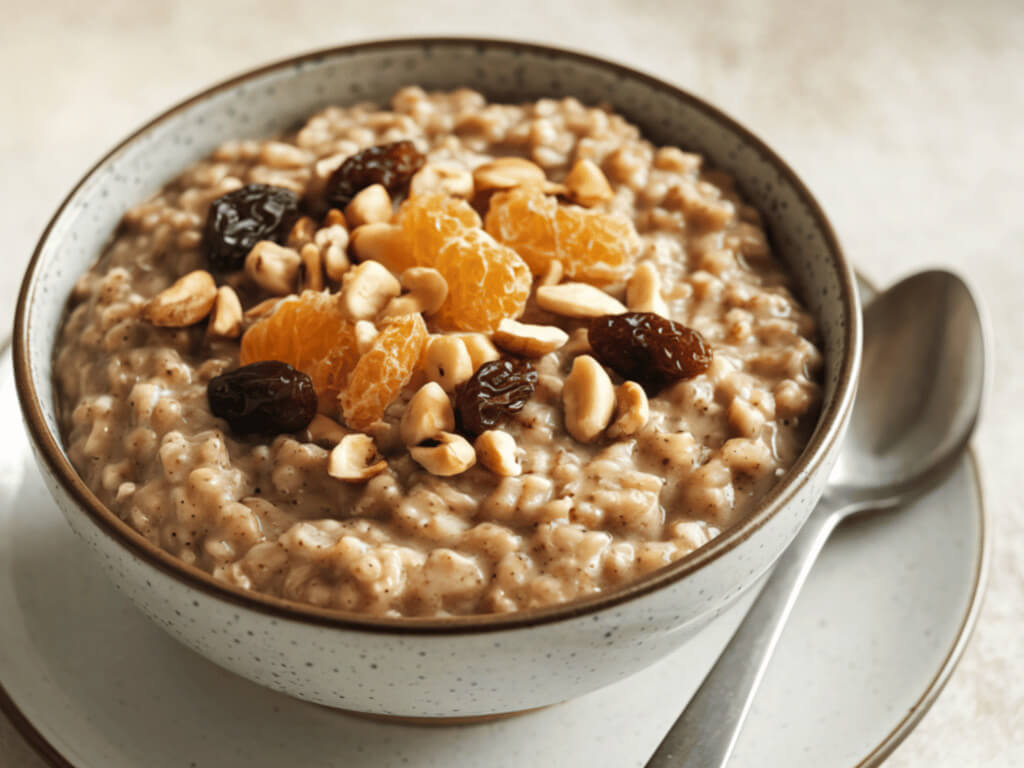
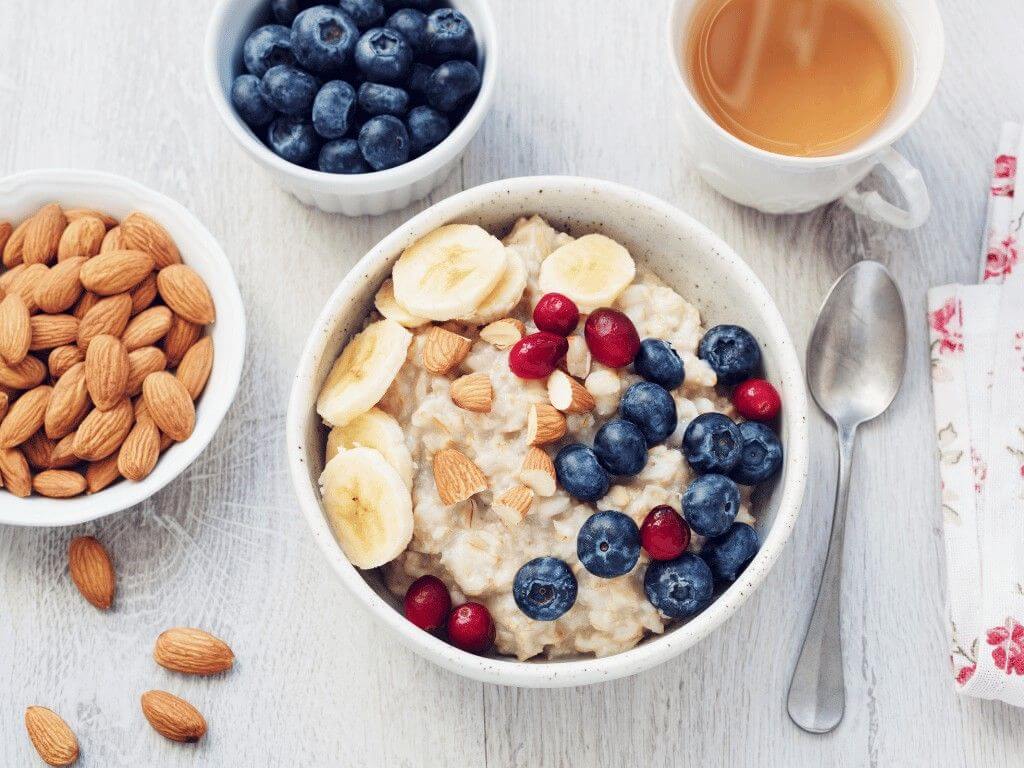
Cooked with Salt Oatmeal
Source of Calories
Nutrition Facts
| Nutrient | Amount | % Daily Value |
|---|---|---|
| Total Carbohydrates | 21 g | 8% |
| Net Carbohydrates | 18.03 g | 7% |
| Sugars | 0.47 g | 1% |
| Added Sugars | 0.53 g | 1% |
| Dietary Fiber | 2.98 g | 11% |
| Protein | 4.45 g | 9% |
| Total Fat | 2.66 g | 3% |
| Saturated Fat | 0.54 g | 3% |
| Monounsaturated Fat | 0.76 g | - |
| Polyunsaturated Fat | 0.98 g | - |
| Trans Fat | 0 g | 0% |
| Cholesterol | 0 mg | 0% |
| Vitamins | ||
| Vitamin A | 0 mcg | 0% |
| Vitamin C | 0 mg | 0% |
| Vitamin D | No data | - |
| Minerals | ||
| Sodium | 124.25 mg | 5% |
| Potassium | 122.5 mg | 3% |
| Calcium | 15.75 mg | 1% |
| Magnesium | 47.25 mg | 11% |
| Iron | 1.58 mg | 9% |
| Zinc | 1.75 mg | 16% |
% DV refers to how much a single serving of an individually packaged food or supplement contributes nutritionally to your daily diet, based on a 2,000-calorie-a-day diet. Generally, having 5% DV or less of a nutrient per serving is considered low, and 20% DV or more of a nutrient per serving is considered high.
Fat Composition
The suggested total fat consumption should be limited to 30% of total energy intake or less. The type of fat consumed should primarily be unsaturated fatty acids, with no more than 10% of total energy intake coming from saturated fatty acids (about 200 calories on a 2000-calorie diet) and no more than 1% of total energy intake coming from trans-fatty acids.
Vitamin Coverage
Vitamin A
0%
Vitamin C
0%
Vitamin D
-
Vitamin E
0.9%
Vitamin K
0.4%
Vitamin B1
11%
Vitamin B2
2%
Vitamin B3
2%
Vitamin B5
11%
Vitamin B6
0.5%
Vitamin B7
-
Vitamin B9
3%
Vitamin B12
0%
There are 13 essential vitamins required for the body to work properly, which are categorised into two categories: fat-soluble and water-soluble vitamins. Vitamins have a Recommended Dietary Allowance (RDA), provided by the Dietary Reference Intakes (DRIs), which vary by age and sex. The %DV indicates how much one serving contributes to the average recommended daily intake.
Mineral Coverage
Calcium
1%
Iron
9%
Magnesium
11%
Phosphorus
11%
Potassium
3%
Sodium
5%
Zinc
16%
Copper
14%
Manganese
44%
Selenium
17%
Minerals are micronutrients, of which 13 of them are essential to the human body. The Recommended Dietary Allowance includes Calcium (1,300 mg/d), Phosphorus (1,250 mg/d), Potassium (4,700 mg/d), Sodium (2,300 mg/d), Chloride (1,500 mg/d), Magnesium (420 mg/d), Iron (18 mg/d), Zinc (11 mg/d), Copper (0.9 mg/d), Selenium (55 mcg/d), Molybdenum (45 mcg/d), Manganese (2.3 mg/d) and Iodine (150 mcg/d).
The data provided by eato.health is for informational purposes only and should not be considered medical advice. Please consult your physician before beginning any diet or nutrition plan.
About
How Long to Burn Off 124 Calories?
*Based on this person: 25-year-old female, 5'7", 144 lbs

Swimming
19 min

Jogging
16 min

Cycling
17 min

Walking
30 min
The data provided by eato.health is for informational purposes only and should not be considered medical advice. Please consult your physician before beginning any diet or nutrition plan.
📚 Health Research & Evidence About This Food
Rolled oats are a fiber-rich whole grain, containing beta-glucan and antioxidants like avenanthramides, which contribute to health benefits such as cholesterol reduction by increasing cholesterol-rich bile release and improved blood sugar control. Research demonstrates that less-processed forms like rolled oats exhibit significantly lower glycemic responses compared to instant oats, effectively supporting blood sugar management due to their minimal processing and retained groat structure, which delays stomach emptying and glucose absorption, and may improve insulin sensitivity.
1. 9 Health Benefits of Eating Oats and Oatmeal
Source: Healthline, 2016
Summary: Oats are rich in fiber, particularly beta-glucan, and antioxidants like avenanthramides, which contribute to various health benefits including reduced cholesterol and improved blood sugar control.
Read More: https://www.healthline.com/nutrition/9-benefits-oats-oatmeal
2. Best Foods That Help Lower and Control Blood Sugar
Source: Medical News Today, 2020
Summary: Rolled oats are preferred over more processed instant oats due to their lower glycemic index, which is beneficial for managing blood sugar levels.
3. Steel-Cut Oats: Health Benefits and Nutrition
Source: WebMD
Summary: Steel-cut oats and rolled oats offer similar nutritional profiles, with steel-cut oats having slightly more fiber.
Read More: https://www.webmd.com/diet/health-benefits-steel-cut-oats
4. Systematic Review of the Effect of Processing of Whole-Grain Oat Cereals on Glycaemic Response
Source: Cambridge University Press
Summary: Rolled oats, along with steel-cut oats, large-flake oats, muesli, and granola, exhibit significantly lower glycaemic responses compared to quick oats and instant oatmeal due to their minimal processing which retains groat structure integrity.
5. A Systematic Review and Meta-Analysis of Randomized Controlled Trials on the Effects of Oats and Oat Processing on Postprandial Blood Glucose and Insulin Responses.
Source: PubMed
Summary: The consumption of intact oat kernels and thick oat flakes significantly reduces postprandial blood glucose and insulin responses, while thin, quick, or instant oat flakes show no significant effects.
Read More: https://pubmed.ncbi.nlm.nih.gov/33296453/
6. How to Enjoy Oatmeal if You Have Diabetes
Source: Healthline, 2014
Summary: Less-processed oats, such as steel-cut oats, are digested slower than refined grains, contributing to better blood sugar management due to their moderate to high fiber content and lower glycemic index.
Read More: https://www.healthline.com/health/diabetes/oatmeal