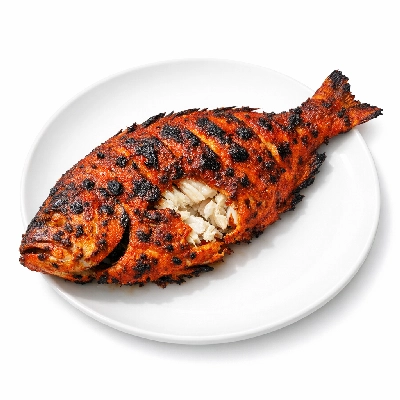
Baked Tandoori Fish
Source of Calories
Nutrition Facts
| Nutrient | Amount | % Daily Value |
|---|---|---|
| Total Carbohydrates | 8.96 g | 3% |
| Net Carbohydrates | 7.48 g | 3% |
| Sugars | 2.15 g | 6% |
| Added Sugars | 0 g | 0% |
| Dietary Fiber | 1.48 g | 5% |
| Protein | 123.47 g | 247% |
| Total Fat | 26.56 g | 34% |
| Saturated Fat | 19.24 g | 96% |
| Monounsaturated Fat | 0.94 g | - |
| Polyunsaturated Fat | 1.8 g | - |
| Trans Fat | 0 g | 0% |
| Cholesterol | 292.57 mg | 98% |
| Vitamins | ||
| Vitamin A | 133.78 mcg | 15% |
| Vitamin C | 13.72 mg | 15% |
| Vitamin D | 6.12 mcg | 31% |
| Minerals | ||
| Sodium | 2068.25 mg | 90% |
| Potassium | 3081.7 mg | 66% |
| Calcium | 131.39 mg | 10% |
| Magnesium | 232.09 mg | 55% |
| Iron | 5.02 mg | 28% |
| Zinc | 3.37 mg | 31% |
% DV refers to how much a single serving of an individually packaged food or supplement contributes nutritionally to your daily diet, based on a 2,000-calorie-a-day diet. Generally, having 5% DV or less of a nutrient per serving is considered low, and 20% DV or more of a nutrient per serving is considered high.
Fat Composition
The suggested total fat consumption should be limited to 30% of total energy intake or less. The type of fat consumed should primarily be unsaturated fatty acids, with no more than 10% of total energy intake coming from saturated fatty acids (about 200 calories on a 2000-calorie diet) and no more than 1% of total energy intake coming from trans-fatty acids.
Vitamin Coverage
Vitamin A
15%
Vitamin C
15%
Vitamin D
31%
Vitamin E
33%
Vitamin K
2%
Vitamin B1
45%
Vitamin B2
36%
Vitamin B3
90%
Vitamin B5
22%
Vitamin B6
101%
Vitamin B7
-
Vitamin B9
13%
Vitamin B12
258%
There are 13 essential vitamins required for the body to work properly, which are categorised into two categories: fat-soluble and water-soluble vitamins. Vitamins have a Recommended Dietary Allowance (RDA), provided by the Dietary Reference Intakes (DRIs), which vary by age and sex. The %DV indicates how much one serving contributes to the average recommended daily intake.
Mineral Coverage
Calcium
10%
Iron
28%
Magnesium
55%
Phosphorus
112%
Potassium
66%
Sodium
90%
Zinc
31%
Copper
27%
Manganese
31%
Selenium
411%
Minerals are micronutrients, of which 13 of them are essential to the human body. The Recommended Dietary Allowance includes Calcium (1,300 mg/d), Phosphorus (1,250 mg/d), Potassium (4,700 mg/d), Sodium (2,300 mg/d), Chloride (1,500 mg/d), Magnesium (420 mg/d), Iron (18 mg/d), Zinc (11 mg/d), Copper (0.9 mg/d), Selenium (55 mcg/d), Molybdenum (45 mcg/d), Manganese (2.3 mg/d) and Iodine (150 mcg/d).
Protein Quality
Leucine
336%
Isoleucine
421%
Valine
373%
Lysine
419%
Tryptophan
388%
Threonine
380%
Phenylalanine
411%
Methionine
540%
Histidine
365%
Guidelines recommend a serving of protein with each meal and 1.2-1.6 g of protein per kg of body weight per day.
The data provided by eato.health is for informational purposes only and should not be considered medical advice. Please consult your physician before beginning any diet or nutrition plan.
About
How Long to Burn Off 793 Calories?
*Based on this person: 25-year-old female, 5'7", 144 lbs

Swimming
1 h 56 min

Jogging
1 h 40 min

Cycling
1 h 43 min

Walking
3 h 6 min
The data provided by eato.health is for informational purposes only and should not be considered medical advice. Please consult your physician before beginning any diet or nutrition plan.
📚 Health Research & Evidence About This Food
Tandoori fish, when prepared by baking or broiling, can be a source of protein and heart-healthy omega-3 fatty acids, as research on baked or broiled fish preparations demonstrates associations with improved cardiac hemodynamics, including a lower heart rate and increased stroke volume. Consuming baked or boiled fish offers greater cardioprotective effects compared to other preparations, with these benefits potentially enhanced by the addition of low-sodium soy sauce and tofu.
1. Intake of Tuna or Other Broiled or Baked Fish Versus Fried Fish and Cardiac Structure, Function, and Hemodynamics.
Source: PubMed
Summary: Consuming broiled or baked fish is significantly associated with improved cardiac hemodynamics, including a lower heart rate, reduced systemic vascular resistance, and increased stroke volume.
Read More: https://pubmed.ncbi.nlm.nih.gov/16442366/
2. Food-Protein-Induced Enterocolitis Syndrome Caused by Fish.
Source: PubMed
Summary: Fish protein can cause Food Protein-Induced Enterocolitis Syndrome (FPIES) in infants, characterized by profuse vomiting and/or diarrhea several hours after ingestion.
Read More: https://pubmed.ncbi.nlm.nih.gov/16371218/
3. Seafood Selections That Help Your Heart - and Our Planet - Harvard Health
Source: Harvard Health, 2025
Summary: Fish, including smaller varieties like anchovies, herring, mackerel, and sardines, are excellent sources of protein, essential micronutrients, and heart-healthy omega-3 fatty acids.
Read More: https://www.health.harvard.edu/heart-health/seafood-selections-that-help-your-heart-and-our-planet
4. How Fish Is Cooked Affects Heart-Health Benefits of Omega-3 Fatty Acids
Source: ScienceDaily, 2026
Summary: Consuming baked or boiled fish is associated with greater cardioprotective effects compared to fried, salted, or dried fish, with the addition of low-sodium soy sauce and tofu potentially enhancing these benefits.
Read More: https://www.sciencedaily.com/releases/2009/11/091117161004.htm
5. Assessment of Dietary Fish Consumption in Pregnancy: Comparing One-, Four- and Thirty-Six-Item Questionnaires
Source: Cambridge University Press
Summary: Different dietary assessment methods for fish consumption, including a single screening question, a brief Food Frequency Questionnaire (FFQ), and a detailed fish-focused FFQ, showed substantial discrepancies in absolute intake estimates but similar effectiveness in ranking individuals based on their methylmercury exposure.