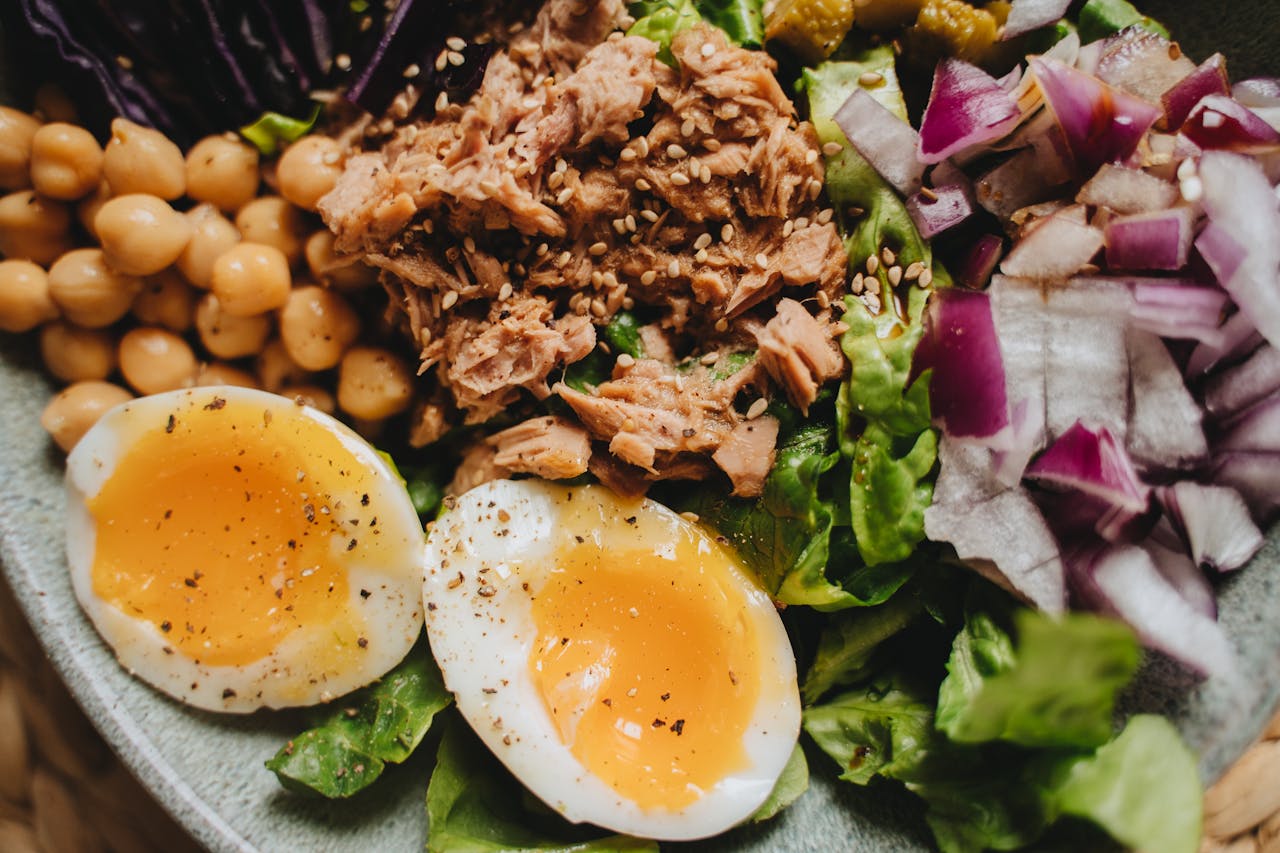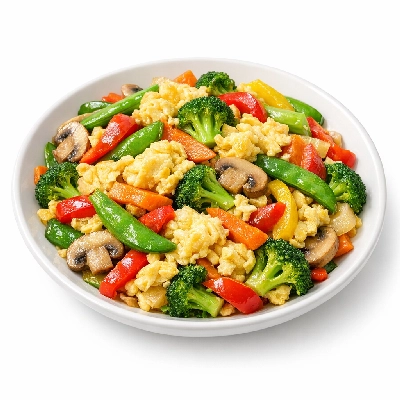
Stir-fried Vegetables with Egg
Source of Calories
Nutrition Facts
| Nutrient | Amount | % Daily Value |
|---|---|---|
| Total Carbohydrates | 39.11 g | 14% |
| Net Carbohydrates | 26.62 g | 11% |
| Sugars | 8.71 g | 25% |
| Added Sugars | 0 g | 0% |
| Dietary Fiber | 12.49 g | 45% |
| Protein | 25.21 g | 50% |
| Total Fat | 27.15 g | 35% |
| Saturated Fat | 6.09 g | 30% |
| Monounsaturated Fat | 8.34 g | - |
| Polyunsaturated Fat | 10.66 g | - |
| Trans Fat | 0.09 g | 100% |
| Cholesterol | 481 mg | 160% |
| Vitamins | ||
| Vitamin A | 796.21 mcg | 88% |
| Vitamin C | 10.67 mg | 12% |
| Vitamin D | 2.6 mcg | 13% |
| Minerals | ||
| Sodium | 2321 mg | 101% |
| Potassium | 747.63 mg | 16% |
| Calcium | 165.94 mg | 13% |
| Magnesium | 90.37 mg | 22% |
| Iron | 5 mg | 28% |
| Zinc | 3.39 mg | 31% |
% DV refers to how much a single serving of an individually packaged food or supplement contributes nutritionally to your daily diet, based on a 2,000-calorie-a-day diet. Generally, having 5% DV or less of a nutrient per serving is considered low, and 20% DV or more of a nutrient per serving is considered high.
Fat Composition
The suggested total fat consumption should be limited to 30% of total energy intake or less. The type of fat consumed should primarily be unsaturated fatty acids, with no more than 10% of total energy intake coming from saturated fatty acids (about 200 calories on a 2000-calorie diet) and no more than 1% of total energy intake coming from trans-fatty acids.
Vitamin Coverage
Vitamin A
88%
Vitamin C
12%
Vitamin D
13%
Vitamin E
23%
Vitamin K
76%
Vitamin B1
18%
Vitamin B2
68%
Vitamin B3
40%
Vitamin B5
52%
Vitamin B6
33%
Vitamin B7
95%
Vitamin B9
0.6%
Vitamin B12
54%
There are 13 essential vitamins required for the body to work properly, which are categorised into two categories: fat-soluble and water-soluble vitamins. Vitamins have a Recommended Dietary Allowance (RDA), provided by the Dietary Reference Intakes (DRIs), which vary by age and sex. The %DV indicates how much one serving contributes to the average recommended daily intake.
Mineral Coverage
Calcium
13%
Iron
28%
Magnesium
22%
Phosphorus
35%
Potassium
16%
Sodium
101%
Zinc
31%
Copper
29%
Manganese
60%
Selenium
74%
Minerals are micronutrients, of which 13 of them are essential to the human body. The Recommended Dietary Allowance includes Calcium (1,300 mg/d), Phosphorus (1,250 mg/d), Potassium (4,700 mg/d), Sodium (2,300 mg/d), Chloride (1,500 mg/d), Magnesium (420 mg/d), Iron (18 mg/d), Zinc (11 mg/d), Copper (0.9 mg/d), Selenium (55 mcg/d), Molybdenum (45 mcg/d), Manganese (2.3 mg/d) and Iodine (150 mcg/d).
Protein Quality
Leucine
3%
Isoleucine
4%
Valine
3%
Lysine
2%
Tryptophan
4%
Threonine
3%
Phenylalanine
5%
Methionine
2%
Histidine
3%
Guidelines recommend a serving of protein with each meal and 1.2-1.6 g of protein per kg of body weight per day.
The data provided by eato.health is for informational purposes only and should not be considered medical advice. Please consult your physician before beginning any diet or nutrition plan.
About
How Long to Burn Off 500 Calories?
*Based on this person: 25-year-old female, 5'7", 144 lbs

Swimming
1 h 14 min

Jogging
1 h 4 min

Cycling
1 h 5 min

Walking
1 h 58 min
The data provided by eato.health is for informational purposes only and should not be considered medical advice. Please consult your physician before beginning any diet or nutrition plan.
📚 Health Research & Evidence About This Food
Stir-fried vegetables, when prepared using the stir-frying method, may optimize nutrient retention if cooked rapidly with high heat and minimal oil, by keeping the pan hot, vegetable pieces small, and cooking time brief. However, observational evidence suggests that the high temperatures and frying process can be detrimental to anthocyanin pigments, which are sensitive to heat, and may increase nitrate content in vegetables, as observed in a cross-sectional study. Cooked vegetables, when prepared without seeds and skin, can also be permissible in low-fiber diets to ease digestion, particularly after certain gut surgeries or for conditions like intestinal intestinal stricture, as noted by MedlinePlus.
1. Low-Fiber Diet: Medlineplus Medical Encyclopedia
Source: MedlinePlus
Summary: Cooked vegetables without seeds and skin, such as yellow squash, are permissible in a low-fiber diet, which is often prescribed after certain gut surgeries or for conditions like intestinal stricture to reduce bowel movement bulk and ease digestion.
Read More: https://medlineplus.gov/ency/patientinstructions/000200.htm
2. The Nitrate Content of Fresh and Cooked Vegetables and Their Health-Related Risks.
Source: PubMed
Summary: The frying process was found to increase the nitrate content in vegetables.
Read More: https://pubmed.ncbi.nlm.nih.gov/31917821/
3. A Dietitian Explains the Healthiest Ways to Cook Vegetables
Source: Prevention, 2026
Summary: Stir-frying is a rapid, high-heat method that uses a small amount of oil, and its nutrient retention can be optimized by keeping the pan hot, vegetable pieces small, and cooking time brief.
Read More: https://www.prevention.com/food-nutrition/a74008087/healthiest-way-to-cook-vegetables/
4. What Is the Best Way to Cook Vegetables?
Source: NutritionFacts.org, 2023
Summary: Frying and even air-frying are detrimental to anthocyanin pigments in vegetables, which are sensitive to high temperatures.
Read More: https://nutritionfacts.org/blog/what-is-the-best-way-to-cook-vegetables/