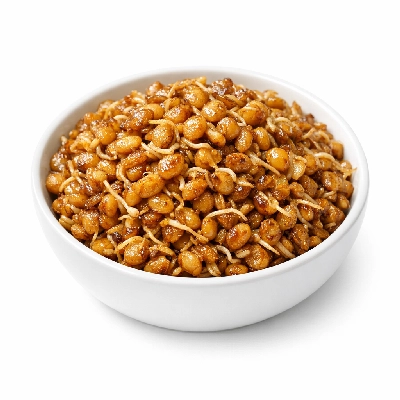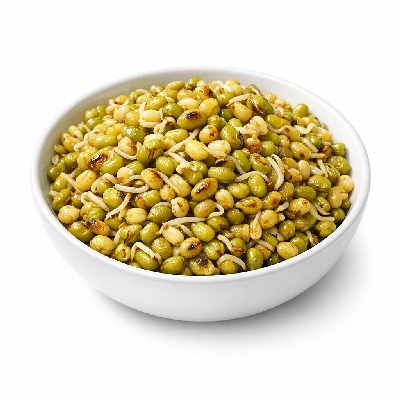
Stir Fried Sprouted Mung Beans
Source of Calories
Nutrition Facts
| Nutrient | Amount | % Daily Value |
|---|---|---|
| Total Carbohydrates | 13.13 g | 5% |
| Net Carbohydrates | 10.78 g | 4% |
| Sugars | No data | - |
| Added Sugars | No data | - |
| Dietary Fiber | 2.36 g | 8% |
| Protein | 5.33 g | 11% |
| Total Fat | 0.26 g | 0% |
| Saturated Fat | 0.05 g | 0% |
| Monounsaturated Fat | 0.07 g | - |
| Polyunsaturated Fat | 0.08 g | - |
| Trans Fat | 0 g | 0% |
| Cholesterol | 0 mg | 0% |
| Vitamins | ||
| Vitamin A | 11.53 mcg | 1% |
| Vitamin C | 19.84 mg | 22% |
| Vitamin D | 0 mcg | 0% |
| Minerals | ||
| Sodium | 11.16 mg | 0% |
| Potassium | 271.56 mg | 6% |
| Calcium | 16.12 mg | 1% |
| Magnesium | 40.92 mg | 10% |
| Iron | 2.36 mg | 13% |
| Zinc | 1.12 mg | 10% |
% DV refers to how much a single serving of an individually packaged food or supplement contributes nutritionally to your daily diet, based on a 2,000-calorie-a-day diet. Generally, having 5% DV or less of a nutrient per serving is considered low, and 20% DV or more of a nutrient per serving is considered high.
Fat Composition
The suggested total fat consumption should be limited to 30% of total energy intake or less. The type of fat consumed should primarily be unsaturated fatty acids, with no more than 10% of total energy intake coming from saturated fatty acids (about 200 calories on a 2000-calorie diet) and no more than 1% of total energy intake coming from trans-fatty acids.
Vitamin Coverage
Vitamin A
1%
Vitamin C
22%
Vitamin D
0%
Vitamin E
-
Vitamin K
-
Vitamin B1
14%
Vitamin B2
17%
Vitamin B3
9%
Vitamin B5
14%
Vitamin B6
9%
Vitamin B7
-
Vitamin B9
22%
Vitamin B12
0%
There are 13 essential vitamins required for the body to work properly, which are categorised into two categories: fat-soluble and water-soluble vitamins. Vitamins have a Recommended Dietary Allowance (RDA), provided by the Dietary Reference Intakes (DRIs), which vary by age and sex. The %DV indicates how much one serving contributes to the average recommended daily intake.
Mineral Coverage
Calcium
1%
Iron
13%
Magnesium
10%
Phosphorus
8%
Potassium
6%
Sodium
0.5%
Zinc
10%
Copper
35%
Manganese
16%
Selenium
1%
Minerals are micronutrients, of which 13 of them are essential to the human body. The Recommended Dietary Allowance includes Calcium (1,300 mg/d), Phosphorus (1,250 mg/d), Potassium (4,700 mg/d), Sodium (2,300 mg/d), Chloride (1,500 mg/d), Magnesium (420 mg/d), Iron (18 mg/d), Zinc (11 mg/d), Copper (0.9 mg/d), Selenium (55 mcg/d), Molybdenum (45 mcg/d), Manganese (2.3 mg/d) and Iodine (150 mcg/d).
Protein Quality
Leucine
12%
Isoleucine
19%
Valine
15%
Lysine
12%
Tryptophan
21%
Threonine
11%
Phenylalanine
20%
Methionine
10%
Histidine
14%
Guidelines recommend a serving of protein with each meal and 1.2-1.6 g of protein per kg of body weight per day.
The data provided by eato.health is for informational purposes only and should not be considered medical advice. Please consult your physician before beginning any diet or nutrition plan.
About
How Long to Burn Off 62 Calories?
*Based on this person: 25-year-old female, 5'7", 144 lbs

Swimming
10 min

Jogging
8 min

Cycling
9 min

Walking
15 min
The data provided by eato.health is for informational purposes only and should not be considered medical advice. Please consult your physician before beginning any diet or nutrition plan.
📚 Health Research & Evidence About This Food
Mung beans are nutrient-dense legumes, rich in protein, fiber, essential amino acids, and various vitamins such as folate, along with powerful antioxidants like phenolic acids and flavonoids. Observational evidence suggests that mung bean sprouts, in particular, may support digestive wellness due to their fiber content, blood pressure regulation by inhibiting angiotensin converting enzyme (ACE) activity, and heart health by balancing cholesterol and reducing triglycerides, with heart-healthy preparations also highlighted by MedlinePlus.
1. Health Benefits of Bean Sprouts: Nutritional Facts and Uses
Source: WebMD
Summary: Mung bean sprouts are rich in vitamins C and K, proteins, and fiber, and may support blood pressure regulation, cancer prevention, digestive wellness, and heart health.
Read More: https://www.webmd.com/diet/health-benefits-bean-sprouts
2. 10 Impressive Health Benefits of Mung Beans
Source: Healthline, 2023
Summary: Mung beans are nutrient-dense legumes, rich in protein, essential amino acids, antioxidants, vitamins, and minerals, making them a valuable plant-based food.
3. Monitoring Quality Parameters of Sprouted Mung Beans Using Near-Infrared Spectroscopy
Source: PubMed
Summary: Near-Infrared Spectroscopy (NIRS) is a highly sensitive and suitable technique for quick and effective quality checks of mung bean sprouts, including the rapid detection of ascorbic acid content.
Read More: https://pubmed.ncbi.nlm.nih.gov/33477304/
4. Medlineplus: SautéEd Mung Beans
Source: MedlinePlus, 2019
Summary: Sautéed mung beans can be prepared in a heart-healthy way by cooking them with garlic, water, and spinach, as outlined in a recipe from the National Heart, Lung, and Blood Institute.
Read More: https://medlineplus.gov/recipes/sauteed-mung-beans/
5. Mung Beans: Health Benefits, Nutrition, and Recipe Tips
Source: Medical News Today, 2019
Summary: Mung beans are a good source of protein and essential B vitamins, particularly vitamin B-9 (folate), which is crucial for DNA synthesis.