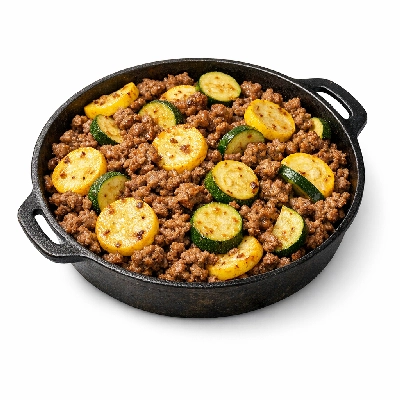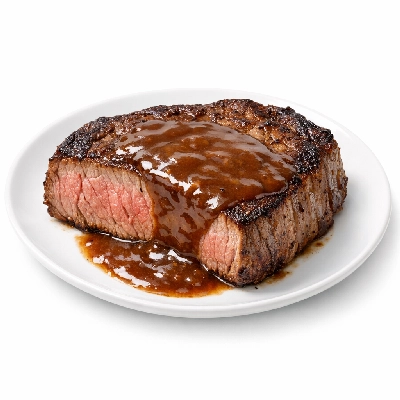
Smothered Beef Steak
Source of Calories
Nutrition Facts
| Nutrient | Amount | % Daily Value |
|---|---|---|
| Total Carbohydrates | 39.14 g | 14% |
| Net Carbohydrates | 31.96 g | 13% |
| Sugars | 13.46 g | 38% |
| Added Sugars | 0 g | 0% |
| Dietary Fiber | 7.18 g | 26% |
| Protein | 173.27 g | 347% |
| Total Fat | 115.81 g | 148% |
| Saturated Fat | 38.94 g | 195% |
| Monounsaturated Fat | 42.77 g | - |
| Polyunsaturated Fat | 19.41 g | - |
| Trans Fat | 0.18 g | 100% |
| Cholesterol | 563.04 mg | 188% |
| Vitamins | ||
| Vitamin A | 283.09 mcg | 31% |
| Vitamin C | 222.41 mg | 247% |
| Vitamin D | 1.38 mcg | 7% |
| Minerals | ||
| Sodium | 3575.82 mg | 155% |
| Potassium | 2830.11 mg | 60% |
| Calcium | 204.48 mg | 16% |
| Magnesium | 182.78 mg | 44% |
| Iron | 13.19 mg | 73% |
| Zinc | 30.7 mg | 279% |
% DV refers to how much a single serving of an individually packaged food or supplement contributes nutritionally to your daily diet, based on a 2,000-calorie-a-day diet. Generally, having 5% DV or less of a nutrient per serving is considered low, and 20% DV or more of a nutrient per serving is considered high.
Fat Composition
The suggested total fat consumption should be limited to 30% of total energy intake or less. The type of fat consumed should primarily be unsaturated fatty acids, with no more than 10% of total energy intake coming from saturated fatty acids (about 200 calories on a 2000-calorie diet) and no more than 1% of total energy intake coming from trans-fatty acids.
Vitamin Coverage
Vitamin A
31%
Vitamin C
247%
Vitamin D
7%
Vitamin E
52%
Vitamin K
59%
Vitamin B1
61%
Vitamin B2
87%
Vitamin B3
304%
Vitamin B5
83%
Vitamin B6
249%
Vitamin B7
-
Vitamin B9
0.2%
Vitamin B12
413%
There are 13 essential vitamins required for the body to work properly, which are categorised into two categories: fat-soluble and water-soluble vitamins. Vitamins have a Recommended Dietary Allowance (RDA), provided by the Dietary Reference Intakes (DRIs), which vary by age and sex. The %DV indicates how much one serving contributes to the average recommended daily intake.
Mineral Coverage
Calcium
16%
Iron
73%
Magnesium
44%
Phosphorus
114%
Potassium
60%
Sodium
155%
Zinc
279%
Copper
73%
Manganese
36%
Selenium
341%
Minerals are micronutrients, of which 13 of them are essential to the human body. The Recommended Dietary Allowance includes Calcium (1,300 mg/d), Phosphorus (1,250 mg/d), Potassium (4,700 mg/d), Sodium (2,300 mg/d), Chloride (1,500 mg/d), Magnesium (420 mg/d), Iron (18 mg/d), Zinc (11 mg/d), Copper (0.9 mg/d), Selenium (55 mcg/d), Molybdenum (45 mcg/d), Manganese (2.3 mg/d) and Iodine (150 mcg/d).
Protein Quality
Leucine
0.7%
Isoleucine
0.7%
Valine
0.8%
Lysine
0.4%
Tryptophan
0.4%
Threonine
0.6%
Phenylalanine
1%
Methionine
0.5%
Histidine
0.4%
Guidelines recommend a serving of protein with each meal and 1.2-1.6 g of protein per kg of body weight per day.
The data provided by eato.health is for informational purposes only and should not be considered medical advice. Please consult your physician before beginning any diet or nutrition plan.
About
How Long to Burn Off 1918 Calories?
*Based on this person: 25-year-old female, 5'7", 144 lbs

Swimming
4 h 41 min

Jogging
4 h 2 min

Cycling
4 h 9 min

Walking
7 h 31 min
The data provided by eato.health is for informational purposes only and should not be considered medical advice. Please consult your physician before beginning any diet or nutrition plan.
FAQ
Per serving, it has about 480 kcal, 43.3 g protein, 29.0 g fat, and 9.8 g carbs, so the protein is strong for fullness, but the calories and fat are fairly high for one plate.
Eating it twice a week could add up to roughly 960 kcal, 19.4 g saturated fat, and 1,788 mg sodium from this dish alone, which may be manageable, based on your diet. If you are managing high LDL, blood pressure, kidney disease, or weight loss, a dietitian or healthcare professional may help you decide whether that frequency fits your overall plan.
Choose a leaner cut, use less gravy, keep the portion moderate, and pair it with vegetables instead of heavier sides. Per serving, smothered beef steak has about 480 kcal, 29.0 g fat, 9.7 g saturated fat, and 894 mg sodium, and if you are managing LDL, blood pressure, or kidney issues, a dietitian may help you choose the right portion.
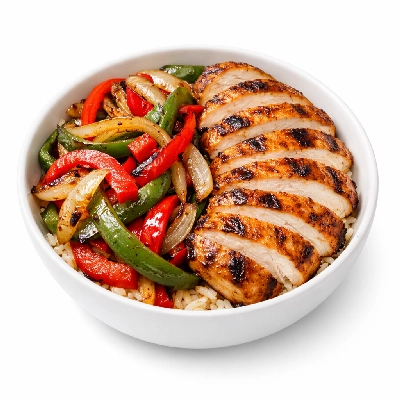
No. A grilled chicken breast with sesame seeds has about 468.5 kcal, 56.6 g protein, 24.7 g fat, and 5.6 g saturated fat, currently lower than a smothered beef steak.
Yes. It has about 9.8 g total carbs, and ketogenic diets typically keep carbs below 50 g per day, sometimes as low as 20 g so it falls within the green range for a keto diet.
Food Health: Research and Evidence
Scientific research and expert reviews suggest that certain components in infant formula, such as specific fats and nutrients, can contribute to better cardiovascular health and improved blood sugar control in infants.
1. Food Health: Research and Evidence
Source: SpringerLink, 2024
Summary: Scientific research and expert reviews suggest that certain components in infant formula, such as specific fats and nutrients, can contribute to better cardiovascular health and improved blood sugar control in infants.
Read More: https://link.springer.com/article/10.1007/s13668-024-00561-9
2. Food Health: Research and Evidence
Source: SpringerLink, 2024
Summary: Scientific research and expert reviews suggest that certain components in infant formula, such as specific fats and nutrients, can contribute to better cardiovascular health and improved blood sugar control in infants.
Read More: https://link.springer.com/article/10.1007/s13668-024-00561-9