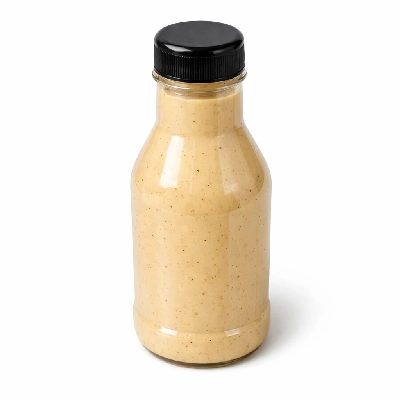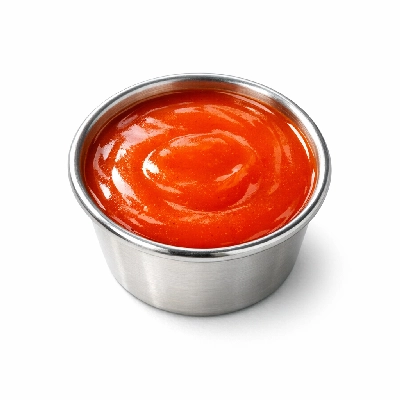
Mcdonald's, Spicy Buffalo Sauce
Source of Calories
Nutrition Facts
| Nutrient | Amount | % Daily Value |
|---|---|---|
| Total Carbohydrates | 0.78 g | 0% |
| Net Carbohydrates | 0.13 g | 0% |
| Sugars | 0 g | 0% |
| Added Sugars | No data | - |
| Dietary Fiber | 0.65 g | 2% |
| Protein | 0.23 g | 0% |
| Total Fat | 6.64 g | 9% |
| Saturated Fat | 0.98 g | 5% |
| Monounsaturated Fat | 1.39 g | - |
| Polyunsaturated Fat | 3.63 g | - |
| Trans Fat | 0.02 g | 100% |
| Cholesterol | 0 mg | 0% |
| Vitamins | ||
| Vitamin A | 132.61 mcg | 15% |
| Vitamin C | 0 mg | 0% |
| Vitamin D | No data | - |
| Minerals | ||
| Sodium | 920.2 mg | 40% |
| Potassium | 43 mg | 1% |
| Calcium | 3.87 mg | 0% |
| Magnesium | 2.58 mg | 1% |
| Iron | 0.15 mg | 1% |
| Zinc | 0.03 mg | 0% |
% DV refers to how much a single serving of an individually packaged food or supplement contributes nutritionally to your daily diet, based on a 2,000-calorie-a-day diet. Generally, having 5% DV or less of a nutrient per serving is considered low, and 20% DV or more of a nutrient per serving is considered high.
Fat Composition
The suggested total fat consumption should be limited to 30% of total energy intake or less. The type of fat consumed should primarily be unsaturated fatty acids, with no more than 10% of total energy intake coming from saturated fatty acids (about 200 calories on a 2000-calorie diet) and no more than 1% of total energy intake coming from trans-fatty acids.
Vitamin Coverage
Vitamin A
15%
Vitamin C
0%
Vitamin D
-
Vitamin E
8%
Vitamin K
-
Vitamin B1
1%
Vitamin B2
2%
Vitamin B3
1%
Vitamin B5
0.9%
Vitamin B6
6%
Vitamin B7
-
Vitamin B9
-
Vitamin B12
0%
There are 13 essential vitamins required for the body to work properly, which are categorised into two categories: fat-soluble and water-soluble vitamins. Vitamins have a Recommended Dietary Allowance (RDA), provided by the Dietary Reference Intakes (DRIs), which vary by age and sex. The %DV indicates how much one serving contributes to the average recommended daily intake.
Mineral Coverage
Calcium
0.3%
Iron
0.8%
Magnesium
0.6%
Phosphorus
0.4%
Potassium
0.9%
Sodium
40%
Zinc
0.2%
Copper
2%
Manganese
0.9%
Selenium
-
Minerals are micronutrients, of which 13 of them are essential to the human body. The Recommended Dietary Allowance includes Calcium (1,300 mg/d), Phosphorus (1,250 mg/d), Potassium (4,700 mg/d), Sodium (2,300 mg/d), Chloride (1,500 mg/d), Magnesium (420 mg/d), Iron (18 mg/d), Zinc (11 mg/d), Copper (0.9 mg/d), Selenium (55 mcg/d), Molybdenum (45 mcg/d), Manganese (2.3 mg/d) and Iodine (150 mcg/d).
The data provided by eato.health is for informational purposes only and should not be considered medical advice. Please consult your physician before beginning any diet or nutrition plan.
About
How Long to Burn Off 61 Calories?
*Based on this person: 25-year-old female, 5'7", 144 lbs

Swimming
9 min

Jogging
8 min

Cycling
8 min

Walking
15 min
The data provided by eato.health is for informational purposes only and should not be considered medical advice. Please consult your physician before beginning any diet or nutrition plan.
📚 Health Research & Evidence About This Food
Buffalo sauce, which often contains capsaicin from chili peppers, includes a compound that mechanistic studies indicate exhibits antioxidant, anti-inflammatory, antibacterial, and analgesic properties by binding to TRPV1 nerve channels. Observational evidence suggests that capsaicin may also contribute to weight loss by enhancing fat-burning and reducing food consumption, and it may support heart health by aiding in the breakdown of fats and positively influence the gut microbiome.
1. Capsaicin: An In-Depth Review of Its Chemical Properties, Health Benefits, and Challenges in Food Applications
Source: SpringerLink
Summary: Capsaicin, a vanilloid compound found predominantly in chili peppers, has garnered significant research interest for its diverse medicinal applications, including antioxidant, inflammatory, antibacterial, and analgesic properties.
Read More: https://link.springer.com/article/10.1186/s43014-025-00321-4
2. Capsaicin: Health Benefits, Safety Information, Dosage, and More
Source: WebMD
Summary: Capsaicin is the active compound in chili peppers, which are used to make buffalo sauce, and it is responsible for the heat in chili peppers and is a primary ingredient in various pain relief treatments.
Read More: https://www.webmd.com/diet/health-benefits-capsaicin
3. 5 Benefits of Eating Spicy Food
Source: Cleveland Clinic
Summary: Capsaicin, found in chili peppers, may contribute to weight loss by enhancing fat-burning and reducing food consumption, and it may also support heart health and positively influence the gut microbiome.
Read More: https://health.clevelandclinic.org/is-spicy-food-good-for-you
4. Tips for Reducing Sodium Intake
Source: CDC, 2026
Summary: High sodium consumption is a significant public health concern, directly linked to elevated blood pressure and an increased risk of serious cardiovascular events, including heart disease and stroke.
Read More: https://www.cdc.gov/salt/reduce-sodium-intake/index.html