Fried Basmati Rice
Source of Calories
Nutrition Facts
| Nutrient | Amount | % Daily Value |
|---|---|---|
| Total Carbohydrates | 95.92 g | 35% |
| Net Carbohydrates | 84.93 g | 34% |
| Sugars | 14.56 g | 42% |
| Added Sugars | 0 g | 0% |
| Dietary Fiber | 10.99 g | 39% |
| Protein | 27.76 g | 56% |
| Total Fat | 38.96 g | 50% |
| Saturated Fat | 7.33 g | 37% |
| Monounsaturated Fat | 10.28 g | - |
| Polyunsaturated Fat | 17.99 g | - |
| Trans Fat | 0.18 g | 100% |
| Cholesterol | 370 mg | 123% |
| Vitamins | ||
| Vitamin A | 1114.47 mcg | 124% |
| Vitamin C | 49.26 mg | 55% |
| Vitamin D | 2 mcg | 10% |
| Minerals | ||
| Sodium | 4311.31 mg | 187% |
| Potassium | 1060.62 mg | 23% |
| Calcium | 183.47 mg | 14% |
| Magnesium | 90.91 mg | 22% |
| Iron | 4.39 mg | 24% |
| Zinc | 3.21 mg | 29% |
% DV refers to how much a single serving of an individually packaged food or supplement contributes nutritionally to your daily diet, based on a 2,000-calorie-a-day diet. Generally, having 5% DV or less of a nutrient per serving is considered low, and 20% DV or more of a nutrient per serving is considered high.
Fat Composition
The suggested total fat consumption should be limited to 30% of total energy intake or less. The type of fat consumed should primarily be unsaturated fatty acids, with no more than 10% of total energy intake coming from saturated fatty acids (about 200 calories on a 2000-calorie diet) and no more than 1% of total energy intake coming from trans-fatty acids.
Vitamin Coverage
Vitamin A
124%
Vitamin C
55%
Vitamin D
10%
Vitamin E
28%
Vitamin K
97%
Vitamin B1
29%
Vitamin B2
51%
Vitamin B3
40%
Vitamin B5
46%
Vitamin B6
46%
Vitamin B7
73%
Vitamin B9
1%
Vitamin B12
42%
There are 13 essential vitamins required for the body to work properly, which are categorised into two categories: fat-soluble and water-soluble vitamins. Vitamins have a Recommended Dietary Allowance (RDA), provided by the Dietary Reference Intakes (DRIs), which vary by age and sex. The %DV indicates how much one serving contributes to the average recommended daily intake.
Mineral Coverage
Calcium
14%
Iron
24%
Magnesium
22%
Phosphorus
34%
Potassium
23%
Sodium
187%
Zinc
29%
Copper
32%
Manganese
54%
Selenium
61%
Minerals are micronutrients, of which 13 of them are essential to the human body. The Recommended Dietary Allowance includes Calcium (1,300 mg/d), Phosphorus (1,250 mg/d), Potassium (4,700 mg/d), Sodium (2,300 mg/d), Chloride (1,500 mg/d), Magnesium (420 mg/d), Iron (18 mg/d), Zinc (11 mg/d), Copper (0.9 mg/d), Selenium (55 mcg/d), Molybdenum (45 mcg/d), Manganese (2.3 mg/d) and Iodine (150 mcg/d).
Protein Quality
Leucine
6%
Isoleucine
8%
Valine
7%
Lysine
5%
Tryptophan
9%
Threonine
6%
Phenylalanine
10%
Methionine
5%
Histidine
6%
Guidelines recommend a serving of protein with each meal and 1.2-1.6 g of protein per kg of body weight per day.
The data provided by eato.health is for informational purposes only and should not be considered medical advice. Please consult your physician before beginning any diet or nutrition plan.
About
How Long to Burn Off 834 Calories?
*Based on this person: 25-year-old female, 5'7", 144 lbs

Swimming
2 h 2 min

Jogging
1 h 46 min

Cycling
1 h 48 min

Walking
3 h 16 min
The data provided by eato.health is for informational purposes only and should not be considered medical advice. Please consult your physician before beginning any diet or nutrition plan.
FAQ
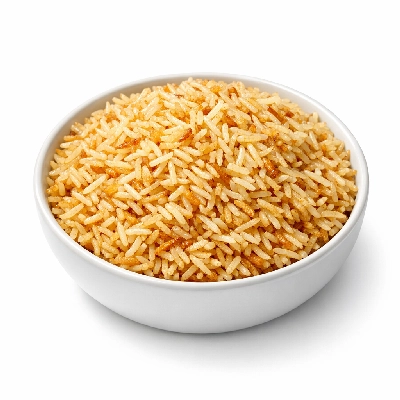
Yes, basmati rice can work very well for fried rice because the grains tend to stay separate and less sticky than many other white rices.
It depends, basmati rice may have a gentler blood sugar effect than many white rice varieties, but frying can still make the final dish less healthy. Per serving, fried basmati rice has about 209 kcal, 24 g carbs, 9.7 g fat, 6.9 g protein, and 1,078 mg sodium, so the sodium is the biggest drawback here. Basmati rice has a glycemic index below 55, which is lower than many white rice types, but that benefit may be partly offset once oil and salty ingredients are added.
Not really. Per serving, fried basmati rice has 9.7 g of fat and high sodium, which may be detrimental to your weight loss journey.
No, it is not especially high in sugar. Per serving, it has about 3.6 g sugar, with 0 g added sugar, so most of the carbs come from starch rather than sugar. The bigger nutrition issue is usually the refined carbs, oil, and sodium, not sugar itself.
Per serving, it has about 24 g total carbs, 21.2 g net carbs, and 2.7 g fiber, so it can still raise blood sugar even though basmati may be lower GI than some other rice types. If you are managing diabetes closely, or using glucose lowering medication, a dietitian or healthcare professional may help you set a portion that fits your plan.
📚 Health Research & Evidence About This Food
Basmati rice, like other cooked rice, is susceptible to food poisoning caused by *Bacillus cereus* if not stored or cooked properly, as heat-resistant spores can survive cooking and multiply rapidly at room temperature.
1. How to Prevent Fried Rice Syndrome
Source: Cleveland Clinic
Summary: Cooked rice, including Basmati rice, is particularly susceptible to Fried Rice Syndrome, a form of food poisoning caused by *Bacillus cereus* when not stored or cooked at appropriate temperatures.
Read More: https://health.clevelandclinic.org/fried-rice-syndrome
2. The Glycemic Potential of White and Red Rice Affected by Oil Type and Time of Addition.
Source: PubMed
Summary: Adding ghee during or before cooking red rice can attenuate postprandial glycemic response and increase resistant starch content.
Read More: https://pubmed.ncbi.nlm.nih.gov/26352188/
3. Glycaemic Responses to Glucose and Rice in People of Chinese and European Ethnicity.
Source: PubMed
Summary: The glycemic index for basmati rice was not significantly higher in Chinese participants compared to Europeans, unlike other rice varieties studied.
Read More: https://pubmed.ncbi.nlm.nih.gov/23181689/
4. Elemental Fingerprinting and Regional Verification of Pakistani Basmati and Non-Basmati Rice Varieties Using Icp-Ms and Multivariate Analysis.
Source: PubMed
Summary: Basmati rice demonstrated a higher accumulation of essential macro and trace elements compared to non-Basmati varieties.
Read More: https://pubmed.ncbi.nlm.nih.gov/41633162/