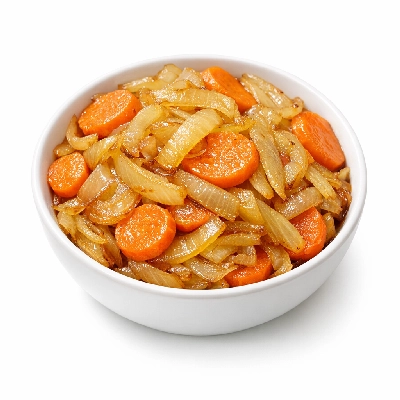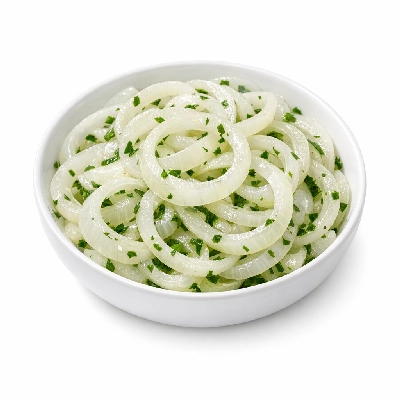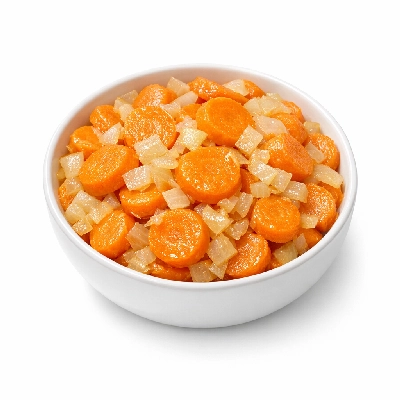
Cooked Carrots & Onions
Source of Calories
Nutrition Facts
| Nutrient | Amount | % Daily Value |
|---|---|---|
| Total Carbohydrates | 57.79 g | 21% |
| Net Carbohydrates | 42.42 g | 17% |
| Sugars | 27.87 g | 80% |
| Added Sugars | 0 g | 0% |
| Dietary Fiber | 15.37 g | 55% |
| Protein | 5.92 g | 12% |
| Total Fat | 28.27 g | 36% |
| Saturated Fat | 3.94 g | 20% |
| Monounsaturated Fat | 19.79 g | - |
| Polyunsaturated Fat | 3.34 g | - |
| Trans Fat | 0 g | 0% |
| Cholesterol | 0 mg | 0% |
| Vitamins | ||
| Vitamin A | 3789.09 mcg | 421% |
| Vitamin C | 37.85 mg | 42% |
| Vitamin D | 0 mcg | 0% |
| Minerals | ||
| Sodium | 2645.1 mg | 115% |
| Potassium | 1678.22 mg | 36% |
| Calcium | 188.22 mg | 14% |
| Magnesium | 70.39 mg | 17% |
| Iron | 1.89 mg | 10% |
| Zinc | 1.36 mg | 12% |
% DV refers to how much a single serving of an individually packaged food or supplement contributes nutritionally to your daily diet, based on a 2,000-calorie-a-day diet. Generally, having 5% DV or less of a nutrient per serving is considered low, and 20% DV or more of a nutrient per serving is considered high.
Fat Composition
The suggested total fat consumption should be limited to 30% of total energy intake or less. The type of fat consumed should primarily be unsaturated fatty acids, with no more than 10% of total energy intake coming from saturated fatty acids (about 200 calories on a 2000-calorie diet) and no more than 1% of total energy intake coming from trans-fatty acids.
Vitamin Coverage
Vitamin A
421%
Vitamin C
42%
Vitamin D
0%
Vitamin E
46%
Vitamin K
65%
Vitamin B1
29%
Vitamin B2
22%
Vitamin B3
29%
Vitamin B5
29%
Vitamin B6
48%
Vitamin B7
-
Vitamin B9
0%
Vitamin B12
0%
There are 13 essential vitamins required for the body to work properly, which are categorised into two categories: fat-soluble and water-soluble vitamins. Vitamins have a Recommended Dietary Allowance (RDA), provided by the Dietary Reference Intakes (DRIs), which vary by age and sex. The %DV indicates how much one serving contributes to the average recommended daily intake.
Mineral Coverage
Calcium
14%
Iron
10%
Magnesium
17%
Phosphorus
16%
Potassium
36%
Sodium
115%
Zinc
12%
Copper
31%
Manganese
39%
Selenium
2%
Minerals are micronutrients, of which 13 of them are essential to the human body. The Recommended Dietary Allowance includes Calcium (1,300 mg/d), Phosphorus (1,250 mg/d), Potassium (4,700 mg/d), Sodium (2,300 mg/d), Chloride (1,500 mg/d), Magnesium (420 mg/d), Iron (18 mg/d), Zinc (11 mg/d), Copper (0.9 mg/d), Selenium (55 mcg/d), Molybdenum (45 mcg/d), Manganese (2.3 mg/d) and Iodine (150 mcg/d).
Protein Quality
Leucine
0.2%
Isoleucine
0.1%
Valine
0.2%
Lysine
0%
Tryptophan
0.1%
Threonine
0.1%
Phenylalanine
0.2%
Methionine
0.1%
Histidine
0.1%
Guidelines recommend a serving of protein with each meal and 1.2-1.6 g of protein per kg of body weight per day.
The data provided by eato.health is for informational purposes only and should not be considered medical advice. Please consult your physician before beginning any diet or nutrition plan.
About
How Long to Burn Off 486 Calories?
*Based on this person: 25-year-old female, 5'7", 144 lbs

Swimming
1 h 12 min

Jogging
1 h 2 min

Cycling
1 h 3 min

Walking
1 h 55 min
The data provided by eato.health is for informational purposes only and should not be considered medical advice. Please consult your physician before beginning any diet or nutrition plan.
📚 Health Research & Evidence About This Food
Carrots and onions are root vegetables known for being low in calories and rich in antioxidants, such as beta carotene in carrots and quercetin and thiosulfinates in onions. Beta carotene supports the immune system as a precursor to vitamin A and may be associated with a lower risk of chronic diseases, according to Medical News Today. However, research also indicates that these vegetables can absorb heavy metals from contaminated irrigation water, posing potential health risks.
1. Boosting the Nutritional Bounty of Carrots and Onions : Usda Ars
Source: USDA ARS, 2022
Summary: Carrots and onions are the focus of Agricultural Research Service scientists who are leveraging genomics to increase their levels of beneficial phytonutrients like beta carotene, anthocyanin, quercetin, thiosulfinates, and fructan, while also improving pest and disease resistance.
2. What Is Beta Carotene? What Are the Benefits?
Source: Medical News Today, 2017
Summary: Carrots contain beta carotene. Beta carotene is converted into vitamin A in the body and acts as an antioxidant that helps protect cells and support immune health.
3. The Uptake of Nickel and Chromium From Irrigation Water by Potatoes, Carrots and Onions.
Source: PubMed
Summary: Carrots and onions, along with potatoes, can absorb heavy metals like nickel and chromium from polluted irrigation water, posing potential health risks upon chronic consumption.
Read More: https://pubmed.ncbi.nlm.nih.gov/23433838/
4. The Pros and Cons of Root Vegetables - Harvard Health
Source: Harvard Health, 2018
Summary: Carrots and onions, as examples of root vegetables, are low in calories and high in antioxidants, but their starchy carbohydrate content means they should be consumed in moderation and prepared simply to avoid potential weight gain from excess glucose conversion.
Read More: https://www.health.harvard.edu/healthy-aging-and-longevity/the-pros-and-cons-of-root-vegetables
5. Roasted Carrot and Beet Soup Recipe
Source: Academy of Nutrition and Dietetics
Summary: Carrots and onions, as key ingredients in Roasted Carrot and Beet Soup, contribute to a unique flavor profile and provide a variety of nutrients, phytonutrients, and fiber.
Read More: https://www.eatright.org/recipes/soups-and-stews/roasted-carrot-and-beet-soup-recipe