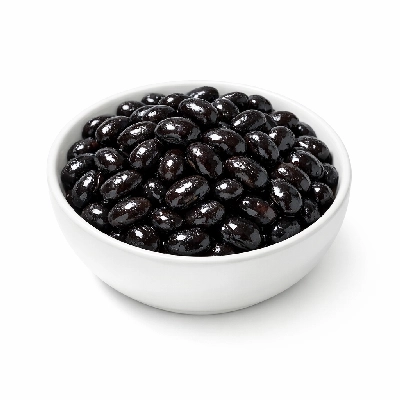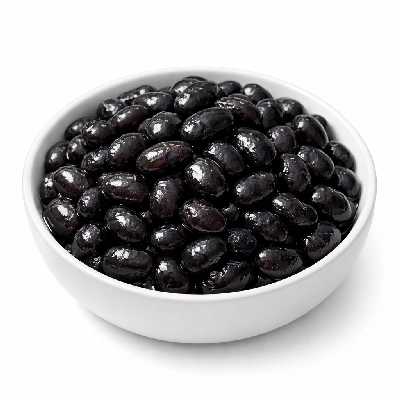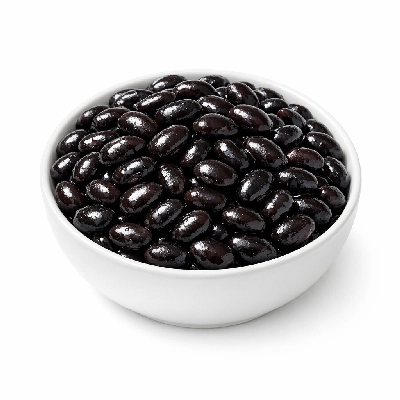
Boiled Black Beans with Salt
Source of Calories
Nutrition Facts
| Nutrient | Amount | % Daily Value |
|---|---|---|
| Total Carbohydrates | 40.78 g | 15% |
| Net Carbohydrates | 25.82 g | 10% |
| Sugars | 0.55 g | 2% |
| Added Sugars | No data | - |
| Dietary Fiber | 14.96 g | 53% |
| Protein | 15.24 g | 30% |
| Total Fat | 0.93 g | 1% |
| Saturated Fat | 0.24 g | 1% |
| Monounsaturated Fat | 0.08 g | - |
| Polyunsaturated Fat | 0.4 g | - |
| Trans Fat | 0 g | 0% |
| Cholesterol | 0 mg | 0% |
| Vitamins | ||
| Vitamin A | 3.1 mcg | 0% |
| Vitamin C | 0 mg | 0% |
| Vitamin D | 0 mcg | 0% |
| Minerals | ||
| Sodium | 407.64 mg | 18% |
| Potassium | 610.6 mg | 13% |
| Calcium | 46.44 mg | 4% |
| Magnesium | 120.4 mg | 29% |
| Iron | 3.61 mg | 20% |
| Zinc | 1.93 mg | 18% |
% DV refers to how much a single serving of an individually packaged food or supplement contributes nutritionally to your daily diet, based on a 2,000-calorie-a-day diet. Generally, having 5% DV or less of a nutrient per serving is considered low, and 20% DV or more of a nutrient per serving is considered high.
Fat Composition
The suggested total fat consumption should be limited to 30% of total energy intake or less. The type of fat consumed should primarily be unsaturated fatty acids, with no more than 10% of total energy intake coming from saturated fatty acids (about 200 calories on a 2000-calorie diet) and no more than 1% of total energy intake coming from trans-fatty acids.
Vitamin Coverage
Vitamin A
0.3%
Vitamin C
0%
Vitamin D
0%
Vitamin E
10%
Vitamin K
5%
Vitamin B1
35%
Vitamin B2
8%
Vitamin B3
5%
Vitamin B5
8%
Vitamin B6
7%
Vitamin B7
-
Vitamin B9
64%
Vitamin B12
0%
There are 13 essential vitamins required for the body to work properly, which are categorised into two categories: fat-soluble and water-soluble vitamins. Vitamins have a Recommended Dietary Allowance (RDA), provided by the Dietary Reference Intakes (DRIs), which vary by age and sex. The %DV indicates how much one serving contributes to the average recommended daily intake.
Mineral Coverage
Calcium
4%
Iron
20%
Magnesium
29%
Phosphorus
19%
Potassium
13%
Sodium
18%
Zinc
18%
Copper
40%
Manganese
33%
Selenium
4%
Minerals are micronutrients, of which 13 of them are essential to the human body. The Recommended Dietary Allowance includes Calcium (1,300 mg/d), Phosphorus (1,250 mg/d), Potassium (4,700 mg/d), Sodium (2,300 mg/d), Chloride (1,500 mg/d), Magnesium (420 mg/d), Iron (18 mg/d), Zinc (11 mg/d), Copper (0.9 mg/d), Selenium (55 mcg/d), Molybdenum (45 mcg/d), Manganese (2.3 mg/d) and Iodine (150 mcg/d).
Protein Quality
Leucine
41%
Isoleucine
51%
Valine
48%
Lysine
39%
Tryptophan
52%
Threonine
46%
Phenylalanine
71%
Methionine
34%
Histidine
43%
Guidelines recommend a serving of protein with each meal and 1.2-1.6 g of protein per kg of body weight per day.
The data provided by eato.health is for informational purposes only and should not be considered medical advice. Please consult your physician before beginning any diet or nutrition plan.
About
How Long to Burn Off 227 Calories?
*Based on this person: 25-year-old female, 5'7", 144 lbs

Swimming
34 min

Jogging
29 min

Cycling
30 min

Walking
54 min
The data provided by eato.health is for informational purposes only and should not be considered medical advice. Please consult your physician before beginning any diet or nutrition plan.
📚 Health Research & Evidence About This Food
Black beans are a nutrient-dense legume rich in fiber, plant-based protein, and antioxidants, contributing to various health benefits. Research, including a PubMed study, indicates they support heart health by improving vascular responses and helping to lower cholesterol, while their fiber content aids blood sugar regulation, promotes satiety, and may protect against certain cancers, according to WebMD. However, the added salt in boiled black beans may moderate some heart health benefits.
1. Black Beans: Health Benefits, Nutrients, Preparation, and More
Source: WebMD
Summary: Black beans contribute to heart health by lowering total and "bad" cholesterol levels, while also offering benefits such as blood sugar regulation, cancer prevention, eye protection, and weight management due to their rich content of antioxidants, fiber, protein, and slow-digesting carbohydrates.
Read More: https://www.webmd.com/diet/health-benefits-black-beans
2. Fiber: The Carb That Helps You Manage Diabetes
Source: CDC, 2024
Summary: Black beans, as a source of dietary fiber, contribute to heart health by preventing the body from absorbing some fat and cholesterol, and also aid in controlling blood sugar, maintaining digestive health, and promoting satiety.
Read More: https://www.cdc.gov/diabetes/healthy-eating/fiber-helps-diabetes.html
3. Why Beans Are Nature’S Perfect Food
Source: UCLA Health
Summary: Black beans, as a type of bean, contribute to heart health by lowering cholesterol levels when replacing animal proteins, and also help regulate blood sugar, prevent constipation, protect against colon cancer, and manage weight due to their high fiber and protein content.
Read More: https://www.uclahealth.org/news/article/why-beans-are-natures-perfect-food
4. Black Beans and Red Kidney Beans Induce Positive Postprandial Vascular Responses in Healthy Adults: A Pilot Randomized Cross-Over Study.
Source: PubMed
Summary: Black beans induce positive postprandial vascular responses in healthy adults, suggesting an immediate beneficial impact on cardiovascular health, in addition to the long-term vascular improvements observed with consistent pulse consumption.
Read More: https://pubmed.ncbi.nlm.nih.gov/32917495/
5. Are Black Beans Good for You?
Source: Cleveland Clinic
Summary: Black beans are an excellent addition to a heart-healthy diet, contributing to cardiovascular well-being through their rich content of soluble and insoluble fiber, antioxidants like anthocyanin and quercetin, and various vitamins, minerals, and phytochemicals.
Read More: https://health.clevelandclinic.org/benefits-of-black-beans