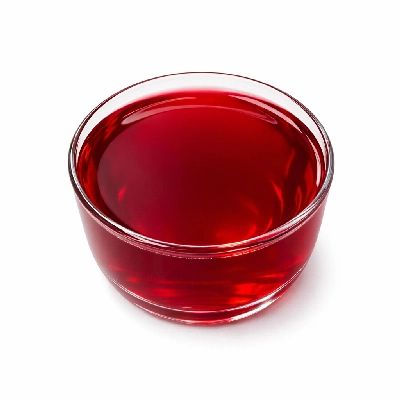
Unsweetened Cranberry Juice
Source of Calories
Nutrition Facts
| Nutrient | Amount | % Daily Value |
|---|---|---|
| Total Carbohydrates | 30.87 g | 11% |
| Net Carbohydrates | 30.61 g | 12% |
| Sugars | 30.61 g | 87% |
| Added Sugars | No data | - |
| Dietary Fiber | 0.25 g | 1% |
| Protein | 0.99 g | 2% |
| Total Fat | 0.33 g | 0% |
| Saturated Fat | 0.03 g | 0% |
| Monounsaturated Fat | 0.06 g | - |
| Polyunsaturated Fat | 0.18 g | - |
| Trans Fat | 0 g | 0% |
| Cholesterol | 0 mg | 0% |
| Vitamins | ||
| Vitamin A | 5.69 mcg | 1% |
| Vitamin C | 23.53 mg | 26% |
| Vitamin D | 0 mcg | 0% |
| Minerals | ||
| Sodium | 5.06 mg | 0% |
| Potassium | 194.81 mg | 4% |
| Calcium | 20.24 mg | 2% |
| Magnesium | 15.18 mg | 4% |
| Iron | 0.63 mg | 4% |
| Zinc | 0.25 mg | 2% |
% DV refers to how much a single serving of an individually packaged food or supplement contributes nutritionally to your daily diet, based on a 2,000-calorie-a-day diet. Generally, having 5% DV or less of a nutrient per serving is considered low, and 20% DV or more of a nutrient per serving is considered high.
Fat Composition
The suggested total fat consumption should be limited to 30% of total energy intake or less. The type of fat consumed should primarily be unsaturated fatty acids, with no more than 10% of total energy intake coming from saturated fatty acids (about 200 calories on a 2000-calorie diet) and no more than 1% of total energy intake coming from trans-fatty acids.
Vitamin Coverage
Vitamin A
0.6%
Vitamin C
26%
Vitamin D
0%
Vitamin E
20%
Vitamin K
11%
Vitamin B1
2%
Vitamin B2
4%
Vitamin B3
1%
Vitamin B5
-
Vitamin B6
8%
Vitamin B7
-
Vitamin B9
0.6%
Vitamin B12
0%
There are 13 essential vitamins required for the body to work properly, which are categorised into two categories: fat-soluble and water-soluble vitamins. Vitamins have a Recommended Dietary Allowance (RDA), provided by the Dietary Reference Intakes (DRIs), which vary by age and sex. The %DV indicates how much one serving contributes to the average recommended daily intake.
Mineral Coverage
Calcium
2%
Iron
4%
Magnesium
4%
Phosphorus
3%
Potassium
4%
Sodium
0.2%
Zinc
2%
Copper
15%
Manganese
-
Selenium
0.5%
Minerals are micronutrients, of which 13 of them are essential to the human body. The Recommended Dietary Allowance includes Calcium (1,300 mg/d), Phosphorus (1,250 mg/d), Potassium (4,700 mg/d), Sodium (2,300 mg/d), Chloride (1,500 mg/d), Magnesium (420 mg/d), Iron (18 mg/d), Zinc (11 mg/d), Copper (0.9 mg/d), Selenium (55 mcg/d), Molybdenum (45 mcg/d), Manganese (2.3 mg/d) and Iodine (150 mcg/d).
The data provided by eato.health is for informational purposes only and should not be considered medical advice. Please consult your physician before beginning any diet or nutrition plan.
About
How Long to Burn Off 116 Calories?
*Based on this person: 25-year-old female, 5'7", 144 lbs

Swimming
18 min

Jogging
15 min

Cycling
16 min

Walking
28 min
The data provided by eato.health is for informational purposes only and should not be considered medical advice. Please consult your physician before beginning any diet or nutrition plan.
📚 Health Research & Evidence About This Food
Cranberry juice significantly reduces clinical urinary tract infection (UTI) episodes in women with a history of UTIs, as demonstrated in a randomized, double-blind, placebo-controlled clinical trial. The U.S. Food and Drug Administration has issued qualified health claims regarding its potential to reduce the risk of recurrent UTIs, noting limited and inconsistent credible scientific evidence. Additionally, chronic cranberry juice intake has been shown to significantly reduce arterial stiffness, a key indicator of central aortic stiffness, in individuals with coronary artery disease, contributing to cardiovascular health. This synthesis draws on research published by FDA and other peer-reviewed sources examining the health properties of cranberry juice.
1. Fda Announces Qualified Health Claim for Certain Cranberry Products and Urinary Tract Infections
Source: FDA, 2024
Summary: The U.S. Food and Drug Administration (FDA) has issued qualified health claims for certain cranberry products, including cranberry juice beverages, regarding their potential to reduce the risk of recurrent urinary tract infections (UTIs) in healthy women, based on limited and inconsistent credible scientific evidence.
2. Effects of Cranberry Juice Consumption on Vascular Function in Patients With Coronary Artery Disease.
Source: PubMed
Summary: Chronic cranberry juice intake significantly reduces arterial stiffness, as evidenced by a decrease in carotid-femoral pulse wave velocity.
Read More: https://pubmed.ncbi.nlm.nih.gov/21411615/
3. Can Cranberry Stop Your Utis?
Source: Cleveland Clinic
Summary: Cranberries contain active compounds called proanthocyanidins (PACs), with studies suggesting a daily intake of PACs for urinary tract infection prevention, though further research is required to establish optimal dosing.
Read More: https://health.clevelandclinic.org/can-cranberry-juice-stop-uti
4. Consumption of a Cranberry Juice Beverage Lowered the Number of Clinical Urinary Tract Infection Episodes in Women With a Recent History of Urinary Tract Infection.
Source: PubMed
Summary: Daily consumption of a cranberry beverage significantly reduces the number of clinical urinary tract infection episodes in women with a recent history of UTIs.
Read More: https://pubmed.ncbi.nlm.nih.gov/27251185/