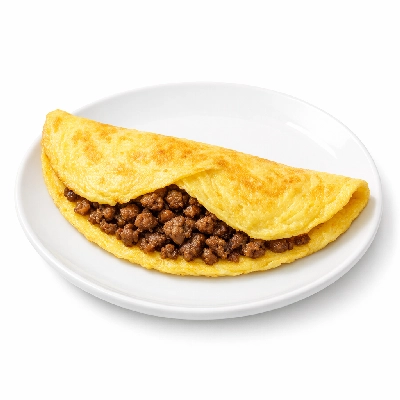
Omelette with Ground Beef
Source of Calories
Nutrition Facts
| Nutrient | Amount | % Daily Value |
|---|---|---|
| Total Carbohydrates | 7.86 g | 3% |
| Net Carbohydrates | 6.8 g | 3% |
| Sugars | 3.99 g | 11% |
| Added Sugars | 0 g | 0% |
| Dietary Fiber | 1.07 g | 4% |
| Protein | 32.83 g | 66% |
| Total Fat | 38.86 g | 50% |
| Saturated Fat | 19.71 g | 99% |
| Monounsaturated Fat | 12.39 g | - |
| Polyunsaturated Fat | 2.17 g | - |
| Trans Fat | 1.21 g | 100% |
| Cholesterol | 285.62 mg | 95% |
| Vitamins | ||
| Vitamin A | 274.43 mcg | 30% |
| Vitamin C | 4.07 mg | 5% |
| Vitamin D | 1.43 mcg | 7% |
| Minerals | ||
| Sodium | 1580.41 mg | 69% |
| Potassium | 502.36 mg | 11% |
| Calcium | 290.16 mg | 22% |
| Magnesium | 41.55 mg | 10% |
| Iron | 3.01 mg | 17% |
| Zinc | 6.41 mg | 58% |
% DV refers to how much a single serving of an individually packaged food or supplement contributes nutritionally to your daily diet, based on a 2,000-calorie-a-day diet. Generally, having 5% DV or less of a nutrient per serving is considered low, and 20% DV or more of a nutrient per serving is considered high.
Fat Composition
The suggested total fat consumption should be limited to 30% of total energy intake or less. The type of fat consumed should primarily be unsaturated fatty acids, with no more than 10% of total energy intake coming from saturated fatty acids (about 200 calories on a 2000-calorie diet) and no more than 1% of total energy intake coming from trans-fatty acids.
Vitamin Coverage
Vitamin A
30%
Vitamin C
5%
Vitamin D
7%
Vitamin E
9%
Vitamin K
3%
Vitamin B1
8%
Vitamin B2
40%
Vitamin B3
39%
Vitamin B5
32%
Vitamin B6
32%
Vitamin B7
34%
Vitamin B9
2%
Vitamin B12
120%
There are 13 essential vitamins required for the body to work properly, which are categorised into two categories: fat-soluble and water-soluble vitamins. Vitamins have a Recommended Dietary Allowance (RDA), provided by the Dietary Reference Intakes (DRIs), which vary by age and sex. The %DV indicates how much one serving contributes to the average recommended daily intake.
Mineral Coverage
Calcium
22%
Iron
17%
Magnesium
10%
Phosphorus
35%
Potassium
11%
Sodium
69%
Zinc
58%
Copper
11%
Manganese
7%
Selenium
67%
Minerals are micronutrients, of which 13 of them are essential to the human body. The Recommended Dietary Allowance includes Calcium (1,300 mg/d), Phosphorus (1,250 mg/d), Potassium (4,700 mg/d), Sodium (2,300 mg/d), Chloride (1,500 mg/d), Magnesium (420 mg/d), Iron (18 mg/d), Zinc (11 mg/d), Copper (0.9 mg/d), Selenium (55 mcg/d), Molybdenum (45 mcg/d), Manganese (2.3 mg/d) and Iodine (150 mcg/d).
Protein Quality
Leucine
19%
Isoleucine
26%
Valine
24%
Lysine
11%
Tryptophan
44%
Threonine
21%
Phenylalanine
26%
Methionine
23%
Histidine
16%
Guidelines recommend a serving of protein with each meal and 1.2-1.6 g of protein per kg of body weight per day.
The data provided by eato.health is for informational purposes only and should not be considered medical advice. Please consult your physician before beginning any diet or nutrition plan.
About
How Long to Burn Off 514 Calories?
*Based on this person: 25-year-old female, 5'7", 144 lbs

Swimming
1 h 16 min

Jogging
1 h 5 min

Cycling
1 h 7 min

Walking
2 h 1 min
The data provided by eato.health is for informational purposes only and should not be considered medical advice. Please consult your physician before beginning any diet or nutrition plan.
📚 Health Research & Evidence About This Food
An omelette with ground beef, via its egg and ground beef components, contributes to a high-protein breakfast that supports satiety, weight management, and muscle mass by providing essential amino acids for muscle repair and synthesis. Its components, eggs and ground beef, are also preferred for faster nutrient absorption after a workout, aiding in muscle protein synthesis and glycogen replenishment.
1. Low-Carb, High-Protein Diets: Risks (Ketosis) and Benefits
Source: WebMD
Summary: High-protein, low-carbohydrate diets, which include foods like ground beef and eggs, aim to shift the body's primary energy source from carbohydrates to fats and proteins, potentially leading to weight loss by promoting satiety.
Read More: https://www.webmd.com/diet/high-protein-low-carbohydrate-diets
2. Meal-Based Enhancement of Protein Quality and Quantity During Weight Loss in Obese Older Adults With Mobility Limitations: Rationale and Design for the Measur-Up Trial - Pmc
Source: NCBI
Summary: High-quality animal protein, specifically lean beef, is being investigated in a pilot study for its potential to preserve lean muscle mass and improve functional status in obese older adults undergoing weight reduction.
Read More: https://www.ncbi.nlm.nih.gov/pmc/articles/PMC4438314/
3. Pictures of the Best and Worst Foods for Psoriasis
Source: WebMD
Summary: Fatty red meat, such as ground beef, should be consumed less frequently by individuals managing psoriasis due to its potential to promote inflammation.
Read More: https://www.webmd.com/skin-problems-and-treatments/psoriasis/ss/slideshow-psoriasis-foods
4. Post-Workout Nutrition: What to Eat After a Workout
Source: Healthline, 2016
Summary: Eggs and various meats are preferred for faster nutrient absorption after a workout.
Read More: https://www.healthline.com/nutrition/eat-after-workout
5. High Protein Breakfast Ideas: Eggs, Meat, Plant, and Dairy-Based Ideas
Source: Medical News Today, 2025
Summary: A high-protein breakfast, such as an omelette with ground beef, offers several health advantages, including better management of blood sugar levels after eating, increased satiety, support for weight management, and enhanced muscle mass.
Read More: https://www.medicalnewstoday.com/articles/high-protein-breakfast