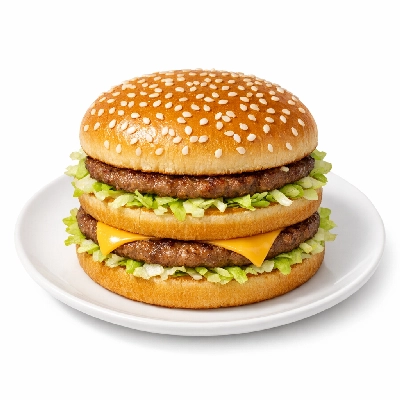
Mcdonald's, Big Mac, without Sauce
Source of Calories
Nutrition Facts
| Nutrient | Amount | % Daily Value |
|---|---|---|
| Total Carbohydrates | 42.02 g | 15% |
| Net Carbohydrates | 38.62 g | 16% |
| Sugars | 7.4 g | 21% |
| Added Sugars | No data | - |
| Dietary Fiber | 3.4 g | 12% |
| Protein | 25.58 g | 51% |
| Total Fat | 23.14 g | 30% |
| Saturated Fat | 8.32 g | 42% |
| Monounsaturated Fat | 7.6 g | - |
| Polyunsaturated Fat | 0.67 g | - |
| Trans Fat | No data | - |
| Cholesterol | 70 mg | 23% |
| Vitamins | ||
| Vitamin A | 111.6 mcg | 12% |
| Vitamin C | 0.8 mg | 1% |
| Vitamin D | No data | - |
| Minerals | ||
| Sodium | 908 mg | 39% |
| Potassium | 384 mg | 8% |
| Calcium | 248 mg | 19% |
| Magnesium | 42 mg | 10% |
| Iron | 4.28 mg | 24% |
| Zinc | 4.14 mg | 38% |
% DV refers to how much a single serving of an individually packaged food or supplement contributes nutritionally to your daily diet, based on a 2,000-calorie-a-day diet. Generally, having 5% DV or less of a nutrient per serving is considered low, and 20% DV or more of a nutrient per serving is considered high.
Fat Composition
The suggested total fat consumption should be limited to 30% of total energy intake or less. The type of fat consumed should primarily be unsaturated fatty acids, with no more than 10% of total energy intake coming from saturated fatty acids (about 200 calories on a 2000-calorie diet) and no more than 1% of total energy intake coming from trans-fatty acids.
Vitamin Coverage
Vitamin A
12%
Vitamin C
0.9%
Vitamin D
-
Vitamin E
-
Vitamin K
-
Vitamin B1
32%
Vitamin B2
34%
Vitamin B3
46%
Vitamin B5
-
Vitamin B6
-
Vitamin B7
-
Vitamin B9
-
Vitamin B12
78%
There are 13 essential vitamins required for the body to work properly, which are categorised into two categories: fat-soluble and water-soluble vitamins. Vitamins have a Recommended Dietary Allowance (RDA), provided by the Dietary Reference Intakes (DRIs), which vary by age and sex. The %DV indicates how much one serving contributes to the average recommended daily intake.
Mineral Coverage
Calcium
19%
Iron
24%
Magnesium
10%
Phosphorus
21%
Potassium
8%
Sodium
39%
Zinc
38%
Copper
23%
Manganese
19%
Selenium
-
Minerals are micronutrients, of which 13 of them are essential to the human body. The Recommended Dietary Allowance includes Calcium (1,300 mg/d), Phosphorus (1,250 mg/d), Potassium (4,700 mg/d), Sodium (2,300 mg/d), Chloride (1,500 mg/d), Magnesium (420 mg/d), Iron (18 mg/d), Zinc (11 mg/d), Copper (0.9 mg/d), Selenium (55 mcg/d), Molybdenum (45 mcg/d), Manganese (2.3 mg/d) and Iodine (150 mcg/d).
The data provided by eato.health is for informational purposes only and should not be considered medical advice. Please consult your physician before beginning any diet or nutrition plan.
About
How Long to Burn Off 468 Calories?
*Based on this person: 25-year-old female, 5'7", 144 lbs

Swimming
1 h 9 min

Jogging
60 min

Cycling
1 h 1 min

Walking
1 h 50 min
The data provided by eato.health is for informational purposes only and should not be considered medical advice. Please consult your physician before beginning any diet or nutrition plan.
📚 Health Research & Evidence About This Food
The Big Mac, like other fast-food items, is generally characterized by high levels of calories, fat, sugar, salt, and processed carbohydrates, while being deficient in essential nutrients like fiber, vitamins, and minerals, a profile that, according to Medical News Today, contributes to rapid increases in blood sugar levels. Regular consumption of fast food, of which the Big Mac is an example, is associated with negative health impacts such as impaired insulin response and weight gain, as Healthline indicates, explaining that high carbohydrate content can lead to frequent blood sugar spikes. The Big Mac, as a component of fast-food burger meals, is part of a category that exhibits substantial variability in sodium content, as shown in studies analyzing nutritional guides from national fast-food chains.
1. Calorie Count - Fast Food: Medlineplus Medical Encyclopedia
Source: MedlinePlus
Summary: A Big Mac contains calories per sandwich.
Read More: https://medlineplus.gov/ency/patientinstructions/000887.htm
2. Wisely Choosing a Fast-Food Burger Meal Results in Meaningful Reduction in Sodium: Implications for Kidney Stone Patients.
Source: PubMed
Summary: Fast-food burger meals, including burgers and fries, exhibit significant variability in sodium content, with median sodium levels for burgers and for fries, allowing for substantial sodium reduction through informed choices.
Read More: https://pubmed.ncbi.nlm.nih.gov/37481046/
3. Fast Food's Effects on 8 Areas of the Body
Source: Healthline, 2018
Summary: Regular fast food consumption, characterized by high calories, sugar, unhealthy fats, and sodium, is associated with numerous negative health impacts across various bodily systems, including impaired insulin response, weight gain, and potential adverse effects on memory and fertility.
Read More: https://www.healthline.com/health/fast-food-effects-on-body
4. What to Know About Fast Food and Diabetes
Source: Medical News Today, 2019
Summary: Fast foods are generally characterized by high levels of calories, fat, sugar, salt, and processed carbohydrates, coupled with a deficiency in essential nutrients like fiber, vitamins, and minerals.