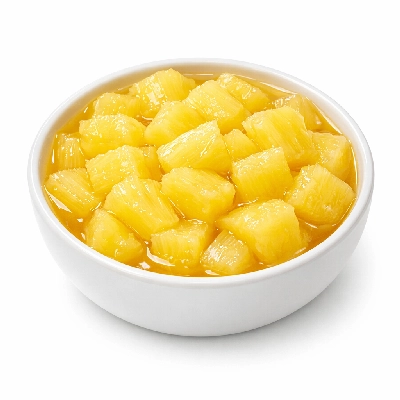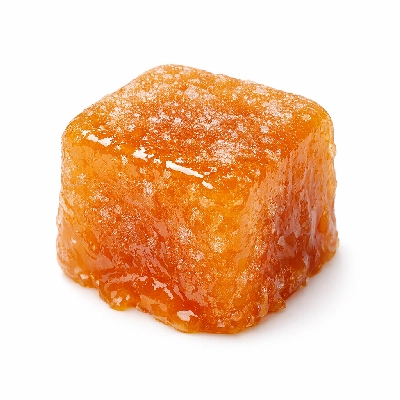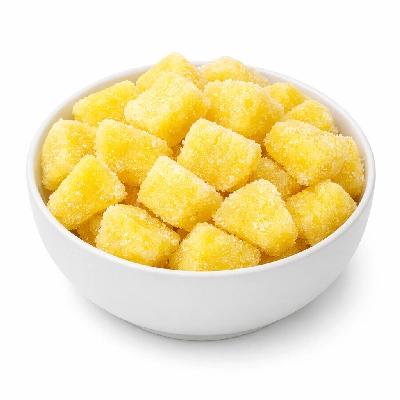
Frozen Pineapple Chunks, Sweetened
Source of Calories
Nutrition Facts
| Nutrient | Amount | % Daily Value |
|---|---|---|
| Total Carbohydrates | 54.39 g | 20% |
| Net Carbohydrates | 51.7 g | 21% |
| Sugars | 51.7 g | 148% |
| Added Sugars | No data | - |
| Dietary Fiber | 2.7 g | 10% |
| Protein | 0.98 g | 2% |
| Total Fat | 0.25 g | 0% |
| Saturated Fat | 0.02 g | 0% |
| Monounsaturated Fat | 0.03 g | - |
| Polyunsaturated Fat | 0.09 g | - |
| Trans Fat | 0 g | 0% |
| Cholesterol | 0 mg | 0% |
| Vitamins | ||
| Vitamin A | 3.68 mcg | 0% |
| Vitamin C | 19.6 mg | 22% |
| Vitamin D | 0 mcg | 0% |
| Minerals | ||
| Sodium | 4.9 mg | 0% |
| Potassium | 245 mg | 5% |
| Calcium | 22.05 mg | 2% |
| Magnesium | 24.5 mg | 6% |
| Iron | 0.98 mg | 5% |
| Zinc | 0.27 mg | 2% |
% DV refers to how much a single serving of an individually packaged food or supplement contributes nutritionally to your daily diet, based on a 2,000-calorie-a-day diet. Generally, having 5% DV or less of a nutrient per serving is considered low, and 20% DV or more of a nutrient per serving is considered high.
Fat Composition
The suggested total fat consumption should be limited to 30% of total energy intake or less. The type of fat consumed should primarily be unsaturated fatty acids, with no more than 10% of total energy intake coming from saturated fatty acids (about 200 calories on a 2000-calorie diet) and no more than 1% of total energy intake coming from trans-fatty acids.
Vitamin Coverage
Vitamin A
0.4%
Vitamin C
22%
Vitamin D
0%
Vitamin E
0.3%
Vitamin K
1%
Vitamin B1
20%
Vitamin B2
6%
Vitamin B3
5%
Vitamin B5
5%
Vitamin B6
11%
Vitamin B7
-
Vitamin B9
7%
Vitamin B12
0%
There are 13 essential vitamins required for the body to work properly, which are categorised into two categories: fat-soluble and water-soluble vitamins. Vitamins have a Recommended Dietary Allowance (RDA), provided by the Dietary Reference Intakes (DRIs), which vary by age and sex. The %DV indicates how much one serving contributes to the average recommended daily intake.
Mineral Coverage
Calcium
2%
Iron
5%
Magnesium
6%
Phosphorus
0.8%
Potassium
5%
Sodium
0.2%
Zinc
2%
Copper
27%
Manganese
113%
Selenium
0.4%
Minerals are micronutrients, of which 13 of them are essential to the human body. The Recommended Dietary Allowance includes Calcium (1,300 mg/d), Phosphorus (1,250 mg/d), Potassium (4,700 mg/d), Sodium (2,300 mg/d), Chloride (1,500 mg/d), Magnesium (420 mg/d), Iron (18 mg/d), Zinc (11 mg/d), Copper (0.9 mg/d), Selenium (55 mcg/d), Molybdenum (45 mcg/d), Manganese (2.3 mg/d) and Iodine (150 mcg/d).
Protein Quality
Leucine
2%
Isoleucine
2%
Valine
2%
Lysine
2%
Tryptophan
4%
Threonine
2%
Phenylalanine
3%
Methionine
4%
Histidine
2%
Guidelines recommend a serving of protein with each meal and 1.2-1.6 g of protein per kg of body weight per day.
The data provided by eato.health is for informational purposes only and should not be considered medical advice. Please consult your physician before beginning any diet or nutrition plan.
About
How Long to Burn Off 211 Calories?
*Based on this person: 25-year-old female, 5'7", 144 lbs

Swimming
31 min

Jogging
27 min

Cycling
28 min

Walking
50 min
The data provided by eato.health is for informational purposes only and should not be considered medical advice. Please consult your physician before beginning any diet or nutrition plan.
📚 Health Research & Evidence About This Food
Pineapple is a tropical fruit recognized for its vitamin C content and the enzyme bromelain. Bromelain, exclusively found in pineapple, is noted for its protein-breaking and anti-inflammatory properties, which may aid digestion and reduce swelling, according to sources like Medical News Today and Cleveland Clinic. The fruit's fiber and water content also contribute to digestive health by promoting regularity. However, the added sugar in this product may moderate some of these health benefits.
1. Bromelain: Usefulness and Safety
Source: NCCIH
Summary: Pineapple has been studied for its potential to reduce sinusitis symptoms and post-surgical pain and swelling, though high-quality research is currently insufficient to make definitive recommendations.
Read More: https://www.nccih.nih.gov/health/bromelain
2. Pineapple: Nutrition, Benefits, and Ways to Eat
Source: Medical News Today, 2018
Summary: Pineapple is a nutritious tropical fruit providing vitamin C, fiber, and the enzyme bromelain, which collectively contribute to potential health benefits such as improved digestion, reduced inflammation, protection against age-related vision problems, and support for skin health; however, the added sugar in these frozen chunks moderates the overall health benefits, especially for individuals managing sugar intake, and it carries risks for individuals with certain medical conditions or allergies.
3. Pineapple (Ananas Comosus): A Comprehensive Review of Nutritional Values, Volatile Compounds, Health Benefits, and Potential Food Products.
Source: PubMed
Summary: Pineapple (*Ananas comosus*) is a tropical fruit highly valued for its unique aroma and sweet taste, with a comprehensive review exploring its nutritional values, volatile compounds, health benefits, and potential food products.
Read More: https://pubmed.ncbi.nlm.nih.gov/33233252/
4. Pineapple Juice: Are There Health Benefits? Pros and Cons, Nutrition Information, and More
Source: WebMD
Summary: Pineapple juice, a concentrated source of vitamins and minerals including bromelain, offers potential health benefits such as immune support, anti-inflammatory effects, improved heart health, cold and allergy relief, enhanced vision, and digestive aid; however, the added sugar in these frozen chunks increases sugar content, which moderates general health benefits and exacerbates risks like tooth decay. It also presents risks like allergies and stomach issues.
Read More: https://www.webmd.com/diet/pineapple-juice-health-benefits
5. 7 Reasons Pineapple Is Good for You
Source: Cleveland Clinic
Summary: Pineapple is a nutrient-rich fruit containing the unique enzyme bromelain, which supports skin and tissue healing, provides anti-inflammatory benefits for conditions like osteoarthritis and muscle soreness, and aids digestion through its fiber content; however, added sugar significantly increases calories, which moderates the low-calorie benefit.
Read More: https://health.clevelandclinic.org/benefits-of-pineapple
6. 14 Foods With More Vitamin C Than an Orange, per Dietitians
Source: Prevention, 2026
Summary: Pineapple, a fresh and juicy tropical fruit, contains vitamin C per cup, making it a superior source of this essential nutrient compared to an orange.
Read More: https://www.prevention.com/food-nutrition/healthy-eating/g71374117/foods-with-vitamin-c/