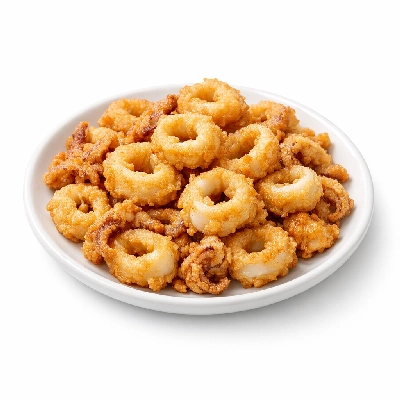
Fried Squid
Source of Calories
Nutrition Facts
| Nutrient | Amount | % Daily Value |
|---|---|---|
| Total Carbohydrates | 6.62 g | 2% |
| Net Carbohydrates | 6.62 g | 3% |
| Sugars | No data | - |
| Added Sugars | No data | - |
| Dietary Fiber | 0 g | 0% |
| Protein | 15.25 g | 30% |
| Total Fat | 6.36 g | 8% |
| Saturated Fat | 1.6 g | 8% |
| Monounsaturated Fat | 2.34 g | - |
| Polyunsaturated Fat | 1.82 g | - |
| Trans Fat | No data | - |
| Cholesterol | 221 mg | 74% |
| Vitamins | ||
| Vitamin A | 9.35 mcg | 1% |
| Vitamin C | 3.57 mg | 4% |
| Vitamin D | No data | - |
| Minerals | ||
| Sodium | 260.1 mg | 11% |
| Potassium | 237.15 mg | 5% |
| Calcium | 33.15 mg | 3% |
| Magnesium | 32.3 mg | 8% |
| Iron | 0.86 mg | 5% |
| Zinc | 1.48 mg | 13% |
% DV refers to how much a single serving of an individually packaged food or supplement contributes nutritionally to your daily diet, based on a 2,000-calorie-a-day diet. Generally, having 5% DV or less of a nutrient per serving is considered low, and 20% DV or more of a nutrient per serving is considered high.
Fat Composition
The suggested total fat consumption should be limited to 30% of total energy intake or less. The type of fat consumed should primarily be unsaturated fatty acids, with no more than 10% of total energy intake coming from saturated fatty acids (about 200 calories on a 2000-calorie diet) and no more than 1% of total energy intake coming from trans-fatty acids.
Vitamin Coverage
Vitamin A
1%
Vitamin C
4%
Vitamin D
-
Vitamin E
-
Vitamin K
-
Vitamin B1
4%
Vitamin B2
30%
Vitamin B3
14%
Vitamin B5
9%
Vitamin B6
3%
Vitamin B7
-
Vitamin B9
4%
Vitamin B12
44%
There are 13 essential vitamins required for the body to work properly, which are categorised into two categories: fat-soluble and water-soluble vitamins. Vitamins have a Recommended Dietary Allowance (RDA), provided by the Dietary Reference Intakes (DRIs), which vary by age and sex. The %DV indicates how much one serving contributes to the average recommended daily intake.
Mineral Coverage
Calcium
3%
Iron
5%
Magnesium
8%
Phosphorus
17%
Potassium
5%
Sodium
11%
Zinc
13%
Copper
200%
Manganese
3%
Selenium
80%
Minerals are micronutrients, of which 13 of them are essential to the human body. The Recommended Dietary Allowance includes Calcium (1,300 mg/d), Phosphorus (1,250 mg/d), Potassium (4,700 mg/d), Sodium (2,300 mg/d), Chloride (1,500 mg/d), Magnesium (420 mg/d), Iron (18 mg/d), Zinc (11 mg/d), Copper (0.9 mg/d), Selenium (55 mcg/d), Molybdenum (45 mcg/d), Manganese (2.3 mg/d) and Iodine (150 mcg/d).
Protein Quality
Leucine
37%
Isoleucine
50%
Valine
40%
Lysine
42%
Tryptophan
49%
Threonine
46%
Phenylalanine
48%
Methionine
52%
Histidine
30%
Guidelines recommend a serving of protein with each meal and 1.2-1.6 g of protein per kg of body weight per day.
The data provided by eato.health is for informational purposes only and should not be considered medical advice. Please consult your physician before beginning any diet or nutrition plan.
About
How Long to Burn Off 149 Calories?
*Based on this person: 25-year-old female, 5'7", 144 lbs

Swimming
22 min

Jogging
19 min

Cycling
20 min

Walking
35 min
The data provided by eato.health is for informational purposes only and should not be considered medical advice. Please consult your physician before beginning any diet or nutrition plan.
📚 Health Research & Evidence About This Food
Squid is a seafood offering significant nutritional value, including high protein content and omega-3 fatty acids, particularly docosahexaenoic acid (DHA), which is present in higher amounts than in many other seafoods. Research demonstrates that squid protein's functional properties, such as gelation and emulsification capacity, can be enhanced through processing like pH-shift methods, and its amino acid content can be well-preserved through vacuum frying, which also reduces protein oxidation. Squid can cause occupational type I allergy, characterized by skin lesions and respiratory distress, due to thermostable proteins such as tropomyosin, which can also exhibit cross-reactivity with other invertebrate tropomyosins.
1. Is Squid Good for You? Pros and Cons, Nutrition Information, and More
Source: WebMD
Summary: Squid is a globally popular seafood offering significant nutritional value, including high protein content, Vitamin C, and omega-3 fatty acids, particularly docosahexaenoic acid (DHA), which is higher in squid than many other seafoods.
2. Functional and Physicochemical Properties of Protein From Giant Squid (Dosidicus Gigas) Extracted Using Foam-Aided Ph-Shift Processing.
Source: PubMed
Summary: Alkaline solubilization and isoelectric precipitation significantly enhance the gelation capacity of protein extracted from giant squid.
Read More: https://pubmed.ncbi.nlm.nih.gov/36851824/
3. Effect of Vacuum Frying and Atmospheric Frying on the Quality and Protein Oxidation of Squid (Loligo Chinensis).
Source: PubMed
Summary: Vacuum-fried squid samples exhibited lower moisture and total fat content, better preservation of amino acid content and protein molecular weight, and significantly lower increases in protein oxidation indicators compared to atmospheric-fried samples.
Read More: https://pubmed.ncbi.nlm.nih.gov/34519066/
4. Occupational Allergic Contact Urticaria to Tropomyosin From Squid - Pmc
Source: NCBI
Summary: Squid can cause occupational type I allergy, characterized by acute itchy, reddened skin lesions and respiratory distress, due to a thermostable kDa tropomyosin-like allergen that shows significant cross-reactivity with other invertebrate tropomyosins.
Read More: https://www.ncbi.nlm.nih.gov/pmc/articles/PMC7734873/
5. Identification of Ige-Binding Proteins of Raw and Cooked Extracts of Loligo Edulis (White Squid).
Source: PubMed
Summary: Squid contains both heat-resistant 36 kDa tropomyosin and heat-sensitive 50 kDa proteins, which are major allergens for accurate diagnosis of squid allergy.
Read More: https://pubmed.ncbi.nlm.nih.gov/20578555/