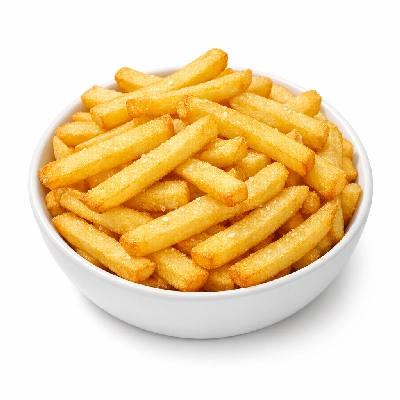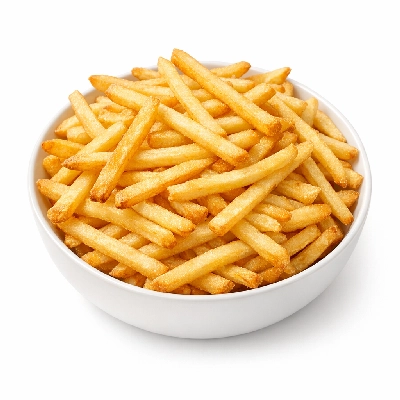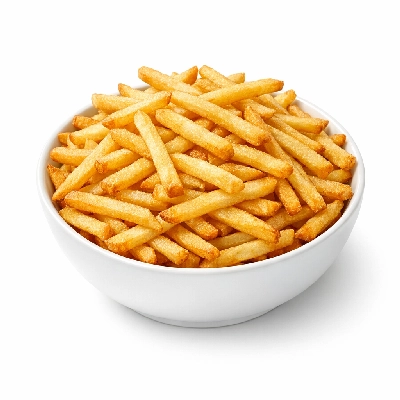
French Fries from Restaurant
Source of Calories
Nutrition Facts
| Nutrient | Amount | % Daily Value |
|---|---|---|
| Total Carbohydrates | 63.24 g | 23% |
| Net Carbohydrates | 56.61 g | 23% |
| Sugars | 0.48 g | 1% |
| Added Sugars | No data | - |
| Dietary Fiber | 6.63 g | 24% |
| Protein | 5.93 g | 12% |
| Total Fat | 23.87 g | 31% |
| Saturated Fat | 4.23 g | 21% |
| Monounsaturated Fat | 5.71 g | - |
| Polyunsaturated Fat | 11.23 g | - |
| Trans Fat | 0.18 g | 100% |
| Cholesterol | 1.7 mg | 1% |
| Vitamins | ||
| Vitamin A | 0 mcg | 0% |
| Vitamin C | 1.87 mg | 2% |
| Vitamin D | No data | - |
| Minerals | ||
| Sodium | 606.9 mg | 26% |
| Potassium | 926.5 mg | 20% |
| Calcium | 28.9 mg | 2% |
| Magnesium | 49.3 mg | 12% |
| Iron | 1.55 mg | 9% |
| Zinc | 0.87 mg | 8% |
% DV refers to how much a single serving of an individually packaged food or supplement contributes nutritionally to your daily diet, based on a 2,000-calorie-a-day diet. Generally, having 5% DV or less of a nutrient per serving is considered low, and 20% DV or more of a nutrient per serving is considered high.
Fat Composition
The suggested total fat consumption should be limited to 30% of total energy intake or less. The type of fat consumed should primarily be unsaturated fatty acids, with no more than 10% of total energy intake coming from saturated fatty acids (about 200 calories on a 2000-calorie diet) and no more than 1% of total energy intake coming from trans-fatty acids.
Vitamin Coverage
Vitamin A
0%
Vitamin C
2%
Vitamin D
-
Vitamin E
11%
Vitamin K
51%
Vitamin B1
16%
Vitamin B2
7%
Vitamin B3
27%
Vitamin B5
19%
Vitamin B6
24%
Vitamin B7
-
Vitamin B9
6%
Vitamin B12
-
There are 13 essential vitamins required for the body to work properly, which are categorised into two categories: fat-soluble and water-soluble vitamins. Vitamins have a Recommended Dietary Allowance (RDA), provided by the Dietary Reference Intakes (DRIs), which vary by age and sex. The %DV indicates how much one serving contributes to the average recommended daily intake.
Mineral Coverage
Calcium
2%
Iron
9%
Magnesium
12%
Phosphorus
17%
Potassium
20%
Sodium
26%
Zinc
8%
Copper
21%
Manganese
17%
Selenium
1%
Minerals are micronutrients, of which 13 of them are essential to the human body. The Recommended Dietary Allowance includes Calcium (1,300 mg/d), Phosphorus (1,250 mg/d), Potassium (4,700 mg/d), Sodium (2,300 mg/d), Chloride (1,500 mg/d), Magnesium (420 mg/d), Iron (18 mg/d), Zinc (11 mg/d), Copper (0.9 mg/d), Selenium (55 mcg/d), Molybdenum (45 mcg/d), Manganese (2.3 mg/d) and Iodine (150 mcg/d).
Protein Quality
Leucine
10%
Isoleucine
15%
Valine
25%
Lysine
9%
Tryptophan
24%
Threonine
13%
Phenylalanine
22%
Methionine
11%
Histidine
10%
Guidelines recommend a serving of protein with each meal and 1.2-1.6 g of protein per kg of body weight per day.
The data provided by eato.health is for informational purposes only and should not be considered medical advice. Please consult your physician before beginning any diet or nutrition plan.
About
How Long to Burn Off 491 Calories?
*Based on this person: 25-year-old female, 5'7", 144 lbs

Swimming
1 h 12 min

Jogging
1 h 2 min

Cycling
1 h 4 min

Walking
1 h 56 min
The data provided by eato.health is for informational purposes only and should not be considered medical advice. Please consult your physician before beginning any diet or nutrition plan.
📚 Health Research & Evidence About This Food
Observational studies and systematic reviews, including research reported by ScienceDaily, indicate that consumption of restaurant French fries is strongly associated with an increased risk of type 2 diabetes and hypertension. Additionally, French fries are high in saturated and trans fats, which can elevate unhealthy cholesterol levels and contribute to cardiovascular disease risk, as noted by Medical News Today and WebMD.
1. Foods High in Fats to Avoid
Source: WebMD
Summary: French fries, as a crunchy combination of fried potatoes and salt, are identified as a food high in saturated fat, and the article suggests making lower-fat, crisp, baked fries from scratch as an alternative.
2. French Fries and Cholesterol: How Much They Contain and Alternatives
Source: Medical News Today, 2022
Summary: French fries, though containing no dietary cholesterol, are often high in trans and saturated fats, which can elevate unhealthy cholesterol levels and increase cardiovascular disease risk, making baked versions with healthier oils and less salt a preferable alternative.
Read More: https://www.medicalnewstoday.com/articles/french-fries-cholesterol
3. Scientists Discovered Something Surprising About French Fries and Diabetes
Source: ScienceDaily, 2026
Summary: French fries, when consumed at servings per week, were associated with a higher risk of developing type 2 diabetes in a large observational study, distinguishing them from other potato preparations like boiled, baked, or mashed potatoes which showed a far less significant risk.
Read More: https://www.sciencedaily.com/releases/2026/06/260603015218.htm
4. Potatoes and Risk of Chronic Disease: A Systematic Review and Dose–Response Meta-Analysis
Source: SpringerLink
Summary: French fries consumption shows a clear positive association with an increased risk of type 2 diabetes and hypertension, with each daily increase linked to significantly higher risks, according to a systematic review and dose-response meta-analysis.
Read More: https://link.springer.com/article/10.1007/s00394-018-1774-2
5. In Defense of French Fries - Harvard Health
Source: Harvard Health, 2019
Summary: French fries, when consumed more than twice a week, were associated with an increased risk of death in an observational study of older adults, likely due to their high fat and salt content and high glycemic index, though occasional consumption in moderation is suggested as acceptable.
Read More: https://www.health.harvard.edu/blog/in-defense-of-french-fries-2019020615893