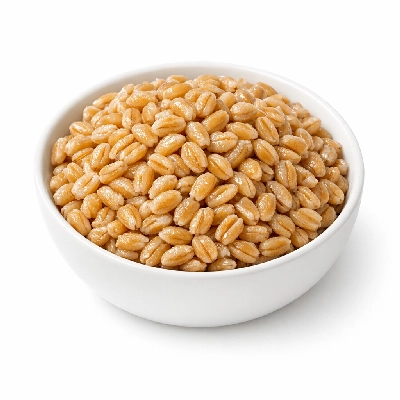
Cooked Spelt
Source of Calories
Nutrition Facts
| Nutrient | Amount | % Daily Value |
|---|---|---|
| Total Carbohydrates | 51.29 g | 19% |
| Net Carbohydrates | 43.73 g | 18% |
| Sugars | No data | - |
| Added Sugars | No data | - |
| Dietary Fiber | 7.57 g | 27% |
| Protein | 10.67 g | 21% |
| Total Fat | 1.65 g | 2% |
| Saturated Fat | No data | - |
| Monounsaturated Fat | No data | - |
| Polyunsaturated Fat | No data | - |
| Trans Fat | No data | - |
| Cholesterol | 0 mg | 0% |
| Vitamins | ||
| Vitamin A | 2.33 mcg | 0% |
| Vitamin C | 0 mg | 0% |
| Vitamin D | No data | - |
| Minerals | ||
| Sodium | 9.7 mg | 0% |
| Potassium | 277.42 mg | 6% |
| Calcium | 19.4 mg | 1% |
| Magnesium | 95.06 mg | 23% |
| Iron | 3.24 mg | 18% |
| Zinc | 2.43 mg | 22% |
% DV refers to how much a single serving of an individually packaged food or supplement contributes nutritionally to your daily diet, based on a 2,000-calorie-a-day diet. Generally, having 5% DV or less of a nutrient per serving is considered low, and 20% DV or more of a nutrient per serving is considered high.
Vitamin Coverage
Vitamin A
0.3%
Vitamin C
0%
Vitamin D
-
Vitamin E
3%
Vitamin K
-
Vitamin B1
17%
Vitamin B2
4%
Vitamin B3
31%
Vitamin B5
-
Vitamin B6
9%
Vitamin B7
-
Vitamin B9
6%
Vitamin B12
0%
There are 13 essential vitamins required for the body to work properly, which are categorised into two categories: fat-soluble and water-soluble vitamins. Vitamins have a Recommended Dietary Allowance (RDA), provided by the Dietary Reference Intakes (DRIs), which vary by age and sex. The %DV indicates how much one serving contributes to the average recommended daily intake.
Mineral Coverage
Calcium
1%
Iron
18%
Magnesium
23%
Phosphorus
23%
Potassium
6%
Sodium
0.4%
Zinc
22%
Copper
46%
Manganese
92%
Selenium
14%
Minerals are micronutrients, of which 13 of them are essential to the human body. The Recommended Dietary Allowance includes Calcium (1,300 mg/d), Phosphorus (1,250 mg/d), Potassium (4,700 mg/d), Sodium (2,300 mg/d), Chloride (1,500 mg/d), Magnesium (420 mg/d), Iron (18 mg/d), Zinc (11 mg/d), Copper (0.9 mg/d), Selenium (55 mcg/d), Molybdenum (45 mcg/d), Manganese (2.3 mg/d) and Iodine (150 mcg/d).
The data provided by eato.health is for informational purposes only and should not be considered medical advice. Please consult your physician before beginning any diet or nutrition plan.
About
How Long to Burn Off 246 Calories?
*Based on this person: 25-year-old female, 5'7", 144 lbs

Swimming
37 min

Jogging
32 min

Cycling
32 min

Walking
58 min
The data provided by eato.health is for informational purposes only and should not be considered medical advice. Please consult your physician before beginning any diet or nutrition plan.
📚 Health Research & Evidence About This Food
Spelt is an ancient grain rich in essential vitamins, minerals, and dietary fiber, and research demonstrates it induces a low acute glycemic response by slowing digestion and mitigating sudden blood sugar surges. Its significant dietary fiber, phytic acid, alkylresorcinols, and antioxidant compounds modulate postprandial glycemia and improve insulin sensitivity, contributing to the control of blood glucose levels and management of hyperinsulinemia. Additionally, observational evidence suggests spelt may improve digestive health by facilitating stool passage and lower heart disease risk by improving cholesterol levels and reducing blood pressure.
1. Spelt: Nutrition, Health Benefits, and How to Use It
Source: Medical News Today, 2018
Summary: Spelt is an excellent source of carbohydrates and dietary fiber, with a slightly higher protein content than common wheat.
2. The Potential Role of Selected Bioactive Compounds From Spelt and Common Wheat in Glycemic Control.
Source: PubMed
Summary: Spelt contains a significant amount of dietary fiber, phytic acid, alkylresorcinols, and antioxidant compounds that modulate postprandial glycemia, improve insulin sensitivity, and manage hyperinsulinemia.
Read More: https://pubmed.ncbi.nlm.nih.gov/29068605/
3. Pasting Properties, Baking Quality, and Starch Digestibility of Einkorn, Emmer, Spelt, and Hard Red Spring Wheat
Source: Wiley Online Library
Summary: Spelt exhibited significantly higher peak viscosity values compared to other tested wheats like einkorn, emmer, and hard red spring wheat.
Read More: https://onlinelibrary.wiley.com/doi/full/10.1002/cche.10644
4. Ancient Wheat Diet Delays Diabetes Development in a Type 2 Diabetes Animal Model.
Source: PubMed
Summary: Spelt diets were found to induce a low acute glycemic response.
Read More: https://pubmed.ncbi.nlm.nih.gov/26177485/
5. Is Spelt Good for You? Nutrition Information, Pros and Cons, and More
Source: WebMD
Summary: Spelt, an ancient grain, is rich in essential vitamins and minerals, particularly in its whole-grain form, and offers potential health benefits such as reducing blood sugar spikes, improving digestive health, lowering heart disease risk, and aiding in weight management.