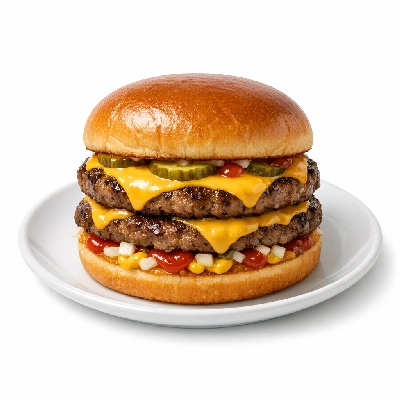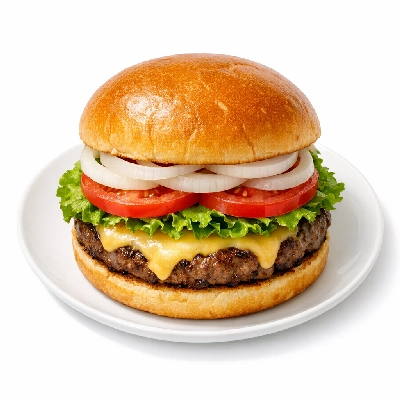
Cheeseburger, Large, Single Patty, with Bun, Lettuce, Tomato, Onion, Mayo, Ketchup, and Mustard
Source of Calories
Nutrition Facts
| Nutrient | Amount | % Daily Value |
|---|---|---|
| Total Carbohydrates | 38.12 g | 14% |
| Net Carbohydrates | 35.75 g | 14% |
| Sugars | 9.67 g | 28% |
| Added Sugars | No data | - |
| Dietary Fiber | 2.37 g | 8% |
| Protein | 29.43 g | 59% |
| Total Fat | 33.97 g | 44% |
| Saturated Fat | 12.35 g | 62% |
| Monounsaturated Fat | 11.51 g | - |
| Polyunsaturated Fat | 5.09 g | - |
| Trans Fat | 1.35 g | 100% |
| Cholesterol | 109.65 mg | 37% |
| Vitamins | ||
| Vitamin A | 106.25 mcg | 12% |
| Vitamin C | 2.37 mg | 3% |
| Vitamin D | 0.16 mcg | 1% |
| Minerals | ||
| Sodium | 1016.95 mg | 44% |
| Potassium | 447.2 mg | 10% |
| Calcium | 156.95 mg | 12% |
| Magnesium | 38.7 mg | 9% |
| Iron | 4.94 mg | 27% |
| Zinc | 4.86 mg | 44% |
% DV refers to how much a single serving of an individually packaged food or supplement contributes nutritionally to your daily diet, based on a 2,000-calorie-a-day diet. Generally, having 5% DV or less of a nutrient per serving is considered low, and 20% DV or more of a nutrient per serving is considered high.
Fat Composition
The suggested total fat consumption should be limited to 30% of total energy intake or less. The type of fat consumed should primarily be unsaturated fatty acids, with no more than 10% of total energy intake coming from saturated fatty acids (about 200 calories on a 2000-calorie diet) and no more than 1% of total energy intake coming from trans-fatty acids.
Vitamin Coverage
Vitamin A
12%
Vitamin C
3%
Vitamin D
0.8%
Vitamin E
8%
Vitamin K
25%
Vitamin B1
32%
Vitamin B2
43%
Vitamin B3
42%
Vitamin B5
32%
Vitamin B6
24%
Vitamin B7
-
Vitamin B9
39%
Vitamin B12
83%
There are 13 essential vitamins required for the body to work properly, which are categorised into two categories: fat-soluble and water-soluble vitamins. Vitamins have a Recommended Dietary Allowance (RDA), provided by the Dietary Reference Intakes (DRIs), which vary by age and sex. The %DV indicates how much one serving contributes to the average recommended daily intake.
Mineral Coverage
Calcium
12%
Iron
27%
Magnesium
9%
Phosphorus
22%
Potassium
10%
Sodium
44%
Zinc
44%
Copper
19%
Manganese
17%
Selenium
65%
Minerals are micronutrients, of which 13 of them are essential to the human body. The Recommended Dietary Allowance includes Calcium (1,300 mg/d), Phosphorus (1,250 mg/d), Potassium (4,700 mg/d), Sodium (2,300 mg/d), Chloride (1,500 mg/d), Magnesium (420 mg/d), Iron (18 mg/d), Zinc (11 mg/d), Copper (0.9 mg/d), Selenium (55 mcg/d), Molybdenum (45 mcg/d), Manganese (2.3 mg/d) and Iodine (150 mcg/d).
The data provided by eato.health is for informational purposes only and should not be considered medical advice. Please consult your physician before beginning any diet or nutrition plan.
About
How Long to Burn Off 576 Calories?
*Based on this person: 25-year-old female, 5'7", 144 lbs

Swimming
1 h 25 min

Jogging
1 h 13 min

Cycling
1 h 15 min

Walking
2 h 16 min
The data provided by eato.health is for informational purposes only and should not be considered medical advice. Please consult your physician before beginning any diet or nutrition plan.
📚 Health Research & Evidence About This Food
Large cheeseburgers, as a common fast-food item, are typically high in calories, saturated fat, and sodium, with the FDA noting that high sodium intake is associated with elevated blood pressure. MedlinePlus also advises consumers to make informed choices regarding fast-food options. However, research published in Taylor & Francis demonstrates that sodium content in beef burgers can be significantly reduced by incorporating aromatic herbs while maintaining sensory acceptance.
1. Calorie Count - Fast Food: Medlineplus Medical Encyclopedia
Source: MedlinePlus
Summary: Cheeseburger, as a popular fast-food item, contributes to calorie intake, with specific calorie counts varying by restaurant, such as at Burger King, at McDonald's, and for a cheeseburger with onion at In 'n Out Burger.
Read More: https://medlineplus.gov/ency/patientinstructions/000887.htm
2. Sodium in Your Diet
Source: FDA, 2024
Summary: Cheeseburger, as a prepared food, is a likely source of high dietary sodium, which is a major contributor to the average American's daily sodium intake and can impact blood pressure.
Read More: https://www.fda.gov/food/nutrition-education-resources-materials/sodium-your-diet
3. Herbal Salt in Beef Burgers: Promoting the Retention of Acceptability in Reducing Sodium
Source: Taylor & Francis
Summary: Cheeseburger, specifically its beef burger component, can achieve a reduction in sodium content without losing sensory acceptance by incorporating a mixture of aromatic herbs like oregano, rosemary, and basil.
Read More: https://www.tandfonline.com/doi/abs/10.1080/15428052.2021.1955794