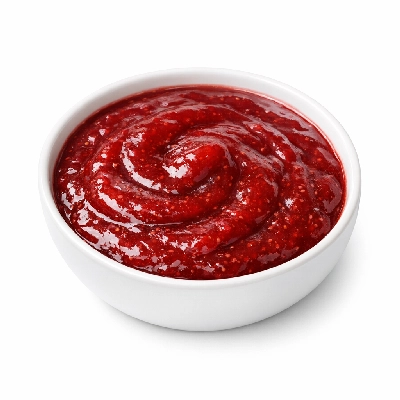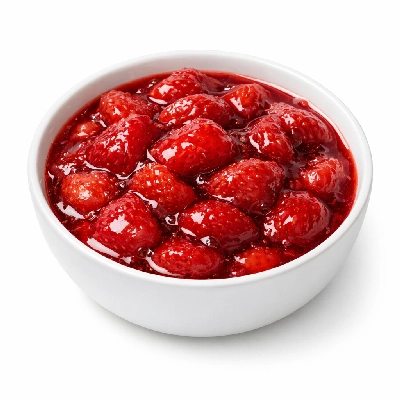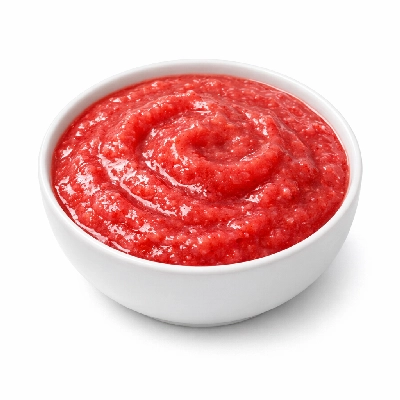
Sweetened Strawberry Puree
Source of Calories
Nutrition Facts
| Nutrient | Amount | % Daily Value |
|---|---|---|
| Total Carbohydrates | 138.39 g | 50% |
| Net Carbohydrates | 128.39 g | 52% |
| Sugars | 124.2 g | 355% |
| Added Sugars | 99.8 g | 200% |
| Dietary Fiber | 10 g | 36% |
| Protein | 3.36 g | 7% |
| Total Fat | 1.51 g | 2% |
| Saturated Fat | 0.07 g | 0% |
| Monounsaturated Fat | 0.23 g | - |
| Polyunsaturated Fat | 0.79 g | - |
| Trans Fat | 0 g | 0% |
| Cholesterol | 0 mg | 0% |
| Vitamins | ||
| Vitamin A | 2.92 mcg | 0% |
| Vitamin C | 294.01 mg | 327% |
| Vitamin D | 0 mcg | 0% |
| Minerals | ||
| Sodium | 5.95 mg | 0% |
| Potassium | 766.9 mg | 16% |
| Calcium | 80.95 mg | 6% |
| Magnesium | 65 mg | 15% |
| Iron | 2.04 mg | 11% |
| Zinc | 0.69 mg | 6% |
% DV refers to how much a single serving of an individually packaged food or supplement contributes nutritionally to your daily diet, based on a 2,000-calorie-a-day diet. Generally, having 5% DV or less of a nutrient per serving is considered low, and 20% DV or more of a nutrient per serving is considered high.
Fat Composition
The suggested total fat consumption should be limited to 30% of total energy intake or less. The type of fat consumed should primarily be unsaturated fatty acids, with no more than 10% of total energy intake coming from saturated fatty acids (about 200 calories on a 2000-calorie diet) and no more than 1% of total energy intake coming from trans-fatty acids.
Vitamin Coverage
Vitamin A
0.3%
Vitamin C
327%
Vitamin D
0%
Vitamin E
10%
Vitamin K
9%
Vitamin B1
11%
Vitamin B2
8%
Vitamin B3
12%
Vitamin B5
13%
Vitamin B6
14%
Vitamin B7
-
Vitamin B9
-
Vitamin B12
0%
There are 13 essential vitamins required for the body to work properly, which are categorised into two categories: fat-soluble and water-soluble vitamins. Vitamins have a Recommended Dietary Allowance (RDA), provided by the Dietary Reference Intakes (DRIs), which vary by age and sex. The %DV indicates how much one serving contributes to the average recommended daily intake.
Mineral Coverage
Calcium
6%
Iron
11%
Magnesium
15%
Phosphorus
10%
Potassium
16%
Sodium
0.3%
Zinc
6%
Copper
26%
Manganese
84%
Selenium
5%
Minerals are micronutrients, of which 13 of them are essential to the human body. The Recommended Dietary Allowance includes Calcium (1,300 mg/d), Phosphorus (1,250 mg/d), Potassium (4,700 mg/d), Sodium (2,300 mg/d), Chloride (1,500 mg/d), Magnesium (420 mg/d), Iron (18 mg/d), Zinc (11 mg/d), Copper (0.9 mg/d), Selenium (55 mcg/d), Molybdenum (45 mcg/d), Manganese (2.3 mg/d) and Iodine (150 mcg/d).
The data provided by eato.health is for informational purposes only and should not be considered medical advice. Please consult your physician before beginning any diet or nutrition plan.
About
How Long to Burn Off 547 Calories?
*Based on this person: 25-year-old female, 5'7", 144 lbs

Swimming
1 h 20 min

Jogging
1 h 9 min

Cycling
1 h 11 min

Walking
2 h 9 min
The data provided by eato.health is for informational purposes only and should not be considered medical advice. Please consult your physician before beginning any diet or nutrition plan.
📚 Health Research & Evidence About This Food
Strawberry puree can be processed to enhance its safety, as research from USDA ARS demonstrates that pressure effectively inactivates Hepatitis A virus and antimicrobial films inhibit bacteria like Escherichia coli O157:H7 by using components like nisin and sodium benzoate. Additionally, strawberry puree contains phenolic compounds such as anthocyanins and proanthocyanidins, though their stability is significantly impacted by storage conditions, with anthocyanins showing high degradation and proanthocyanidins demonstrating greater stability.
1. Evaluation of a Norovirus Detection Methodology for Soft Red Fruits.
Source: PubMed
Summary: The recovery of both GI and GII noroviruses was generally more efficient from strawberry puree compared to other soft red fruit types in a methodology for detecting noroviruses.
Read More: https://pubmed.ncbi.nlm.nih.gov/21056775/
2. Pressure Inactivation of Hepatitis a Virus in Strawberry Puree
Source: USDA ARS
Summary: Pressure effectively inactivates Hepatitis A virus in strawberry puree.
Read More: https://www.ars.usda.gov/research/publications/publication/?seqNo115=173040
3. Antimicrobial Films for Strawberry Puree and Strawberry's Health Benefits
Source: USDA ARS
Summary: Antimicrobial films containing polylactic acid polymer, nisin, EDTA, sodium benzoate, and potassium sorbate effectively inhibited Escherichia coli O157:H7 and natural microflora in strawberry puree at various temperatures.
Read More: https://www.ars.usda.gov/research/publications/publication/?seqNo115=243081
4. Effect of Storage Conditions on the Stability of Polyphenols of Apple and Strawberry Purees Produced at Industrial Scale by Different Processing Techniques.
Source: PubMed
Summary: Storage conditions significantly impact the levels of phenolic compounds in strawberry puree, with anthocyanins showing the highest degradation and proanthocyanidins demonstrating the greatest stability during storage.
Read More: https://pubmed.ncbi.nlm.nih.gov/36706308/