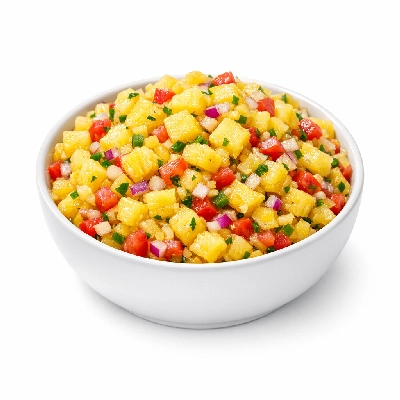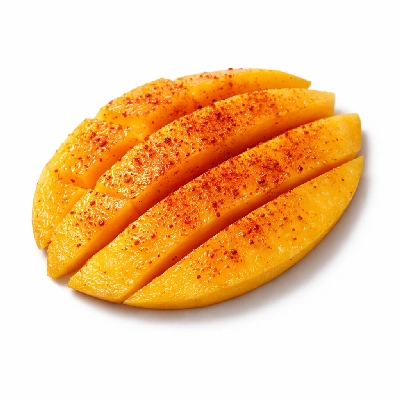
Sliced Chili Powder Mango
Source of Calories
Nutrition Facts
| Nutrient | Amount | % Daily Value |
|---|---|---|
| Total Carbohydrates | 32.3 g | 12% |
| Net Carbohydrates | 28.09 g | 11% |
| Sugars | 28.46 g | 81% |
| Added Sugars | 0 g | 0% |
| Dietary Fiber | 4.22 g | 15% |
| Protein | 2.04 g | 4% |
| Total Fat | 1.16 g | 1% |
| Saturated Fat | 0.25 g | 1% |
| Monounsaturated Fat | 0.37 g | - |
| Polyunsaturated Fat | 0.36 g | - |
| Trans Fat | 0 g | 0% |
| Cholesterol | 0 mg | 0% |
| Vitamins | ||
| Vitamin A | 150.58 mcg | 17% |
| Vitamin C | 75.37 mg | 84% |
| Vitamin D | 0 mcg | 0% |
| Minerals | ||
| Sodium | 76.61 mg | 3% |
| Potassium | 398.46 mg | 8% |
| Calcium | 31.35 mg | 2% |
| Magnesium | 24.57 mg | 6% |
| Iron | 0.78 mg | 4% |
| Zinc | 0.3 mg | 3% |
% DV refers to how much a single serving of an individually packaged food or supplement contributes nutritionally to your daily diet, based on a 2,000-calorie-a-day diet. Generally, having 5% DV or less of a nutrient per serving is considered low, and 20% DV or more of a nutrient per serving is considered high.
Fat Composition
The suggested total fat consumption should be limited to 30% of total energy intake or less. The type of fat consumed should primarily be unsaturated fatty acids, with no more than 10% of total energy intake coming from saturated fatty acids (about 200 calories on a 2000-calorie diet) and no more than 1% of total energy intake coming from trans-fatty acids.
Vitamin Coverage
Vitamin A
17%
Vitamin C
84%
Vitamin D
0%
Vitamin E
19%
Vitamin K
10%
Vitamin B1
6%
Vitamin B2
8%
Vitamin B3
11%
Vitamin B5
9%
Vitamin B6
18%
Vitamin B7
-
Vitamin B9
0.2%
Vitamin B12
0%
There are 13 essential vitamins required for the body to work properly, which are categorised into two categories: fat-soluble and water-soluble vitamins. Vitamins have a Recommended Dietary Allowance (RDA), provided by the Dietary Reference Intakes (DRIs), which vary by age and sex. The %DV indicates how much one serving contributes to the average recommended daily intake.
Mineral Coverage
Calcium
2%
Iron
4%
Magnesium
6%
Phosphorus
3%
Potassium
8%
Sodium
3%
Zinc
3%
Copper
28%
Manganese
7%
Selenium
3%
Minerals are micronutrients, of which 13 of them are essential to the human body. The Recommended Dietary Allowance includes Calcium (1,300 mg/d), Phosphorus (1,250 mg/d), Potassium (4,700 mg/d), Sodium (2,300 mg/d), Chloride (1,500 mg/d), Magnesium (420 mg/d), Iron (18 mg/d), Zinc (11 mg/d), Copper (0.9 mg/d), Selenium (55 mcg/d), Molybdenum (45 mcg/d), Manganese (2.3 mg/d) and Iodine (150 mcg/d).
Protein Quality
Leucine
0.6%
Isoleucine
0.8%
Valine
0.8%
Lysine
0.4%
Tryptophan
0.5%
Threonine
0.5%
Phenylalanine
0.8%
Methionine
0.5%
Histidine
0.5%
Guidelines recommend a serving of protein with each meal and 1.2-1.6 g of protein per kg of body weight per day.
The data provided by eato.health is for informational purposes only and should not be considered medical advice. Please consult your physician before beginning any diet or nutrition plan.
About
How Long to Burn Off 132 Calories?
*Based on this person: 25-year-old female, 5'7", 144 lbs

Swimming
20 min

Jogging
17 min

Cycling
18 min

Walking
31 min
The data provided by eato.health is for informational purposes only and should not be considered medical advice. Please consult your physician before beginning any diet or nutrition plan.
📚 Health Research & Evidence About This Food
Mangoes are a nutrient-dense fruit and an excellent source of vitamin C, which is vital for immune health and collagen formation, and contain antioxidants like beta-carotene. Clinical evidence from a randomized controlled crossover study published in Wiley Online Library demonstrates that mango consumption significantly increases gut microbiome diversity in overweight/obese individuals, while other compounds like mangiferin, lutein, and zeaxanthin may support overall health, including eye, skin, and hair health, as noted by Medical News Today.
1. Mango: Health Benefits, Nutrients per Serving, Preparation Information, and More
Source: WebMD
Summary: Mangoes are an excellent source of vitamin C, vital for blood vessel formation and collagen, and beta-carotene, which is associated with a lower risk of cancer.
2. Total Phenolics, Carotenoids, Ascorbic Acid, and Antioxidant Properties of Fresh-Cut Mango (Mangifera Indica L., Cv. Tommy Atkin) as Affected by Infrared Heat Treatment.
Source: PubMed
Summary: Infrared heat treatment significantly increased total phenolics and enhanced the antioxidant properties of fresh-cut mango cubes, as measured by ABTS, DPPH, and ORAC assays.
Read More: https://pubmed.ncbi.nlm.nih.gov/23094872/
3. 14 Foods With More Vitamin C Than an Orange, per Dietitians
Source: Prevention, 2026
Summary: One cup of sweet mango provides vitamin C, an essential nutrient for immune health.
Read More: https://www.prevention.com/food-nutrition/healthy-eating/g71374117/foods-with-vitamin-c/
4. The Effects of Fresh Mango Consumption on Gut Health and Microbiome – Randomized Controlled Trial
Source: Wiley Online Library
Summary: Mango consumption significantly increased the Shannon–Wiener and Simpson alpha diversity indices of the gut microbiome compared to low-fat cookie consumption.
Read More: https://onlinelibrary.wiley.com/doi/full/10.1002/fsn3.3243
5. Mangoes: Benefits, Nutrition, and Recipes
Source: Medical News Today, 2019
Summary: Mangoes are tropical stone fruits known for their diverse health benefits, including supporting eye, skin, and hair health, and potentially aiding in the prevention of cancer and heart disease.
6. Mango: Nutrition, Health Benefits, and How to Eat It
Source: Healthline, 2018
Summary: Mango is a nutrient-dense drupe that provides calories, protein, carbohydrates, fat, fiber, and natural sugar per cup.
Read More: https://www.healthline.com/nutrition/mango