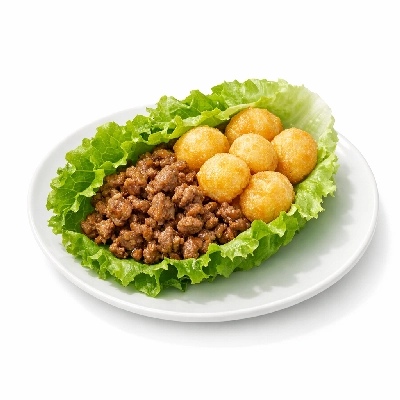
Minced Meat & Cheese
Source of Calories
Nutrition Facts
| Nutrient | Amount | % Daily Value |
|---|---|---|
| Total Carbohydrates | 20.66 g | 8% |
| Net Carbohydrates | 18.33 g | 7% |
| Sugars | 5.72 g | 16% |
| Added Sugars | 0 g | 0% |
| Dietary Fiber | 2.32 g | 8% |
| Protein | 142.63 g | 285% |
| Total Fat | 140.31 g | 180% |
| Saturated Fat | 67.67 g | 338% |
| Monounsaturated Fat | 55.15 g | - |
| Polyunsaturated Fat | 3.86 g | - |
| Trans Fat | 0 g | 0% |
| Cholesterol | 198 mg | 66% |
| Vitamins | ||
| Vitamin A | 674.58 mcg | 75% |
| Vitamin C | 10.95 mg | 12% |
| Vitamin D | 1.2 mcg | 6% |
| Minerals | ||
| Sodium | 3637.89 mg | 158% |
| Potassium | 363.26 mg | 8% |
| Calcium | 1467.82 mg | 113% |
| Magnesium | 69.11 mg | 16% |
| Iron | 0.86 mg | 5% |
| Zinc | 7.59 mg | 69% |
% DV refers to how much a single serving of an individually packaged food or supplement contributes nutritionally to your daily diet, based on a 2,000-calorie-a-day diet. Generally, having 5% DV or less of a nutrient per serving is considered low, and 20% DV or more of a nutrient per serving is considered high.
Fat Composition
The suggested total fat consumption should be limited to 30% of total energy intake or less. The type of fat consumed should primarily be unsaturated fatty acids, with no more than 10% of total energy intake coming from saturated fatty acids (about 200 calories on a 2000-calorie diet) and no more than 1% of total energy intake coming from trans-fatty acids.
Vitamin Coverage
Vitamin A
75%
Vitamin C
12%
Vitamin D
6%
Vitamin E
23%
Vitamin K
13%
Vitamin B1
10%
Vitamin B2
69%
Vitamin B3
2%
Vitamin B5
21%
Vitamin B6
22%
Vitamin B7
10%
Vitamin B9
14%
Vitamin B12
92%
There are 13 essential vitamins required for the body to work properly, which are categorised into two categories: fat-soluble and water-soluble vitamins. Vitamins have a Recommended Dietary Allowance (RDA), provided by the Dietary Reference Intakes (DRIs), which vary by age and sex. The %DV indicates how much one serving contributes to the average recommended daily intake.
Mineral Coverage
Calcium
113%
Iron
5%
Magnesium
16%
Phosphorus
77%
Potassium
8%
Sodium
158%
Zinc
69%
Copper
16%
Manganese
21%
Selenium
107%
Minerals are micronutrients, of which 13 of them are essential to the human body. The Recommended Dietary Allowance includes Calcium (1,300 mg/d), Phosphorus (1,250 mg/d), Potassium (4,700 mg/d), Sodium (2,300 mg/d), Chloride (1,500 mg/d), Magnesium (420 mg/d), Iron (18 mg/d), Zinc (11 mg/d), Copper (0.9 mg/d), Selenium (55 mcg/d), Molybdenum (45 mcg/d), Manganese (2.3 mg/d) and Iodine (150 mcg/d).
Protein Quality
Leucine
133%
Isoleucine
183%
Valine
169%
Lysine
78%
Tryptophan
314%
Threonine
150%
Phenylalanine
188%
Methionine
166%
Histidine
113%
Guidelines recommend a serving of protein with each meal and 1.2-1.6 g of protein per kg of body weight per day.
The data provided by eato.health is for informational purposes only and should not be considered medical advice. Please consult your physician before beginning any diet or nutrition plan.
About
How Long to Burn Off 1900 Calories?
*Based on this person: 25-year-old female, 5'7", 144 lbs

Swimming
4 h 38 min

Jogging
3 h 60 min

Cycling
4 h 6 min

Walking
7 h 26 min
The data provided by eato.health is for informational purposes only and should not be considered medical advice. Please consult your physician before beginning any diet or nutrition plan.
📚 Health Research & Evidence About This Food
Scientific research and expert reviews suggest that minced meat can play a meaningful role in a balanced diet. Below are selected studies and authoritative articles that explore the nutritional value and potential health benefits of minced meat, particularly in specific populations. For instance, studies in older men indicate that minced beef enhances protein digestion and retention compared to beef steak, leading to a more positive whole-body protein balance due to faster amino acid absorption. Regulations also ensure product quality and consumer information regarding fat and connective tissue content in minced meat.
1. Meat Products: Sell Them Legally in England - Gov.Uk
Source: GOV.UK, 2017
Summary: Minced meat has specific standards for fat content and collagen to meat protein ratio, and its labels must display the maximum fat percentage and collagen to meat protein ratio.
Read More: https://www.gov.uk/guidance/meat-products-sell-them-legally-in-england
2. Meats for Diabetes: Meats That Are Healthy and Meats to Avoid
Source: Medical News Today, 2020
Summary: Minced meat is categorized as a medium-fat meat, containing fat and calories per serving.
Read More: https://www.medicalnewstoday.com/articles/meats-for-diabetes
3. Minced Beef Is More Rapidly Digested and Absorbed Than Beef Steak, Resulting in Greater Postprandial Protein Retention in Older Men.
Source: PubMed
Summary: Minced beef leads to faster amino acid absorption and a more positive whole-body protein balance in older men compared to beef steak.
Read More: https://pubmed.ncbi.nlm.nih.gov/23636241/