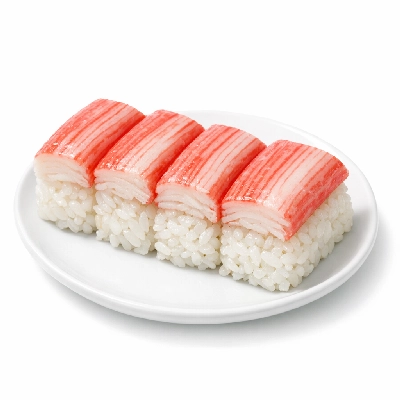
Kani Sushi
Source of Calories
Nutrition Facts
| Nutrient | Amount | % Daily Value |
|---|---|---|
| Total Carbohydrates | 193.43 g | 70% |
| Net Carbohydrates | 171.58 g | 69% |
| Sugars | 16.83 g | 48% |
| Added Sugars | 12.57 g | 25% |
| Dietary Fiber | 21.86 g | 78% |
| Protein | 29.66 g | 59% |
| Total Fat | 33.62 g | 43% |
| Saturated Fat | 4.31 g | 22% |
| Monounsaturated Fat | 19.71 g | - |
| Polyunsaturated Fat | 3.71 g | - |
| Trans Fat | 0 g | 0% |
| Cholesterol | 10 mg | 3% |
| Vitamins | ||
| Vitamin A | 17.49 mcg | 2% |
| Vitamin C | 21.56 mg | 24% |
| Vitamin D | 0 mcg | 0% |
| Minerals | ||
| Sodium | 4011.59 mg | 174% |
| Potassium | 1457.61 mg | 31% |
| Calcium | 95.28 mg | 7% |
| Magnesium | 76.95 mg | 18% |
| Iron | 1.87 mg | 10% |
| Zinc | 1.53 mg | 14% |
% DV refers to how much a single serving of an individually packaged food or supplement contributes nutritionally to your daily diet, based on a 2,000-calorie-a-day diet. Generally, having 5% DV or less of a nutrient per serving is considered low, and 20% DV or more of a nutrient per serving is considered high.
Fat Composition
The suggested total fat consumption should be limited to 30% of total energy intake or less. The type of fat consumed should primarily be unsaturated fatty acids, with no more than 10% of total energy intake coming from saturated fatty acids (about 200 calories on a 2000-calorie diet) and no more than 1% of total energy intake coming from trans-fatty acids.
Vitamin Coverage
Vitamin A
2%
Vitamin C
24%
Vitamin D
0%
Vitamin E
28%
Vitamin K
42%
Vitamin B1
12%
Vitamin B2
24%
Vitamin B3
24%
Vitamin B5
59%
Vitamin B6
33%
Vitamin B7
-
Vitamin B9
0.6%
Vitamin B12
250%
There are 13 essential vitamins required for the body to work properly, which are categorised into two categories: fat-soluble and water-soluble vitamins. Vitamins have a Recommended Dietary Allowance (RDA), provided by the Dietary Reference Intakes (DRIs), which vary by age and sex. The %DV indicates how much one serving contributes to the average recommended daily intake.
Mineral Coverage
Calcium
7%
Iron
10%
Magnesium
18%
Phosphorus
11%
Potassium
31%
Sodium
174%
Zinc
14%
Copper
46%
Manganese
21%
Selenium
2%
Minerals are micronutrients, of which 13 of them are essential to the human body. The Recommended Dietary Allowance includes Calcium (1,300 mg/d), Phosphorus (1,250 mg/d), Potassium (4,700 mg/d), Sodium (2,300 mg/d), Chloride (1,500 mg/d), Magnesium (420 mg/d), Iron (18 mg/d), Zinc (11 mg/d), Copper (0.9 mg/d), Selenium (55 mcg/d), Molybdenum (45 mcg/d), Manganese (2.3 mg/d) and Iodine (150 mcg/d).
Protein Quality
Leucine
3%
Isoleucine
4%
Valine
3%
Lysine
2%
Tryptophan
4%
Threonine
3%
Phenylalanine
5%
Methionine
2%
Histidine
3%
Guidelines recommend a serving of protein with each meal and 1.2-1.6 g of protein per kg of body weight per day.
The data provided by eato.health is for informational purposes only and should not be considered medical advice. Please consult your physician before beginning any diet or nutrition plan.
About
How Long to Burn Off 1147 Calories?
*Based on this person: 25-year-old female, 5'7", 144 lbs

Swimming
2 h 48 min

Jogging
2 h 25 min

Cycling
2 h 29 min

Walking
4 h 30 min
The data provided by eato.health is for informational purposes only and should not be considered medical advice. Please consult your physician before beginning any diet or nutrition plan.
FAQ
It depends. Kani sushi can be high in sodium. Per serving (1 roll), Kani sushi has about 286.8 kcal, 48.36 g carbs, 7.42 g protein, 8.41 g fat, 1.08 g saturated fat, and 1,002.9 mg sodium. Those who are concerned about their sodium may want to practice smaller portions when eating Kani sushi.
If the kani is surimi (imitation crab), it is usually made from cooked fish, which may be lower risk than raw seafood, but sushi can still carry food safety risk from handling, storage, or other raw ingredients in the same roll. It may be safer to choose a reputable shop and avoid rolls with raw fish if you are more vulnerable to foodborne illness or pregnant.
Per serving (1 roll), kani sushi has about 286.8 kcal. It also has about 48.36 g carbs, 7.42 g protein, and 8.41 g fat.
It depends, but it may be safer only if the kani is cooked surimi and the roll does not contain raw fish or raw seafood. FDA based pregnancy guidance generally advises avoiding raw or undercooked seafood during pregnancy because of infection risk, while cooked low mercury seafood options are usually the safer choice.
Not really. Per serving (1 roll), it has about 7.42 g protein, while the carbs are much higher at 48.36 g. It can provide some protein, but is not considered to be a protein heavy dish.
📚 Health Research & Evidence About This Food
Kani sushi, made with imitation crab, is a processed fish product primarily composed of minced fish (often pollock), starch, and additives, generally containing no actual crab meat beyond a small amount of crab extract for flavor. Imitation crab differs nutritionally from real crab, deriving most of its calories from carbohydrates, unlike real crab which is richer in protein and essential nutrients like vitamin B12, zinc, selenium, and omega-3 fatty acids. While sushi is often considered a healthy option due to ingredients like lean protein and omega-3s from fish, the specific composition of imitation crab contributes a distinct nutritional profile with a higher proportion of carbohydrates and fewer beneficial micronutrients.
1. What Is Imitation Crab and Is It Safe to Eat?
Source: Medical News Today, 2021
Summary: Imitation crab, often called surimi, is primarily made from minced fish flesh, typically pollock, combined with water, starch, and various additives, and generally contains no actual crab meat.
Read More: https://www.medicalnewstoday.com/articles/imitation-crab
2. Sushi for Weight Loss: Does It Help?
Source: Medical News Today, 2023
Summary: Sushi is often considered a healthy and weight-loss-friendly option due to its nutritious ingredients, including lean protein, omega-3 fatty acids, vitamin D from fish, and iodine, antioxidants, and protein from nori.
Read More: https://www.medicalnewstoday.com/articles/is-sushi-good-for-weight-loss
3. What Is Imitation Crab and Should You Eat It?
Source: Healthline, 2018
Summary: Imitation crab, a processed fish product primarily made from surimi, significantly differs nutritionally from real crab, deriving most of its calories from carbohydrates while real crab gets most of its calories from protein and is richer in essential nutrients.
Read More: https://www.healthline.com/nutrition/imitation-crab