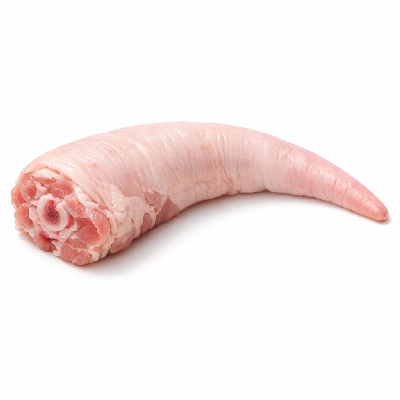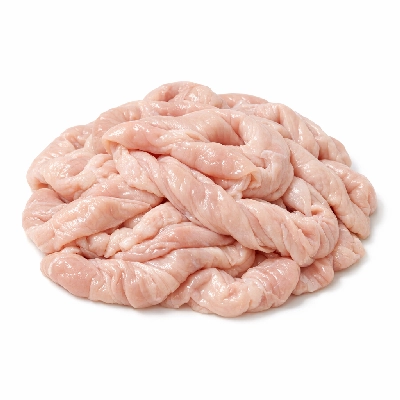
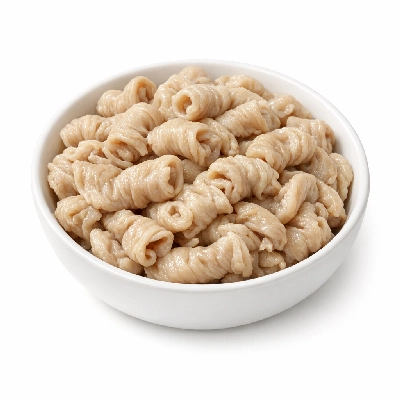
Fresh Raw Pork Chitterlings, Variety Meats and By-products
Source of Calories
Nutrition Facts
| Nutrient | Amount | % Daily Value |
|---|---|---|
| Total Carbohydrates | 0 g | 0% |
| Net Carbohydrates | 0 g | 0% |
| Sugars | 0 g | 0% |
| Added Sugars | No data | - |
| Dietary Fiber | 0 g | 0% |
| Protein | 2.17 g | 4% |
| Total Fat | 4.71 g | 6% |
| Saturated Fat | 2.16 g | 11% |
| Monounsaturated Fat | 1.52 g | - |
| Polyunsaturated Fat | 0.28 g | - |
| Trans Fat | 0 g | 0% |
| Cholesterol | 43.66 mg | 15% |
| Vitamins | ||
| Vitamin A | 0 mcg | 0% |
| Vitamin C | 0.31 mg | 0% |
| Vitamin D | No data | - |
| Minerals | ||
| Sodium | 6.8 mg | 0% |
| Potassium | 5.1 mg | 0% |
| Calcium | 4.54 mg | 0% |
| Magnesium | 1.7 mg | 0% |
| Iron | 0.29 mg | 2% |
| Zinc | 0.29 mg | 3% |
% DV refers to how much a single serving of an individually packaged food or supplement contributes nutritionally to your daily diet, based on a 2,000-calorie-a-day diet. Generally, having 5% DV or less of a nutrient per serving is considered low, and 20% DV or more of a nutrient per serving is considered high.
Fat Composition
The suggested total fat consumption should be limited to 30% of total energy intake or less. The type of fat consumed should primarily be unsaturated fatty acids, with no more than 10% of total energy intake coming from saturated fatty acids (about 200 calories on a 2000-calorie diet) and no more than 1% of total energy intake coming from trans-fatty acids.
Vitamin Coverage
Vitamin A
0%
Vitamin C
0.3%
Vitamin D
-
Vitamin E
0.3%
Vitamin K
0%
Vitamin B1
0.5%
Vitamin B2
2%
Vitamin B3
0.4%
Vitamin B5
1%
Vitamin B6
0.2%
Vitamin B7
-
Vitamin B9
0.2%
Vitamin B12
10%
There are 13 essential vitamins required for the body to work properly, which are categorised into two categories: fat-soluble and water-soluble vitamins. Vitamins have a Recommended Dietary Allowance (RDA), provided by the Dietary Reference Intakes (DRIs), which vary by age and sex. The %DV indicates how much one serving contributes to the average recommended daily intake.
Mineral Coverage
Calcium
0.3%
Iron
2%
Magnesium
0.4%
Phosphorus
1%
Potassium
0.1%
Sodium
0.3%
Zinc
3%
Copper
2%
Manganese
0.6%
Selenium
8%
Minerals are micronutrients, of which 13 of them are essential to the human body. The Recommended Dietary Allowance includes Calcium (1,300 mg/d), Phosphorus (1,250 mg/d), Potassium (4,700 mg/d), Sodium (2,300 mg/d), Chloride (1,500 mg/d), Magnesium (420 mg/d), Iron (18 mg/d), Zinc (11 mg/d), Copper (0.9 mg/d), Selenium (55 mcg/d), Molybdenum (45 mcg/d), Manganese (2.3 mg/d) and Iodine (150 mcg/d).
The data provided by eato.health is for informational purposes only and should not be considered medical advice. Please consult your physician before beginning any diet or nutrition plan.
About
How Long to Burn Off 52 Calories?
*Based on this person: 25-year-old female, 5'7", 144 lbs

Swimming
8 min

Jogging
7 min

Cycling
7 min

Walking
13 min
The data provided by eato.health is for informational purposes only and should not be considered medical advice. Please consult your physician before beginning any diet or nutrition plan.
📚 Health Research & Evidence About This Food
Pork chitterlings, as a type of offal, share nutritional considerations with red meat, including potential for carcinogen formation like HAAs and PAHs during high-temperature cooking, according to NCBI. Observational evidence from SpringerLink suggests that grilled chitterlings may be associated with polycyclic aromatic hydrocarbon exposure. The CDC emphasizes the importance of careful handling and thorough cooking to prevent Yersinia infection.
1. 1. Exposure Data - Red Meat and Processed Meat - Ncbi Bookshelf
Source: NCBI
Summary: Pork chitterlings, as a type of offal sometimes grouped with red meat, are subject to the same considerations regarding nutritional content, potential contaminants, and the formation of carcinogens like HAAs and PAHs during high-temperature cooking, as detailed in this IARC Monograph.
2. Risk Assessment of Polycyclic Aromatic Hydrocarbons in Meat and Edible Oils: Results of a Total Diet Study in South Korea
Source: SpringerLink, 2022
Summary: Pork chitterlings, while not directly assessed in this study, are related to beef chitterlings, which were identified as having the highest benzo[a]pyrene toxic equivalency factor when grilled, leading to a classification of 'possible concern' for stir-fried beef chitterlings due0 to polycyclic aromatic hydrocarbon exposure.
Read More: https://link.springer.com/article/10.1007/s10068-022-01137-5
3. Tips for Preparing Chitlins
Source: CDC, 2024
Summary: Pork chitterlings require careful handling and thorough cooking, including boiling for at least 5 minutes before cleaning and simmering until tender, to prevent Yersinia infection, as outlined in CDC food safety guidelines.
Read More: https://www.cdc.gov/yersinia/about/prepare-chitlins.html