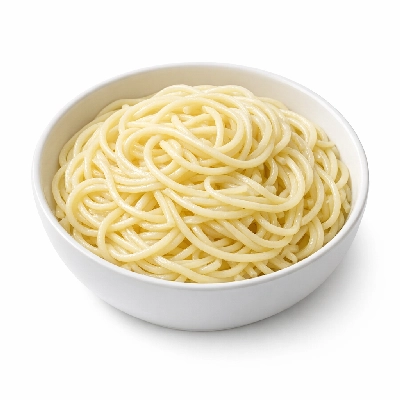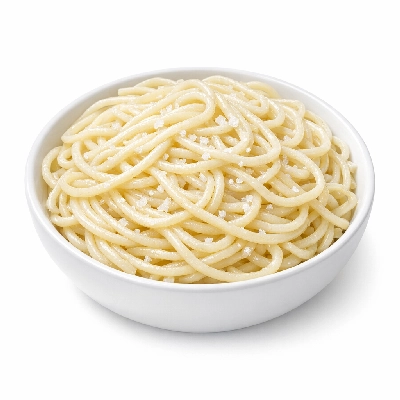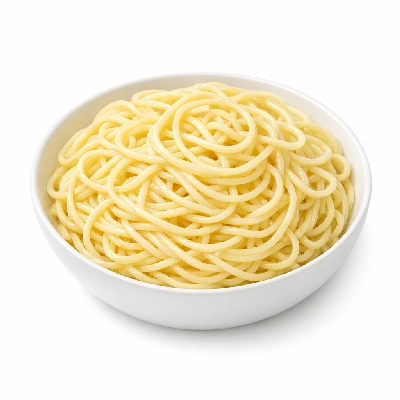
Cooked Unenriched Spaghetti, without Added Salt
Source of Calories
Nutrition Facts
| Nutrient | Amount | % Daily Value |
|---|---|---|
| Total Carbohydrates | 43.2 g | 16% |
| Net Carbohydrates | 40.68 g | 16% |
| Sugars | 0.78 g | 2% |
| Added Sugars | No data | - |
| Dietary Fiber | 2.52 g | 9% |
| Protein | 8.12 g | 16% |
| Total Fat | 1.3 g | 2% |
| Saturated Fat | 0.25 g | 1% |
| Monounsaturated Fat | 0.18 g | - |
| Polyunsaturated Fat | 0.46 g | - |
| Trans Fat | 0 g | 0% |
| Cholesterol | 0 mg | 0% |
| Vitamins | ||
| Vitamin A | 0 mcg | 0% |
| Vitamin C | 0 mg | 0% |
| Vitamin D | 0 mcg | 0% |
| Minerals | ||
| Sodium | 1.4 mg | 0% |
| Potassium | 61.6 mg | 1% |
| Calcium | 9.8 mg | 1% |
| Magnesium | 25.2 mg | 6% |
| Iron | 0.7 mg | 4% |
| Zinc | 0.71 mg | 6% |
% DV refers to how much a single serving of an individually packaged food or supplement contributes nutritionally to your daily diet, based on a 2,000-calorie-a-day diet. Generally, having 5% DV or less of a nutrient per serving is considered low, and 20% DV or more of a nutrient per serving is considered high.
Fat Composition
The suggested total fat consumption should be limited to 30% of total energy intake or less. The type of fat consumed should primarily be unsaturated fatty acids, with no more than 10% of total energy intake coming from saturated fatty acids (about 200 calories on a 2000-calorie diet) and no more than 1% of total energy intake coming from trans-fatty acids.
Vitamin Coverage
Vitamin A
0%
Vitamin C
0%
Vitamin D
0%
Vitamin E
0.6%
Vitamin K
0%
Vitamin B1
2%
Vitamin B2
2%
Vitamin B3
3%
Vitamin B5
3%
Vitamin B6
4%
Vitamin B7
-
Vitamin B9
2%
Vitamin B12
0%
There are 13 essential vitamins required for the body to work properly, which are categorised into two categories: fat-soluble and water-soluble vitamins. Vitamins have a Recommended Dietary Allowance (RDA), provided by the Dietary Reference Intakes (DRIs), which vary by age and sex. The %DV indicates how much one serving contributes to the average recommended daily intake.
Mineral Coverage
Calcium
0.8%
Iron
4%
Magnesium
6%
Phosphorus
6%
Potassium
1%
Sodium
0.1%
Zinc
6%
Copper
16%
Manganese
20%
Selenium
67%
Minerals are micronutrients, of which 13 of them are essential to the human body. The Recommended Dietary Allowance includes Calcium (1,300 mg/d), Phosphorus (1,250 mg/d), Potassium (4,700 mg/d), Sodium (2,300 mg/d), Chloride (1,500 mg/d), Magnesium (420 mg/d), Iron (18 mg/d), Zinc (11 mg/d), Copper (0.9 mg/d), Selenium (55 mcg/d), Molybdenum (45 mcg/d), Manganese (2.3 mg/d) and Iodine (150 mcg/d).
Protein Quality
Leucine
21%
Isoleucine
24%
Valine
22%
Lysine
7%
Tryptophan
33%
Threonine
21%
Phenylalanine
36%
Methionine
14%
Histidine
19%
Guidelines recommend a serving of protein with each meal and 1.2-1.6 g of protein per kg of body weight per day.
The data provided by eato.health is for informational purposes only and should not be considered medical advice. Please consult your physician before beginning any diet or nutrition plan.
About
How Long to Burn Off 221 Calories?
*Based on this person: 25-year-old female, 5'7", 144 lbs

Swimming
33 min

Jogging
28 min

Cycling
29 min

Walking
52 min
The data provided by eato.health is for informational purposes only and should not be considered medical advice. Please consult your physician before beginning any diet or nutrition plan.
📚 Health Research & Evidence About This Food
Pasta's unique structural properties contribute to lower post-meal blood glucose and insulin responses compared to other durum semolina products, according to the American Society for Nutrition. However, individual blood sugar responses vary, with those having insulin resistance potentially experiencing higher spikes, as observed by Stanford Medicine. As a refined carbohydrate, spaghetti provides food energy, and while its consumption may be associated with weight management considerations, cooking it without added salt supports a low-sodium dietary profile.
1. 5 High Starch Foods to Avoid
Source: WebMD
Summary: Spaghetti is a high-starch food, contributes significantly to carbohydrate intake, with a cup of cooked spaghetti containing carbohydrates, some of which are starch, and reducing its consumption is suggested for managing blood sugar and1 blood pressure.
2. Pasta Structure May Influence Post-Meal Blood Glucose and Insulin Response - American Society for Nutrition
Source: American Society for Nutrition, 2022
Summary: Spaghetti, particularly through pasta's unique structure, results in lower post-meal blood glucose and insulin responses compared to other durum semolina products, making it a healthier carbohydrate source due to its slow disintegration during digestion.
Read More: https://nutrition.org/pasta-structure-may-influence-post-meal-blood-glucose-and-insulin-response/
3. Preservation and Physical Property Roles of Sodium in Foods - Strategies to Reduce Sodium Intake in the United States - Ncbi Bookshelf
Source: NCBI
Summary: Spaghetti, as a grain-based food, is part of a category where sodium significantly impacts flavor, fermentation control, dough texture, leavening, and shelf life, with potential for sodium reduction through reformulation.
Read More: https://www.ncbi.nlm.nih.gov/books/NBK50952/
4. Blood Sugar Response to Various Carbohydrates Can Point to Metabolic Health Subtypes, Study Finds
Source: Stanford Medicine, 2025
Summary: Spaghetti, specifically its impact on blood sugar spikes, is shown to vary significantly among individuals, with the highest spikes after eating pasta occurring in participants with insulin resistance, highlighting the importance of personalized dietary approaches.
Read More: https://med.stanford.edu/news/all-news/2025/06/carb-sugar-spikes.html
5. Impact of Pasta Intake on Body Weight and Body Composition
Source: PubMed
Summary: Spaghetti, as a staple refined carbohydrate, has been implicated in overweight and obesity due to its impact on body weight and body composition, as explored in a technical review.
Read More: https://pubmed.ncbi.nlm.nih.gov/37375591/